

Drinking alcohol while taking prednisone is not recommended. Although there is no direct pharmacological interaction, prednisone and alcohol affect many of the same body systems.
Combining alcohol and prednisone amplifies shared side effects, including gastrointestinal bleeding, immune suppression, blood sugar spikes, and mood instability. Avoiding alcohol for the entire duration of prednisone treatment is always the safest approach.
Prednisone is prescribed more than 20 million times per year in the U.S., making it one of the most widely dispensed corticosteroids. Most prescribers do not give explicit alcohol guidance at the pharmacy level. That communication gap leaves many patients unknowingly at risk, searching for answers after the fact.
Key Takeaways
- Drinking alcohol while taking prednisone is not recommended because both substances share overlapping side effects that compound when combined.
- Prednisone is prescribed more than 20 million times annually in the U.S., yet specific alcohol warnings are rarely provided at the pharmacy counter.
- Up to 90% of patients who take corticosteroids for 60 or more days experience at least one adverse side effect, according to a review published in the Ochsner Journal.
- The combination increases the risk of gastrointestinal bleeding, liver strain, elevated blood sugar, weakened immunity, and mood instability.
- If stopping drinking during a prednisone course proves difficult, this may signal early signs of alcohol dependence that warrant professional evaluation.
What Is Prednisone?
Prednisone is a synthetic corticosteroid that mimics cortisol, a stress hormone produced by the adrenal glands. Doctors prescribe it to suppress the immune system and reduce inflammation in a wide range of conditions. Common uses include rheumatoid arthritis, lupus, asthma, multiple sclerosis, Crohn’s disease, and acute allergic reactions.
It works by switching off pro-inflammatory genes while activating anti-inflammatory ones, essentially telling the immune system to stand down. Prednisone is available in oral, injectable, and topical forms. Dosages range from 5 mg per day for mild conditions to 60 mg or higher for severe inflammatory events.
What Happens When You Mix Prednisone and Alcohol?
Prednisone and alcohol do not interact at the direct pharmacological level, meaning they do not block or amplify each other’s mechanisms. However, they target many of the same organ systems, including the gastrointestinal tract, immune system, liver, blood sugar regulation, and central nervous system. When both are active simultaneously, their overlapping risks intensify rather than simply add together.
Prednisone suppresses immune function and increases gut vulnerability. Alcohol affects the body by being a CNS depressant that also damages the mucosal lining of the stomach and impairs immune cell coordination. Together, they place compounded stress on multiple systems at the same time, making side effects more severe and significantly harder to manage without medical intervention, as reported by Drugs.com.
7 Risks of Combining Prednisone and Alcohol
The following are the top 7 risks of combining alcohol and prednisone:
1. Gastrointestinal Damage
Both prednisone and alcohol irritate the lining of the stomach and intestines. Prednisone increases susceptibility to peptic ulcers and mucosal erosion. Alcohol compounds this by raising gastric acid levels and causing direct tissue damage. Together, the risk of stomach ulcers, gastrointestinal bleeding, and gastritis is meaningfully higher than from either substance alone.
2. Weakened Immune System
Prednisone reduces immune function as a core part of its mechanism. Even low doses below 5 mg daily have been shown to measurably increase serious infection rates. Alcohol further impairs the immune cells responsible for clearing bacteria from the lungs and disrupts the barrier tissues that keep pathogens out. Together, the vulnerability to bacterial and respiratory infections is significantly compounded.
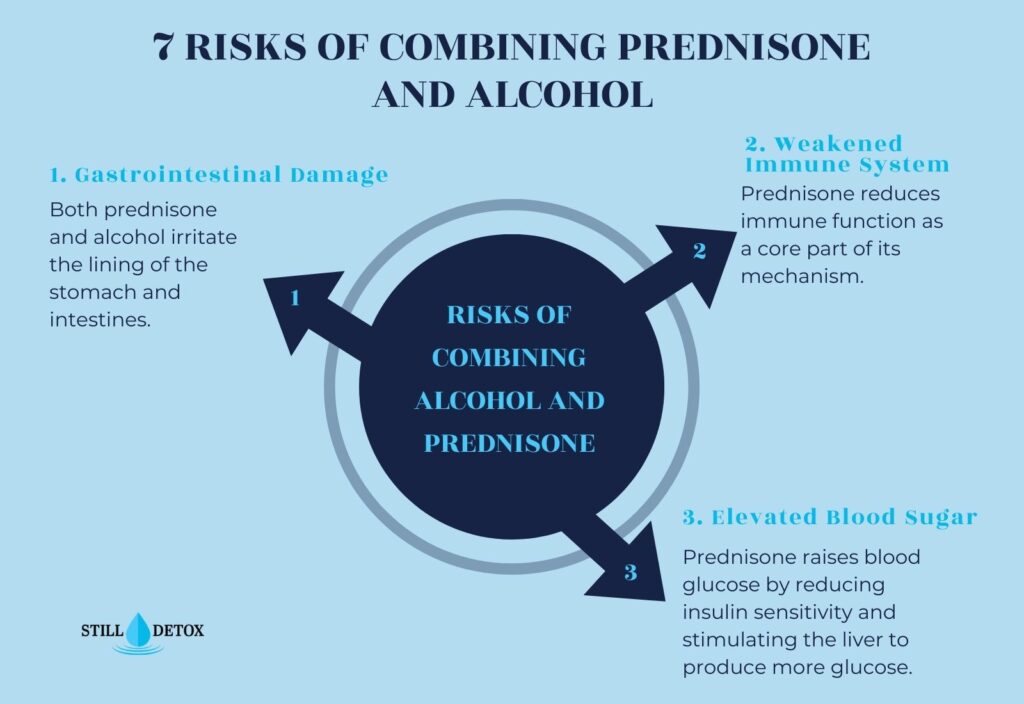
3. Elevated Blood Sugar
Prednisone raises blood glucose by reducing insulin sensitivity and stimulating the liver to produce more glucose. Alcohol independently causes unpredictable blood sugar fluctuations, including dangerous drops, in people who have not eaten. This combination is especially dangerous for anyone with diabetes or prediabetes, according to NIAAA, where even moderate drinking during a prednisone course can trigger serious metabolic events.
4. Bone Loss and Fracture Risk
Long-term prednisone use is one of the most well-documented drug-induced causes of osteoporosis. Alcohol independently contributes to bone mineral density loss over time. It also increases fall risk by impairing balance and coordination. In older adults, postmenopausal women, or anyone already on long-term steroids, this combination carries a meaningful and preventable risk of fractures.
5. Liver Strain
Prednisone is not primarily metabolized by the liver, but both substances place stress on hepatic function at higher doses. Alcohol is processed entirely by the liver, and chronic heavy drinking leads to fatty liver, alcoholic hepatitis, and cirrhosis. Adding a corticosteroid to an already overburdened liver, especially in people with underlying liver conditions, compounds damage significantly.
6. Mood Instability and Psychiatric Risk
Prednisone is known to cause mood swings, anxiety, insomnia, irritability, and, in high doses, steroid-induced psychosis. Alcohol is a CNS depressant that worsens anxiety and depression with regular use. Combining both escalates emotional instability and raises the risk of serious psychiatric events. People with a history of mental health conditions face the greatest risk from this combination, with some developing severe behavioral changes that resemble alcohol-induced psychosis.
7. High Blood Pressure and Fluid Retention
Prednisone causes sodium and fluid retention, which elevates blood pressure. Alcohol can also raise blood pressure acutely, particularly in individuals who drink regularly. This cardiovascular strain is especially concerning for people managing inflammatory conditions such as lupus or rheumatoid arthritis, where blood pressure control is already a clinical priority, as reported in a study by Fardet, L.
Risk Comparison: Prednisone Alone vs. Prednisone Combined with Alcohol
| Risk Category | Prednisone Alone | Prednisone + Alcohol |
|---|---|---|
| Gastrointestinal Bleeding | Moderate | High |
| Immune Suppression | Moderate to High | Significantly Higher |
| Blood Sugar Spikes | Moderate | High |
| Bone Density Loss | Moderate (long-term) | High |
| Liver Stress | Low to Moderate | High |
| Mood Instability | Moderate | High |
| Infection Risk | Moderate | Significantly Higher |
| Blood Pressure Elevation | Moderate | High |
Does Prednisone Dosage Change the Alcohol Risk?
Yes, dosage directly affects how dangerous combining prednisone with alcohol becomes. Higher doses mean deeper immune suppression, greater blood sugar elevation, and more pronounced GI vulnerability. Here is how the risk profile changes at different dosage levels.
The following are the ways changing prednisone doasge change alcohol risk:
Prednisone 5 mg and Alcohol
At 5 mg daily, prednisone carries the lowest risk profile. Occasional light drinking may not cause severe harm in otherwise healthy adults on a short course at this dose. That said, even low-dose prednisone irritates the stomach and suppresses immunity to some degree. Abstaining is still the safest choice, and consulting your prescriber is always recommended.
Prednisone 20 mg and Alcohol
At 20 mg daily, the risks of combining alcohol and prednisone escalate significantly. Blood sugar changes become more pronounced, immune suppression deepens, and gastrointestinal irritation is more likely to cause clinical problems. Even moderate social drinking at this dose range carries measurable clinical risk. Alcohol should be avoided throughout the course.
Prednisone 40 mg and Alcohol
At doses of 40 mg or higher, prednisone causes substantial immunosuppression and significant metabolic disruption. Any alcohol consumption at this dosage level is strongly discouraged by most clinicians. The combination places extreme and simultaneous stress on the gastrointestinal tract, liver, and immune system. Patients on high-dose prednisone should observe complete abstinence.
Can You Drink Alcohol on a 5-Day Prednisone Course?
Short-term courses such as a 5-day prednisone taper or a Medrol dose pack are among the most commonly prescribed steroid regimens. The brief duration reduces cumulative risk compared to long-term use, but it does not eliminate it. The gastrointestinal and immune risks remain active throughout the entire course, regardless of how short it is.
If the 5-day course is treating an acute allergic reaction, inflammation, or respiratory flare, the body is already under considerable physiological stress. Drinking alcohol during this window disrupts the healing process, irritates the stomach lining, and can mask or amplify symptoms. Completing the full 5-day course before having any alcohol is the appropriate approach.
Prednisolone and Alcohol
Prednisolone is the biologically active form of prednisone. The liver converts prednisone into prednisolone, which is the compound that actually performs the anti-inflammatory function in the body. Some patients are prescribed prednisolone directly, including children who receive liquid formulations and patients treated for severe alcoholic hepatitis or certain eye conditions.
The alcohol interaction risks for prednisolone are the same as for prednisone. Combining prednisolone and alcohol carries equivalent risks of GI damage, immune suppression, elevated blood sugar, and liver strain. Patients with inflammatory bowel disease, asthma, or autoimmune conditions who take prednisolone should apply the same alcohol caution as prednisone users.
Methylprednisolone (Medrol Pack) and Alcohol
Methylprednisolone, sold under the brand name Medrol, is a close relative of prednisone frequently prescribed as a dose pack for acute back pain, inflammation, or allergic reactions. It is one of the most commonly searched steroid-alcohol combinations because the Medrol pack is so frequently dispensed for short-term conditions where patients expect to resume normal activities, including social drinking.
Mixing methylprednisolone and alcohol carries the same risk profile as prednisone and alcohol. The combination raises gastrointestinal bleeding risk, disrupts blood sugar control, suppresses immunity, and can amplify mood changes. After stopping a Medrol pack, waiting at least 24 to 48 hours before consuming any alcohol is the standard recommendation, with longer waits advised for heavier drinkers.
How Long After Taking Prednisone Can You Drink Alcohol?
This is one of the most common questions associated with prednisone treatment, and there is no single answer that applies to every situation. Prednisone has a half-life of approximately 3 to 4 hours. Most of the drug clears from the bloodstream within 16 to 22 hours after the last dose. However, its biological effects on the immune system, blood sugar, and the gut lining can persist for longer than the drug itself remains measurable.
A practical guideline for most adults is to wait at least 24 hours after the final dose before consuming alcohol. For longer courses or higher doses, waiting 48 hours is a more conservative and safer target. The appropriate window ultimately depends on your dosage, how long you took prednisone, your metabolic health, and any other medications you are taking.
| Prednisone Course | Suggested Wait Before Drinking |
|---|---|
| 5-day low-dose course | At least 24 hours after the final dose |
| 10 to 14-day moderate-dose course | At least 48 hours after the final dose |
| Long-term use (months or more) | Consult your prescribing physician |
| Methylprednisolone (Medrol pack) | 24 to 48 hours after the final dose |
| Methylprednisolone after a long course | Consult your physician |
Who Should Completely Avoid Alcohol While on Prednisone?
While most prescribers recommend limiting or avoiding alcohol for all prednisone users, certain groups face a substantially higher risk and should observe complete abstinence throughout treatment.
These include:
- People with a history of peptic ulcers, GERD, or prior gastrointestinal bleeding
- Individuals with type 1 or type 2 diabetes, or prediabetes
- Patients with osteoporosis or a prior history of fractures
- Adults over age 65
- Anyone concurrently taking NSAIDs such as ibuprofen, naproxen, or aspirin
- Individuals with liver disease, fatty liver, or elevated liver enzymes
- Patients being treated with prednisolone for alcoholic hepatitis
- People with a personal history of anxiety, depression, or bipolar disorder
- Individuals with a current or prior diagnosis of alcohol use disorder
Recognizing When Alcohol Use Has Become a Problem
Some people prescribed prednisone find they cannot reduce or stop drinking even when told it is medically necessary. This difficulty is a recognized sign of physical or psychological alcohol dependence and is not a matter of willpower. Those managing a chronic inflammatory condition requiring prednisone while also drinking heavily face compounded health risks that worsen over time.
Patterns such as drinking daily during a prednisone course, experiencing cravings when trying to stop, or noticing physical symptoms like tremors or sweating when alcohol is skipped all indicate a level of dependence that goes beyond casual use. Understanding the full alcohol withdrawal timeline helps clarify whether someone’s drinking has become physically dependent and whether supervised support is needed.
People dealing with both a chronic condition requiring immunosuppressant medication and an alcohol use disorder often benefit from dual diagnosis treatment, which addresses both the medical and behavioral health conditions at the same time. Treating only one without the other significantly reduces the chances of a lasting recovery.
If someone you care about is unable to stop drinking despite a medical directive, the first step toward safety often begins with professionally managed alcohol detox in Florida, where withdrawal can be monitored and complications prevented.
Research on what happens during 30 days without alcohol consistently shows measurable improvements in immune function, liver health, sleep quality, and blood sugar regulation within the first month. These are precisely the systems most at risk when drinking and taking prednisone simultaneously.
If alcohol use has progressed to a diagnosable disorder, understanding what alcohol addiction looks like clinically can help a person or family member recognize the condition for what it is and act on it decisively.
Frequently Asked Questions
What happens if you drink alcohol while taking prednisone?
Drinking alcohol while taking prednisone amplifies shared side effects, including stomach irritation, weakened immunity, mood instability, and blood sugar fluctuations. Both substances affect the gastrointestinal tract and immune system in similar ways. When combined, these effects compound rather than simply add together. The result is a higher risk of serious complications, including gastrointestinal bleeding, infection, and worsening psychiatric symptoms.
How much alcohol can I drink on prednisone?
The safest amount is zero. There is no officially established safe level of alcohol consumption for people taking prednisone. Occasional light drinking at very low doses may not cause severe harm for some healthy adults, but even one or two drinks can increase gastrointestinal irritation and blood sugar disruption. Your prescriber is the only person who can give you guidance specific to your dosage and health history.
Can I have a glass of wine while taking prednisone?
A single glass of wine is unlikely to cause a severe reaction in a healthy adult taking a low dose of prednisone for a short period. However, no amount of alcohol is considered safe during prednisone treatment. Wine still raises gastric acid and affects blood sugar. If your prescriber has not cleared alcohol use, abstaining entirely is the right choice.
How long after stopping prednisone can I drink alcohol?
For a standard 5-day or 7-day course, waiting at least 24 hours after the final dose is a commonly cited minimum. For moderate-dose courses of 10 days or more, waiting 48 hours is a safer guideline. For long-term prednisone use, the appropriate waiting period should be discussed directly with your prescribing doctor, as systemic effects can persist beyond the drug’s half-life.
Is it safe to drink alcohol while taking prednisone 5 mg?
The risk at 5 mg is lower than at higher doses, but it is not eliminated. Low-dose prednisone still suppresses immune function and irritates the stomach lining to some degree. An occasional light drink may not cause serious harm for an otherwise healthy adult, but abstaining is always the safest choice. Always consult your prescriber before making this decision on your own.
Can I drink while taking a Medrol dose pack?
No. Methylprednisolone (Medrol) carries the same alcohol interaction risks as prednisone. Drinking during a Medrol pack increases GI irritation, disrupts blood sugar, and amplifies mood effects. Since the Medrol pack is typically a short 6-day course, completing it before drinking is a minimal ask. Wait at least 24 to 48 hours after the final pill before having any alcohol.
Does alcohol make prednisone less effective?
Yes. Regular or heavy alcohol use can undermine prednisone’s effectiveness by increasing systemic inflammation, disrupting the immune regulation that prednisone is trying to achieve, and worsening the underlying condition being treated. If you are taking prednisone for an inflammatory condition and drinking regularly, you may find that symptoms are harder to control or that you need higher doses to achieve the same effect.
Can you drink alcohol while taking steroids for inflammation?
Drinking while on any oral corticosteroid used for inflammation, including prednisone, prednisolone, methylprednisolone, or dexamethasone, is not advisable. Steroids for inflammation work by suppressing immune activity. Alcohol independently stresses the same systems and can worsen the condition being treated. The same caution applies across the corticosteroid class regardless of which specific steroid is prescribed.
References
- National Institute on Alcohol Abuse and Alcoholism. (2022). Harmful interactions: Mixing alcohol with medicines. National Institutes of Health. https://www.niaaa.nih.gov/publications/brochures-and-fact-sheets/harmful-interactions-mixing-alcohol-with-medicines
- National Institute on Alcohol Abuse and Alcoholism. (2023). Alcohol’s effects on the body. National Institutes of Health. https://www.niaaa.nih.gov/alcohols-effects-health/alcohols-effects-body
- U.S. National Library of Medicine. (2022). Prednisone. DailyMed. https://dailymed.nlm.nih.gov/dailymed/drugInfo.cfm?setid=3115aef0-fd50-4ec8-a064-3effb695f3f2
- Fardet, L., & Fève, B. (2014). Systemic glucocorticoid therapy: A review of its metabolic and cardiovascular adverse events. Drugs, 74(15), 1731-1745.
- Liu, D., Ahmet, A., Ward, L., Krishnamoorthy, P., Mandelcorn, E. D., Leigh, R., Brown, J. P., Cohen, A., & Kim, H. (2013). A practical guide to the monitoring and management of the complications of systemic corticosteroid therapy. Allergy, Asthma and Clinical Immunology, 9(1), 30.
- Pope, C. (2024, August 12). Is it OK to drink alcohol with prednisone? Drugs.com.