

Ativan (lorazepam) stays in your system for 2 to 6 days after a single dose, though detection windows differ by test type, dosage, and how long you have been using the medication. Lorazepam is a short-to-intermediate-acting benzodiazepine prescribed for anxiety, seizures, and insomnia. Despite its relatively short half-life, its metabolites linger in the body well after the calming effects wear off.
Key Takeaways
- Ativan has a half-life of 10 to 20 hours, meaning full elimination takes 2 to 4 days for most adults.
- Urine tests detect lorazepam for up to 6 days after a single dose, and up to 30 days with chronic use.
- Over 10.5 million Ativan prescriptions were written in the United States in 2020, making it one of the most commonly dispensed benzodiazepines that year.
- According to SAMHSA, approximately 723,000 people aged 12 and older misused lorazepam products in 2020.
- Long-term or high-dose Ativan use significantly extends detection windows and raises the risk of physical dependence.
What Is Ativan (Lorazepam)?
Ativan is the brand name for lorazepam, a Schedule IV controlled substance in the benzodiazepine class. It is prescribed to treat generalized anxiety disorder, panic attacks, seizures, alcohol withdrawal, and short-term insomnia. Lorazepam works by boosting the effect of gamma-aminobutyric acid (GABA), the brain’s primary inhibitory neurotransmitter, producing sedation and reducing central nervous system activity.
It is available in oral tablets, sublingual tablets, and injectable forms. The FDA has approved the injectable form, which is commonly used in emergency settings for status epilepticus and acute anxiety episodes.
Ativan Half-Life: How Long Does It Take to Clear?
The half-life of Ativan is approximately 10 to 20 hours, which refers to the time required to reduce its plasma concentration by 50 percent. Complete elimination takes 5 to 6 half-lives, meaning most adults clear lorazepam from their system within 2 to 4 days. However, lorazepam glucuronide, its primary inactive metabolite, remains detectable in urine for several days beyond that window.
Compared to longer-acting options like Valium (diazepam), Ativan clears the body faster. But its relatively short half-life also means withdrawal symptoms can emerge sooner after the last dose. For context, how long Klonopin stays in your system differs significantly because clonazepam carries a longer half-life of 18 to 50 hours.
How Long Does Ativan Stay in Your System by Test Type
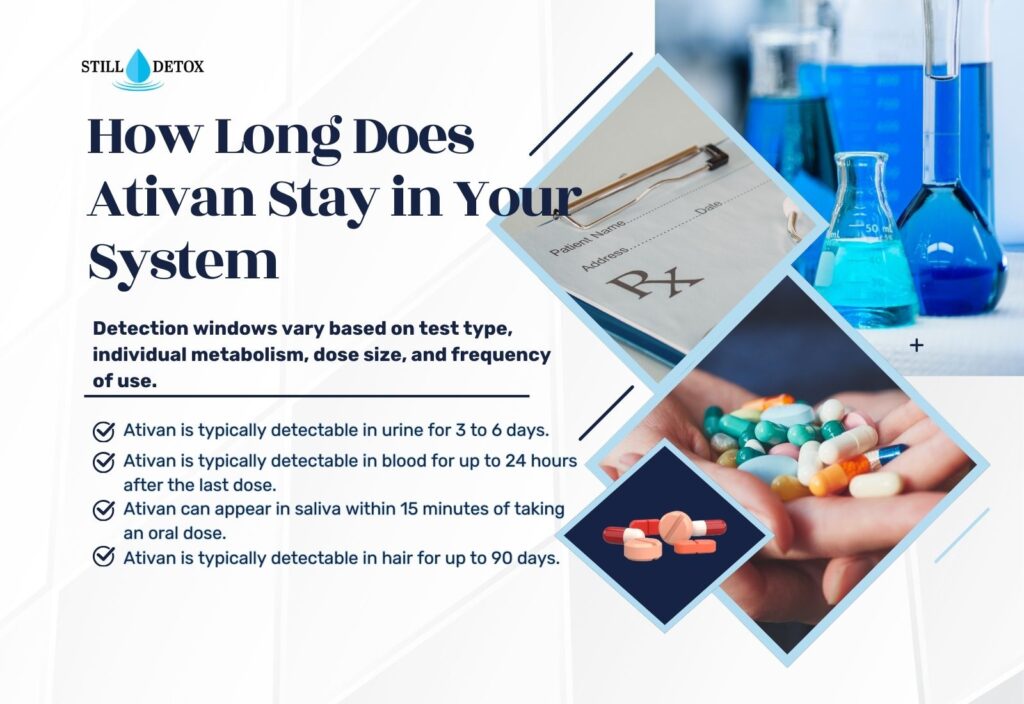
Detection windows vary based on test type, individual metabolism, dose size, and frequency of use. The table below outlines standard detection timeframes for lorazepam.
| Test Type | Single Dose | Chronic Use |
|---|---|---|
| Urine | 3 to 6 days | Up to 30 days |
| Blood | Up to 24 hours | Up to 24 to 48 hours |
| Saliva | Up to 8 hours | Up to 8 hours |
| Hair | Up to 90 days | Up to 90 days |
How Long Does Ativan Stay in Urine?
Urine testing is the most common method for detecting lorazepam. After a single dose, Ativan is typically detectable in urine for 3 to 6 days. Chronic or high-dose users may continue to test positive for up to 30 days due to metabolite accumulation. The primary compound detected is lorazepam glucuronide, which has a longer elimination window than the parent drug itself.
How Long Does Ativan Stay in the Blood?
Blood tests have the shortest practical detection window for lorazepam. Ativan is typically detectable in blood for up to 24 hours after the last dose. Blood testing is most useful in clinical and legal contexts to confirm recent impairment, not to detect past use. At higher doses or in older adults, the detection window may extend to 48 hours.
How Long Does Ativan Stay in Saliva?
Saliva tests are non-invasive and detect lorazepam for up to 8 hours after ingestion. The drug can appear in saliva within 15 minutes of taking an oral dose. Oral hydration and hygiene can slightly affect detection accuracy. Saliva testing is less common for benzodiazepines compared to urine testing in standard screening panels.
How Long Does Ativan Stay in Hair?
Hair follicle tests offer the longest detection window, identifying lorazepam metabolites for up to 90 days. Hair testing is used primarily to assess long-term or repeated use history rather than single-episode exposure. Note that hair testing typically misses use from the first 5 to 7 days after ingestion because hair grows slowly from the scalp.
How Long Does Ativan Last? Effects Duration
The effects of Ativan typically last 6 to 8 hours after an oral dose. Onset occurs within 15 to 30 minutes of ingestion, with peak sedative and anxiolytic effects reached within 1 to 2 hours. These effects include reduced anxiety, muscle relaxation, sedation, and anti-seizure activity.
People who take Ativan at bedtime often experience grogginess the following morning, especially at doses above 1 mg. This residual sedation is one reason physicians caution against driving or operating machinery after a nighttime dose. Those relying on Ativan for sleep should also be aware that long-term use is associated with rebound insomnia from benzodiazepines, where sleep quality worsens once the medication is stopped.
How Long Does Ativan Take to Kick In?
Oral Ativan begins to work within 15 to 30 minutes for most adults. Sublingual administration is faster, typically taking effect in 5 to 15 minutes. Intravenous (IV) Ativan works within 1 to 5 minutes and is used when rapid sedation is medically necessary. Taking an oral dose on an empty stomach can slightly accelerate the onset compared to taking it with a meal.
IV Ativan stays effective for a shorter clinical duration than oral Ativan, typically 1 to 4 hours, because peak plasma concentrations are reached and cleared more quickly via the intravenous route.
Factors That Affect How Long Ativan Stays in Your System
Multiple variables influence how quickly the body processes and eliminates lorazepam. Understanding these factors helps explain why detection windows can differ substantially from person to person.
- Dosage and frequency: Higher doses and more frequent use cause lorazepam to accumulate in body tissue, extending the detection window considerably beyond typical timeframes. A person using Ativan daily for months will clear it far more slowly than someone who took a single therapeutic dose.
- Metabolism: Individuals with faster metabolic rates eliminate lorazepam more quickly. Genetics, body composition, thyroid function, and physical activity level all influence metabolic speed.
- Age: Older adults clear benzodiazepines more slowly due to reduced liver enzyme activity and decreased kidney clearance. Ativan elimination can take significantly longer in adults over 65 compared to younger individuals.
- Liver and kidney function: Lorazepam is hepatically metabolized and renally excreted. Impaired liver or kidney function slows clearance and extends how long the drug remains detectable in all test types.
- Polysubstance use: Combining Ativan with alcohol or other central nervous system depressants can alter its metabolism. Certain medications, including antifungals and some antibiotics, can inhibit enzymes responsible for lorazepam clearance.
- Hydration: Staying adequately hydrated supports kidney function and promotes more efficient excretion of lorazepam metabolites through urine. Dehydration may slow renal clearance slightly.
Does Ativan Build Up in Your System with Repeated Use?
Yes, Ativan accumulates in body tissue with regular use. When doses are taken before prior doses are fully cleared, lorazepam builds up over time. This accumulation is why chronic users have significantly longer urine detection windows than occasional users and why tolerance develops more quickly with daily use.
The buildup of lorazepam in the body also explains why stopping the medication abruptly after prolonged use can trigger serious withdrawal symptoms. Tapering with a structured benzo taper schedule under medical supervision is the safest way to discontinue Ativan after regular use.
Does Ativan Show Up on a Drug Test?
Yes, Ativan shows up on standard drug tests that screen for benzodiazepines. Most 5-panel, 10-panel, and extended workplace drug tests include a benzodiazepine category. Lorazepam is reported as a positive for the benzodiazepine class rather than identified as lorazepam specifically, as studied by Greenblatt. If you have a valid prescription, disclose it to the testing facility before your screening.
A confirmatory gas chromatography-mass spectrometry (GC-MS) or liquid chromatography-mass spectrometry (LC-MS) test can identify lorazepam specifically when needed for legal or clinical purposes.
Signs of Ativan Dependence and When to Seek Help
Physical dependence on Ativan can develop in as little as 2 to 4 weeks of daily use at therapeutic doses. Signs that dependence may be forming include needing increasingly higher doses to achieve the same effect, experiencing anxiety or insomnia between scheduled doses, and feeling unable to function without taking the medication.
Stopping Ativan abruptly after regular use carries a serious risk of benzodiazepine withdrawal, which can include rebound anxiety, tremors, sweating, and potentially life-threatening seizures. Many people who stop on their own also experience rebound anxiety from benzodiazepine use, which makes independent discontinuation even harder to sustain.
Professional support is essential. The Ativan addiction treatment program at Still Detox offers medically supervised detox, individualized therapy, and aftercare planning tailored to each patient’s history and needs. Our benzodiazepine addiction treatment team in Boca Raton, Florida, helps patients safely taper off lorazepam while managing withdrawal symptoms under 24/7 medical supervision. Call (561) 556-2677 to speak with our admissions team today.
Frequently Asked Questions
How long does 0.5 mg of Ativan stay in urine?
A 0.5 mg dose of Ativan is typically detectable in urine for 3 to 5 days in most adults. The half-life of 10 to 20 hours means the drug clears from the blood within 24 hours, but the urinary metabolite lorazepam glucuronide persists longer. Kidney function, hydration, and metabolic rate all affect how quickly this low dose clears.
How long does 1 mg of lorazepam stay in your system?
A 1 mg dose of lorazepam has the same half-life as any therapeutic dose, approximately 10 to 20 hours. Most adults will clear it from the blood within 24 hours and from the urine within 3 to 6 days. Repeat dosing, reduced kidney function, older age, and slower metabolism can extend this window considerably beyond typical estimates.
How long does Ativan make you sleepy?
The sedative effects of Ativan typically last 6 to 8 hours. However, some individuals, particularly older adults or those taking doses above 1 mg, report residual drowsiness for up to 12 hours. Dose size, individual tolerance, age, and whether Ativan was combined with alcohol or other sedatives all influence how long sleepiness persists after a dose.
How long does IV Ativan stay in your system?
IV Ativan follows the same elimination pathway as oral lorazepam once absorbed. It is typically detectable in blood for up to 24 hours and in urine for 3 to 6 days after a single intravenous dose. The key difference is onset speed: IV Ativan acts within 1 to 5 minutes, and its clinical sedation effect lasts 1 to 4 hours, shorter than the oral form.
What does Ativan show up as on a drug test?
Ativan shows up as a benzodiazepine on standard urine screening panels. It is not flagged specifically as lorazepam on most initial immunoassay screens. A confirmatory GC-MS or LC-MS test can identify lorazepam specifically. If you hold a valid prescription, disclose it to the testing administrator in advance of any scheduled drug screen.
How long does it take for Ativan to wear off completely?
The calming and sedative effects of Ativan wear off within 6 to 8 hours for most adults at standard doses. Mild cognitive slowing or drowsiness may persist for up to 12 to 24 hours, particularly at higher doses or in elderly patients. The drug itself remains present in the body for 2 to 4 days after the effects have fully subsided.
References
- Greenblatt, D. J., Divoll, M., Abernethy, D. R., Ochs, H. R., & Shader, R. I. (1983). Clinical pharmacokinetics of the newer benzodiazepines. Clinical Pharmacokinetics, 8(3), 233-252.
- Substance Abuse and Mental Health Services Administration. (2021). Key substance use and mental health indicators in the United States: Results from the 2020 National Survey on Drug Use and Health. U.S. Department of Health and Human Services. https://www.samhsa.gov/data/sites/default/files/reports/rpt35325/NSDUHFFRPDFWHTMLFiles2020/2020NSDUHFFR1PDFW102121.pdf
- U.S. Food and Drug Administration. (2020). FDA requiring Boxed Warning updated to improve safe use of benzodiazepine drug class. https://www.fda.gov/drugs/drug-safety-and-availability/fda-requiring-boxed-warning-updated-improve-safe-use-benzodiazepine-drug-class
- National Library of Medicine. (2023). Lorazepam: Compound summary. PubChem. https://pubchem.ncbi.nlm.nih.gov/compound/Lorazepam