

Greening out means consuming more cannabis than your body can comfortably process, triggering an acute THC toxicity reaction. The term describes the combination of intense physical and psychological symptoms that follow THC overconsumption.
It can happen to anyone. First-time users, experienced smokers, and even people who switch consumption methods are all at risk. Understanding what greening out is and what to do about it can prevent a scary situation from becoming a medical emergency.
Key Highlights
- Greening out is a THC overconsumption reaction causing symptoms like nausea, dizziness, rapid heart rate, panic, and vomiting.
- THC potency in cannabis has risen from approximately 4% in 1995 to over 15% by 2021, according to the National Institute on Drug Abuse, significantly increasing the risk of greening out.
- Emergency department visits linked to marijuana use increased 12.1% per year between 2006 and 2014.
- Most greening out episodes resolve within a few hours to 24 hours without medical intervention.
- Mixing cannabis with alcohol or other substances significantly increases both the likelihood and severity of a green out.
What Is Greening Out?
Greening out is informal slang for acute THC toxicity, the physical and psychological response to consuming more cannabis than your system can handle. THC floods the brain’s CB1 receptors in the endocannabinoid system, disrupting normal regulation of mood, perception, and body function.
The name likely comes from the pale, greenish skin tone that some people develop during the episode. It is sometimes called a “green out” or “greenout” and is closely related to what many refer to as a marijuana overdose, though it is rarely life-threatening.
Greening Out Symptoms: What Does It Feel Like?
Greening out symptoms range from mildly uncomfortable to severely distressing. Marijuana’s adverse effects typically appear in two categories: physical and psychological.
Physical Symptoms
- Nausea and vomiting
- Dizziness or lightheadedness
- Pale, clammy, or greenish skin
- Rapid or irregular heartbeat
- Profuse sweating or chills
- Trembling or shaking, especially in the legs
- Loss of coordination or balance
- Headache
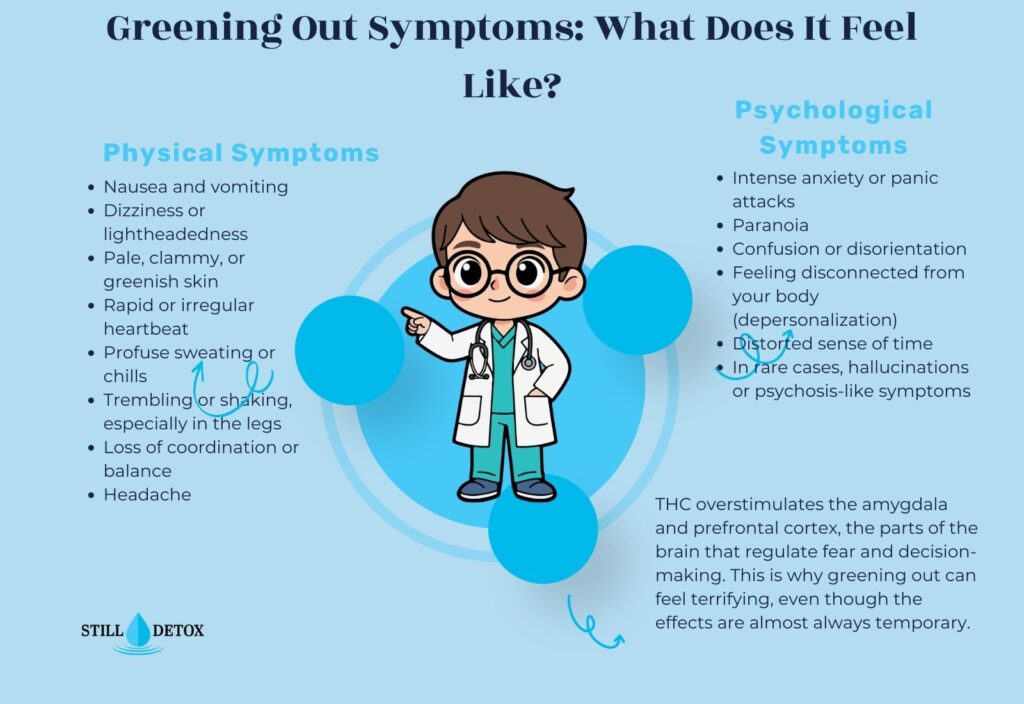
Psychological Symptoms
- Intense anxiety or panic attacks
- Paranoia
- Confusion or disorientation
- Feeling disconnected from your body (depersonalization)
- Distorted sense of time
- In rare cases, hallucinations or psychosis-like symptoms
THC overstimulates the amygdala and prefrontal cortex, the parts of the brain that regulate fear and decision-making. This is why greening out can feel terrifying, even though the effects are almost always temporary.
What Causes Greening Out?
THC overconsumption is the root cause, but several specific factors increase your risk significantly.
- Edibles: Edibles are the most common trigger for greening out. Unlike smoking or vaping, edibles take 30 minutes to 2 hours to produce effects. People consume more before they feel anything and then get hit with an overwhelming dose. Products like Delta-8, Delta-9, and high-potency edibles vary dramatically in THC concentration and onset time.
- High-potency products: Concentrates, dabs, wax, and newer cannabinoids like THCP and its comparison to standard THC can deliver far more THC per dose than traditional flower. A new or returning user can easily overconsume without realizing it.
- Low tolerance: First-time users and people returning to cannabis after a long break have the lowest tolerance. Their endocannabinoid systems are unprepared for even moderate doses.
- Mixing substances: Combining cannabis with alcohol is one of the most common causes of a severe green out. Alcohol increases THC absorption through the bloodstream, intensifying and prolonging its effects. Mixing cannabis with other substances, such as codeine and weed, creates additional unpredictable risks.
- Hotboxing or rapid consumption: Inhaling large amounts of smoke in a confined space, as seen with hotboxing, rapidly elevates blood THC levels and increases the risk of greening out.
- Empty stomach or dehydration: Consuming cannabis when dehydrated or on an empty stomach accelerates THC absorption and worsens symptom severity.
How Long Does Greening Out Last?
A typical green out episode lasts anywhere from 30 minutes to a few hours. For most people, the worst symptoms peak within the first one to two hours and gradually subside as THC is metabolized.
Edible-related green outs can last significantly longer, sometimes six to eight hours, because edibles produce a longer-lasting high with delayed peak absorption.
In some cases, residual symptoms like fatigue, brain fog, or low-grade anxiety can linger for 24 hours or more, sometimes called a “greenout hangover.” Factors that affect duration include the amount consumed, the method of consumption, body weight, metabolism, and tolerance level.
What to Do When Greening Out
If you or someone you know is greening out, the most important thing is to stay calm and ride it out. Follow these steps.
- Stop consuming immediately: Do not smoke, vape, or consume more cannabis or alcohol. Adding more THC will worsen symptoms.
- Move to a safe, calm space: Sit or lie down in a quiet area away from loud noise and bright lights. Reduce stimulation as much as possible.
- Focus on slow, deep breathing: Slow, controlled breaths reduce anxiety and lower heart rate. Breathe in for four counts, hold for four, and exhale for four.
- Stay hydrated: Sip water slowly. Avoid caffeine and alcohol, which can worsen dehydration and heighten anxiety.
- Eat a light snack: A small carbohydrate-rich snack like crackers or bread can help stabilize blood sugar and ease nausea.
- Try the peppercorn trick: Anecdotal evidence suggests chewing or smelling black peppercorns may ease anxiety. Peppercorns contain beta-caryophyllene, a terpene that may interact with cannabinoid receptors to reduce distress.
- Do not be alone: Stay with a trusted person who can monitor your condition and keep you grounded.
If symptoms are severe, including chest pain, loss of consciousness, or uncontrollable vomiting, call 911 immediately.
For more detailed guidance on how to sober up from weed and reduce the effects of being too high, additional strategies can help ease the experience while your body processes the THC.
How to Help Someone Who Is Greening Out
If someone around you is greening out, your calm presence is the most valuable thing you can offer.
Guide them to a quiet, comfortable space and speak in a low, steady voice. Reassure them that what they are feeling is temporary and that they are safe. Do not leave them alone, especially if they are confused or unable to communicate clearly.
Encourage slow, deep breaths and offer small sips of water. Keep the environment calm by dimming lights and reducing noise. Do not offer more cannabis, alcohol, or any other substance. Monitor their symptoms closely and call emergency services if the situation escalates.
Is Greening Out Dangerous?
In most cases, greening out is not life-threatening. No confirmed fatalities from THC toxicity alone have been documented. However, that does not mean it is risk-free.
People with underlying heart conditions, high blood pressure, or a history of anxiety disorders may experience more severe cardiovascular or psychological reactions. Greening out can impair motor coordination and judgment, increasing the risk of falls or accidents. In rare cases, extreme THC overconsumption has been linked to cannabis-induced psychosis.
Repeated green out episodes may indicate problematic cannabis use. If you are frequently greening out despite trying to moderate consumption, it may signal a growing tolerance or dependence on cannabis that warrants professional support.
If you are concerned about cannabis use affecting daily life, speaking with a behavioral health professional can provide clarity and support.
How to Prevent Greening Out
Preventing a green out comes down to controlling your dose and understanding your own tolerance.
- Start with a low dose, especially with edibles or new products.
- Wait at least 90 minutes before taking more of an edible.
- Know the THC percentage of every product before consuming.
- Avoid mixing cannabis with alcohol or other substances.
- Stay hydrated and eat before consuming.
- Do not consume in unfamiliar or high-stress environments.
- Take breaks from cannabis to reset your tolerance.
Frequently Asked Questions
What does greening out feel like?
Greening out typically feels like a sudden wave of nausea, dizziness, and intense anxiety that comes on quickly after consuming too much cannabis. Many people describe a racing heartbeat, sweating, and a feeling of losing control. Some experience the sensation that time has slowed or stopped. The experience varies by person and dose but is almost always temporary and resolves within a few hours.
What happens when you green out?
When you green out, excess THC overwhelms the brain’s CB1 receptors, disrupting the endocannabinoid system’s normal balance. This triggers both physical symptoms, including nausea, sweating, and rapid heart rate, and psychological symptoms like paranoia and panic. The body works to metabolize the excess THC, and symptoms gradually ease as levels drop. Most people recover fully within a few hours without needing medical treatment.
How long can a green out last?
A green out from smoking or vaping typically lasts 30 minutes to two hours. Edible-related episodes can last considerably longer, sometimes up to six to eight hours, because edibles are absorbed differently through the digestive system. Residual fatigue or brain fog can persist for up to 24 hours. Factors like the amount consumed, tolerance level, body composition, and whether substances were mixed all affect the total duration.
How do you calm down from greening out?
To calm down during a green out, move to a quiet, dimly lit space and focus on slow, controlled deep breathing. Sip water, eat a light snack, and remind yourself that the feelings are temporary and will pass. The peppercorn trick, chewing or sniffing black peppercorns, may offer mild relief for some people. Avoid further cannabis, alcohol, or stimulants. Having a calm, trusted person with you makes a significant difference.
Can you die from greening out?
No documented deaths from THC toxicity alone have been confirmed. Greening out is considered non-lethal in a pure cannabis context. However, serious complications can occur if cannabis is mixed with other substances, if it triggers a severe cardiovascular event in someone with a pre-existing heart condition, or if an accident occurs due to impaired coordination. If cannabis has been mixed with unknown substances, or symptoms are severe and escalating, seek emergency medical care immediately.
Is greening out the same as overdosing on weed?
Greening out is often described as a marijuana overdose, but it differs from a traditional drug overdose in that it is not typically fatal. It is more accurately described as acute THC toxicity, meaning the body has taken in more THC than it can comfortably process at one time. While not life-threatening in most cases, the symptoms can be severe and distressing, and the risk of harm increases significantly when cannabis is combined with other substances.
References
- National Institute on Drug Abuse. (2023). Cannabis (marijuana) research report. National Institutes of Health. https://nida.nih.gov/research-topics/cannabis-marijuana
- Centers for Disease Control and Prevention. (2023). Marijuana and public health. U.S. Department of Health and Human Services. https://www.cdc.gov/marijuana/index.htm
- Substance Abuse and Mental Health Services Administration. (2023). Key substance use and mental health indicators in the United States: Results from the 2022 National Survey on Drug Use and Health. U.S. Department of Health and Human Services. https://www.samhsa.gov/data/report/2022-nsduh-annual-national-report
- Volkow, N. D., Baler, R. D., Compton, W. M., and Weiss, S. R. B. (2014). Adverse health effects of marijuana use. New England Journal of Medicine, 370(23), 2219-2227.
- Hasin, D. S., Saha, T. D., Kerridge, B. T., Goldstein, R. B., Chou, S. P., Zhang, H., Jung, J., Pickering, R. P., Ruan, W. J., Smith, S. M., Huang, B., and Grant, B. F. (2015). Prevalence of marijuana use disorders in the United States between 2001-2002 and 2012-2013. JAMA Psychiatry, 72(12), 1235-1242.
- ElSohly, M. A., Mehmedic, Z., Foster, S., Gon, C., Chandra, S., and Church, J. C. (2016). Changes in cannabis potency over the last two decades (1995-2014). Biological Psychiatry, 79(7), 613-619.