

Barbiturates and benzodiazepines are both central nervous system (CNS) depressants that enhance GABA activity in the brain. Understanding the difference between barbiturates and benzodiazepines is critical because these two drug classes carry vastly different overdose risks, addiction potential, and medical applications.
Both drug classes were once widely prescribed for anxiety, insomnia, and seizures. Today, benzodiazepines have largely replaced barbiturates because of a significantly safer overdose profile and more predictable clinical outcomes.
Key Highlights
- Barbiturates and benzodiazepines both target GABA-A receptors in the brain, but through distinct binding mechanisms that drive major differences in overdose risk and addiction potential.
- According to NIDA, benzodiazepine prescriptions increased by 67% between 1996 and 2013, rising from 8.1 million to 13.5 million, as benzos replaced barbiturates across most clinical settings.
- A barbiturate dose just 3 to 5 times the therapeutic amount can cause fatal respiratory depression. Benzodiazepines typically require 15 to 20 times the therapeutic dose to reach life-threatening levels when taken alone.
- Barbiturate withdrawal can be fatal without medical supervision. Benzodiazepine withdrawal is serious but generally less acutely lethal when managed with a proper taper under clinical care.
- Both drug classes require professional medical detox and evidence-based treatment for safe recovery.
What Are Barbiturates?
Barbiturates are a class of CNS depressant drugs derived from barbituric acid. First introduced in the early 1900s, they were widely prescribed through the mid-20th century for anxiety, insomnia, seizures, and surgical anesthesia.
They work by binding directly to GABA-A receptors and opening chloride ion channels even without GABA present. This mechanism produces powerful, dose-dependent CNS depression that slows breathing, heart rate, and brain activity with a dangerously narrow safety margin.
Common Barbiturates and Their Uses
- Phenobarbital (Luminal): Used for epilepsy and seizure disorders; one of the few barbiturates still in clinical use in the U.S.
- Pentobarbital (Nembutal): Used in surgical anesthesia, physician-assisted death protocols, and veterinary euthanasia.
- Butalbital: Found in combination headache medications such as Fioricet and Fiorinal.
- Secobarbital (Seconal): Historically prescribed for insomnia; now rarely prescribed.
- Amobarbital (Amytal): Previously used for anxiety and sleep disorders; largely discontinued in most clinical settings.
Barbiturates are classified as Schedule II, III, or IV controlled substances depending on formulation and abuse potential. Their extremely narrow therapeutic index is the primary reason clinical use has sharply declined since the 1970s.
What Are Benzodiazepines?
Benzodiazepines, commonly called benzos, are a class of CNS depressants introduced in the 1960s as a safer alternative to barbiturates. They are prescribed for anxiety disorders, panic attacks, insomnia, seizures, muscle spasms, and alcohol withdrawal management.
Unlike barbiturates, benzodiazepines do not directly open chloride channels. They bind to a separate allosteric site on the GABA-A receptor and amplify GABA’s natural inhibitory effects only when GABA is already present. This selective action creates a physiological ceiling effect that significantly reduces fatal overdose risk when taken alone.
Common Benzodiazepines and Their Uses
- Alprazolam (Xanax): Short-acting; prescribed for generalized anxiety and panic disorders.
- Diazepam (Valium): Long-acting; used for anxiety, muscle spasms, alcohol withdrawal, and seizures.
- Lorazepam (Ativan): Intermediate-acting; used for anxiety, seizures, and pre-procedural sedation.
- Clonazepam (Klonopin): Long-acting; prescribed for panic disorder and certain seizure types.
- Temazepam (Restoril): Primarily used for short-term management of insomnia.
All benzodiazepines are Schedule IV controlled substances. Despite a wider safety margin than barbiturates, benzos carry significant risks of dependence, tolerance, and severe withdrawal with prolonged use.
Barbiturates vs. Benzodiazepines: Mechanism of Action
The most critical difference between barbiturates and benzodiazepines is how each drug class interacts with the GABA-A receptor. Both enhance inhibitory neurotransmission, but through distinct binding sites with very different risk profiles as a result.
Barbiturates bind directly to the GABA-A receptor complex and can open chloride ion channels independent of GABA. This produces unchecked, dose-dependent CNS depression with no physiological ceiling. Research published in NCBI confirms that just 3 to 5 times the therapeutic barbiturate dose can produce fatal respiratory depression.
Benzodiazepines bind to a separate allosteric site on the GABA-A receptor. They can only enhance GABA’s effects when GABA is already present at the receptor, which creates a self-limiting ceiling effect on sedation and respiratory depression. This fundamental pharmacological distinction explains why benzodiazepines are a much safer clinical choice for most conditions.
Mechanism of Action: Barbiturates vs. Benzodiazepines
| Feature | Barbiturates | Benzodiazepines |
|---|---|---|
| Receptor Binding Site | GABA-A receptor (direct chloride channel activator) | Allosteric site on the GABA-A receptor |
| GABA Requirement | Can act without GABA present | Requires GABA to be present to work |
| CNS Depression Pattern | Broad, escalating with dose, no ceiling | Selective, self-limiting due to the ceiling effect |
| Fatal Overdose Threshold | 3-5x therapeutic dose | 15-20x therapeutic dose (when taken alone) |
| Specific Antidote | None | Flumazenil (competitive antagonist) |
| Chloride Channel Effect | Increases channel open duration | Increases channel opening frequency |
Are Barbiturates Stronger Than Benzodiazepines?
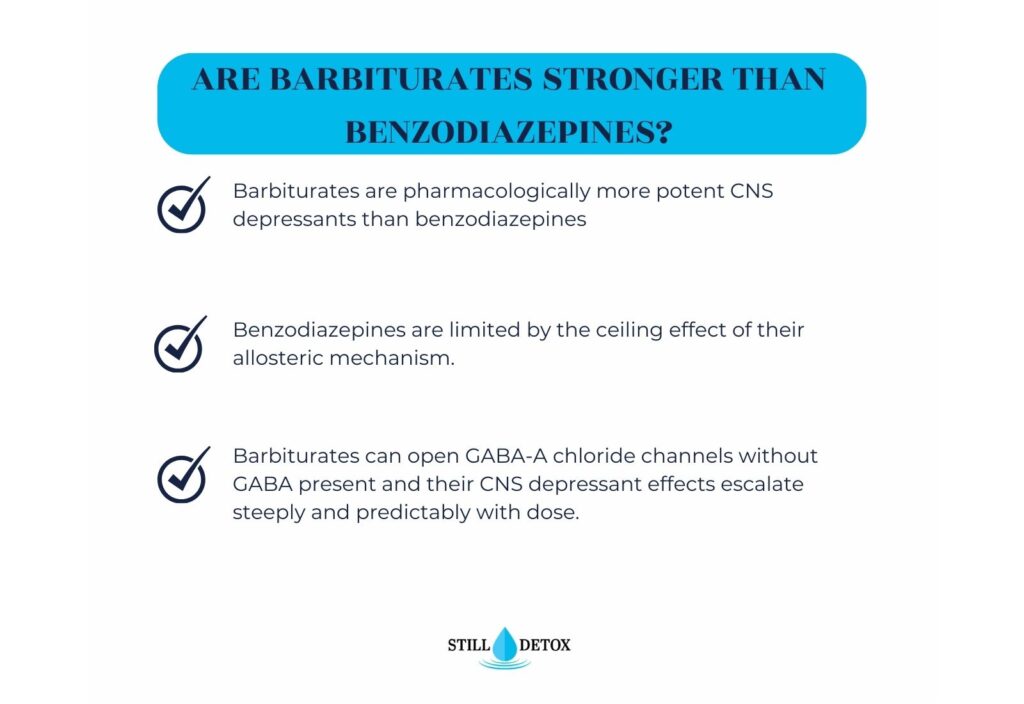
Barbiturates are pharmacologically more potent CNS depressants than benzodiazepines, but greater potency here is not a clinical advantage. It is the primary driver of their higher overdose lethality.
Because barbiturates can open GABA-A chloride channels without GABA present, their CNS depressant effects escalate steeply and predictably with dose. Respiratory depression follows directly. A dose just 3 to 5 times the therapeutic amount can result in coma or death.
Benzodiazepines are limited by the ceiling effect of their allosteric mechanism. When taken alone, benzodiazepines rarely produce fatal respiratory depression even at high doses. The danger rises sharply when benzos are combined with alcohol, opioids, or other CNS depressants, which removes the protective ceiling effect.
In clinical terms, benzodiazepines replaced barbiturates not because they are weaker, but because they achieve comparable therapeutic effects with a dramatically safer toxicological profile. The comparison between Valium vs. Xanax illustrates how even within the benzodiazepine class, different drugs vary in potency, half-life, and clinical indication.
Why Are Benzodiazepines Preferred Over Barbiturates?
The medical shift from barbiturates to benzodiazepines began in the 1960s and was largely complete by the 1980s. This shift reflects the unacceptable risk-to-benefit ratio of barbiturates presented for routine clinical use.
Benzodiazepines are preferred over barbiturates for these clinically documented reasons:
- Wider therapeutic index: A far greater gap exists between the therapeutic and lethal dose.
- Specific antidote: Flumazenil can reverse benzodiazepine overdose; no equivalent antidote exists for barbiturates.
- Lower abuse potential: Benzos produce less drug-seeking euphoria and have a less reinforcing pharmacological reward profile.
- Slower tolerance development: Patients require less frequent dose escalation compared to barbiturate treatment courses.
- More clinical versatility: Benzodiazepines safely manage alcohol withdrawal, which barbiturates cannot address with equivalent safety.
- Better cardiovascular profile: Barbiturates significantly depress blood pressure and heart rate; benzodiazepines affect cardiovascular function far less at therapeutic doses.
- More predictable pharmacokinetics: Benzodiazepine half-lives are more consistent across formulations and patient populations.
Benzodiazepines are not without serious risk. Long-term use can cause physical dependence, rebound anxiety, and withdrawal that demands careful medical management. Understanding how prolonged benzo use can worsen anxiety over time is critical for patients considering these medications for chronic conditions.
Is Xanax a Barbiturate?
No. Xanax (alprazolam) is not a barbiturate. It is a short-acting benzodiazepine prescribed for anxiety and panic disorder. This is one of the most frequently searched misconceptions about these two drug classes.
Xanax acts through the benzodiazepine-specific allosteric site on the GABA-A receptor. It does not directly open chloride channels independently of GABA, which is the defining mechanism of barbiturate action. The pharmacology is fundamentally different despite both drugs depressing the CNS.
Other drugs commonly mistaken for barbiturates include:
- Valium (diazepam): Benzodiazepine, not a barbiturate.
- Ativan (lorazepam): Benzodiazepine; commonly prescribed for anxiety and sleep disturbances linked to racing thoughts and nighttime anxiety.
- Klonopin (clonazepam): Benzodiazepine, not a barbiturate.
- Ambien (zolpidem): Neither a benzo nor a barbiturate. It is a Z-drug (non-benzodiazepine hypnotic) that acts on a specific GABA-A receptor subset.
Phenobarbital is the most commonly encountered true barbiturate still in active clinical use in the U.S., primarily for epilepsy. It should not be confused with benzodiazepines despite some shared clinical indications like seizure management.
Addiction and Dependence Risks
Both barbiturates and benzodiazepines carry a significant risk of physical and psychological dependence, but barbiturates produce dependence more rapidly and more severely. Tolerance to barbiturates can develop after just a single dose in some individuals, driving rapid dose escalation toward dangerous thresholds.
Benzodiazepine dependence typically develops with prolonged use, often beyond 4 to 6 weeks of daily dosing. According to SAMHSA’s 2019 National Survey on Drug Use and Health, nearly 6 million Americans reported misusing prescription tranquilizers, including benzodiazepines, in the prior year. The widespread clinical availability of benzos is a key factor in higher misuse rates despite their relative safety advantage over barbiturates.
Both drug classes engage the brain’s reward pathways by disinhibiting dopamine-producing neurons in the ventral tegmental area, increasing dopamine release in a mechanism comparable to opioids and cannabinoids. This shared reward pathway explains why physical dependence and compulsive drug-seeking behavior can develop even in patients who use these medications exactly as prescribed.
Withdrawal: Barbiturates vs. Benzodiazepines
Withdrawal from both drug classes is medically serious, but barbiturate withdrawal carries substantially higher mortality risk if unmanaged. Abrupt cessation of barbiturates after physical dependence can produce life-threatening seizures, hyperthermia, delirium, and circulatory failure within 12 to 24 hours of the last dose.
Benzodiazepine withdrawal, while severe, is less acutely lethal under medical supervision. Symptoms include rebound anxiety, insomnia, muscle rigidity, tremors, and, in high-dose or long-term users, seizures and delirium. A properly managed benzo taper schedule under medical supervision dramatically reduces the risk of life-threatening complications and improves long-term recovery outcomes.
Barbiturate vs. Benzodiazepine Withdrawal Comparison
| Symptom/Factor | Barbiturate Withdrawal | Benzodiazepine Withdrawal |
|---|---|---|
| Onset | 12-24 hours after last dose | 24-72 hours (short-acting); up to 7 days (long-acting) |
| Anxiety and Agitation | Severe | Moderate to severe |
| Seizure Risk | High; frequently severe | Possible; risk is highest with abrupt cessation |
| Hyperthermia | Yes, potentially fatal | Rare |
| Delirium | Common in severe cases | Possible in severe, prolonged-use cases |
| Cardiovascular Instability | Significant | Less common |
| Duration | Peaks at 2-4 days; resolves over 1-2 weeks | Can persist weeks to months; PAWS possible |
| Medical Management | Long-acting benzo substitution plus supportive care | Gradual tapering protocol, typically with diazepam |
| Fatality Risk Without Treatment | High | Low to moderate |
Neither withdrawal process should be attempted without medical supervision. Attempting to detox from either drug class without clinical support significantly increases seizure risk, psychiatric complications, and the likelihood of relapse.
Treatment for Barbiturate and Benzodiazepine Addiction
Treatment for addiction to either drug class follows the same core framework: medical detoxification, followed by behavioral therapy and structured long-term recovery support. The specific detox protocols differ based on each drug’s pharmacology and the severity of withdrawal risk.
For patients in barbiturate addiction treatment, the clinical standard involves 24/7 medical monitoring throughout the acute withdrawal phase. Clinicians often substitute a long-acting benzodiazepine to safely stabilize CNS function during barbiturate withdrawal before gradually tapering the substitute medication under controlled conditions.
For benzodiazepine addiction, a structured taper is the standard of care. Switching from a short-acting benzodiazepine to a long-acting one, such as diazepam, before incremental dose reduction gives the CNS time to recalibrate. Patients who experience worsening rebound anxiety during detox benefit from integrated psychiatric support alongside the medical taper.
Long-term recovery from either drug class involves cognitive behavioral therapy (CBT), group therapy, relapse prevention planning, and treatment of co-occurring mental health conditions. Patients who use alcohol or opioids alongside sedatives require integrated dual-diagnosis programming to address all contributing factors and reduce relapse risk.
Frequently Asked Questions
What are the differences between benzodiazepines and barbiturates?
Barbiturates directly open GABA-A chloride channels even without GABA present, producing broad CNS depression with a dangerously narrow safety margin. Benzodiazepines only enhance GABA’s effects when GABA is already bound to the receptor, creating a protective ceiling effect. Barbiturates carry a much higher overdose risk, produce faster tolerance, and have no specific antidote. Benzodiazepines are more widely used today because they deliver effective sedation with substantially lower fatal overdose risk when taken alone.
Are barbiturates or benzos stronger?
Barbiturates are pharmacologically more potent CNS depressants than benzodiazepines. A barbiturate dose just 3 to 5 times the therapeutic amount can cause fatal respiratory failure. Benzodiazepines require roughly 15 to 20 times the therapeutic dose to reach life-threatening CNS depression when taken alone. The greater potency of barbiturates is the reason they carry a much higher overdose risk, not a clinical advantage over benzos.
Why are benzodiazepines preferred over barbiturates?
Benzodiazepines have a wider therapeutic index, a specific overdose antidote (flumazenil), slower tolerance development, and fewer dangerous drug interactions than barbiturates. They also produce less cardiovascular depression and are safer for managing alcohol withdrawal. The medical community transitioned to benzodiazepines starting in the 1960s because barbiturates presented an unacceptable overdose and dependence risk relative to their clinical benefit for most patients.
What are the differences between barbiturates and benzodiazepines in terms of effectiveness and side effects?
Both drug classes are effective for anxiety, insomnia, and seizures. Barbiturates are more powerful sedatives but cause greater respiratory depression, cardiovascular effects, and cognitive impairment. Benzodiazepines cause drowsiness and some cognitive changes, but with fewer severe acute side effects at therapeutic doses. Long-term use of either class produces dependence. Barbiturate overdose has no antidote and is frequently fatal; benzodiazepine overdose can be reversed with flumazenil when treated promptly.
References
- Food and Drug Administration. (2020). FDA requiring boxed warning updated to improve safe use of benzodiazepine drug class. https://www.fda.gov/drugs/drug-safety-and-availability/fda-requiring-boxed-warning-updated-improve-safe-use-benzodiazepine-drug-class
- Lopez-Munoz, F., Ucha-Udabe, R., & Alamo, C. (2005). The history of barbiturates a century after their clinical introduction. Neuropsychiatric Disease and Treatment, 1(4), 329-343.
- National Institute on Drug Abuse. (2022). Benzodiazepines and opioids. https://nida.nih.gov/research-topics/opioids/benzodiazepines-opioids
- Riss, J., Cloyd, J., Gates, J., & Collins, S. (2008). Benzodiazepines in epilepsy: Pharmacology and pharmacokinetics. Acta Neurologica Scandinavica, 118(2), 69-86.
- Substance Abuse and Mental Health Services Administration. (2020). Key substance use and mental health indicators in the United States: Results from the 2019 National Survey on Drug Use and Health. https://www.samhsa.gov/data/sites/default/files/reports/rpt29393/2019NSDUHFFRPDFWHTML/2019NSDUHFFR1PDFW090120.pdf
- Weaver, M. F. (2015). Prescription sedative misuse and abuse. Yale Journal of Biology and Medicine, 88(3), 247-256.
- World Health Organization. (2019). Model list of essential medicines (21st ed.).