


Yes, Adderall can cause psychosis.
Adderall psychosis is a recognized side effect of amphetamine-based stimulants, particularly when taken at high doses or misused. It produces hallucinations, paranoia, and delusions that closely resemble schizophrenia. The risk rises sharply above 40mg daily, and most cases resolve after stopping the medication under medical supervision.
Adderall (amphetamine-dextroamphetamine) is a Schedule II controlled stimulant prescribed for ADHD and narcolepsy. While effective at therapeutic doses, its dopaminergic mechanism creates real psychiatric risk for certain users. Understanding these risks is critical for patients, caregivers, and clinicians.
Key Takeaways
- Adderall psychosis occurs in an estimated 0.10% of users at prescribed doses, rising to 0.21% among adolescents taking amphetamines, according to a 2019 study in the New England Journal of Medicine.
- A 2024 McLean Hospital study found that high-dose Adderall users (40mg or more daily) face more than a 5-fold increased risk of developing psychosis or mania.
- Symptoms include auditory and visual hallucinations, paranoid delusions, disorganized thinking, and extreme agitation.
- Most psychotic episodes resolve within two weeks of discontinuing Adderall under medical supervision.
- People with a personal or family history of psychotic disorders, bipolar disorder, or chronic sleep deprivation face a significantly higher risk.
What Is Adderall-Induced Psychosis?
Adderall-induced psychosis is a psychiatric state in which a person loses contact with reality as a direct result of amphetamine use. It is classified as a substance-induced psychotic disorder, distinct from primary psychotic illnesses like schizophrenia. The key marker is that symptoms are temporally linked to Adderall use or withdrawal.
The condition can emerge during active use, after a dose increase, or in some cases during discontinuation. It is not limited to people who misuse the drug. Psychosis has been documented in patients taking Adderall at regularly prescribed therapeutic doses, though the rate is significantly lower.
How Does Adderall Trigger Psychosis?
Adderall works by flooding the brain’s dopamine and norepinephrine pathways with excess neurotransmitter activity. Elevated dopamine beyond a normal threshold is directly associated with psychotic states. This is the same neurochemical disruption seen in schizophrenia.
At high doses, the dopamine system becomes overloaded to a point where reality testing breaks down. Chronic stimulant use also sensitizes dopamine receptors over time. This sensitization makes the brain increasingly reactive to prescription amphetamines, lowering the threshold for psychosis with repeated exposure.
Sleep deprivation, a common consequence of Adderall use, compounds this risk. Extended sleep loss alone can trigger psychotic symptoms, and when combined with overstimulation of dopamine pathways, the risk increases substantially.
Adderall Psychosis Symptoms
Adderall psychosis symptoms closely resemble acute schizophrenia, but visual hallucinations are more prevalent, and disorganized thinking is less common. Symptoms typically emerge during heavy use, after significant dose escalation, or following a prolonged binge.
Common symptoms of Adderall-induced psychosis include:
- Auditory hallucinations: Hearing voices, sounds, or noises that are not present
- Visual hallucinations: Seeing people, objects, or patterns that do not exist
- Tactile hallucinations: Feeling sensations on the skin without a physical cause
- Paranoid delusions: Persistent, unfounded belief that others are monitoring, following, or intending harm
- Grandiose delusions: Inflated self-importance or belief in special powers or abilities
- Disorganized speech: Incoherent or rapidly shifting thought patterns
- Extreme agitation or aggression: Unprovoked hostility, restlessness, or violent behavior
- Social withdrawal: Isolating due to paranoia or fear
If any of these symptoms appear after taking Adderall, stop the medication and seek immediate clinical evaluation. Do not attempt to manage these symptoms without professional guidance.
Who Is at Higher Risk for Adderall-Induced Psychosis?
Not everyone who takes Adderall will develop psychosis. However, certain biological and behavioral factors raise the risk substantially. Dose and duration of use are the most significant predictors of psychosis onset.
High-risk groups include:
- High-dose users: Those taking 40mg or more of Adderall (corresponding to 30mg or more of dextroamphetamine) daily carry the greatest risk
- People with bipolar disorder: Stimulants can precipitate or worsen manic or mixed episodes, which may include psychotic features
- People with a family history of psychosis: Genetic predisposition to schizophrenia or schizoaffective disorder significantly elevates vulnerability
- Individuals with schizophrenia: Baseline psychosis risk makes any stimulant use particularly dangerous
- Chronic sleep-deprived individuals: Ongoing sleep deprivation amplifies dopaminergic instability
- People misusing Adderall: Those taking it without a prescription or in doses beyond what is prescribed face compounded risk
People without ADHD are also at elevated risk. Without the neurobiological context of ADHD, the dopamine surge from Adderall is not offset by regulatory deficits, making the overstimulation more pronounced.
Understanding whether Adderall is addictive is important for anyone concerned about escalating use and its psychiatric consequences. Dependency accelerates dose escalation, which directly increases psychosis risk.
Adderall Psychosis vs. Schizophrenia
Clinicians often struggle to differentiate Adderall-induced psychosis from primary schizophrenia during an acute episode. Both conditions share overlapping symptoms. The critical distinction lies in the timeline, history of substance use, and the resolution pattern.
| Feature | Adderall Psychosis | Schizophrenia |
|---|---|---|
| Onset | Suddenly, tied to amphetamine use | Gradual, over weeks to months |
| Visual hallucinations | Common | Less common |
| Auditory hallucinations | Present | Very common |
| Disorganized thinking | Rare | Frequent |
| Duration | Days to weeks after stopping | Chronic, long-term course |
| Resolution | Often resolves with cessation | Requires ongoing treatment |
| Transition risk | ~22% may develop schizophrenia spectrum disorder | N/A |
A 2020 meta-analysis by Murrie et al. found that approximately 22% of people diagnosed with amphetamine-induced psychosis later transitioned to a schizophrenia spectrum disorder. This rate is lower than that of cannabis-induced psychosis (34%) but higher than that of opioid-induced psychosis (12%). Early intervention and clinical follow-up are critical to monitor for this transition.
How Long Does Adderall Psychosis Last?
Duration depends on the dose consumed, the length of use, the severity of symptoms, and the individual’s baseline mental health. For most people, symptoms begin to subside once Adderall clears the body.
Knowing how long Adderall stays in your system provides useful context. Adderall’s effects typically last 4 to 12 hours, depending on formulation, but psychotic symptoms can persist beyond the drug’s half-life, particularly after chronic high-dose use.
Research on stimulant-induced psychosis recovery shows approximately 64% of cases resolve within 10 days, and around 82% resolve within 30 days of cessation. In some cases, particularly those involving underlying psychotic disorders or prolonged heavy misuse, symptoms can persist for several months.
Adderall withdrawal psychosis is a less common but documented phenomenon where psychosis emerges or worsens during abrupt cessation rather than during active use. This underscores the need for medically supervised discontinuation.
Adderall Psychosis Treatment
Treatment for Adderall-induced psychosis is multimodal. It addresses acute psychiatric symptoms, the underlying stimulant use, and any co-occurring mental health conditions identified during evaluation.
The following are the treatment options for adderall psychosis:
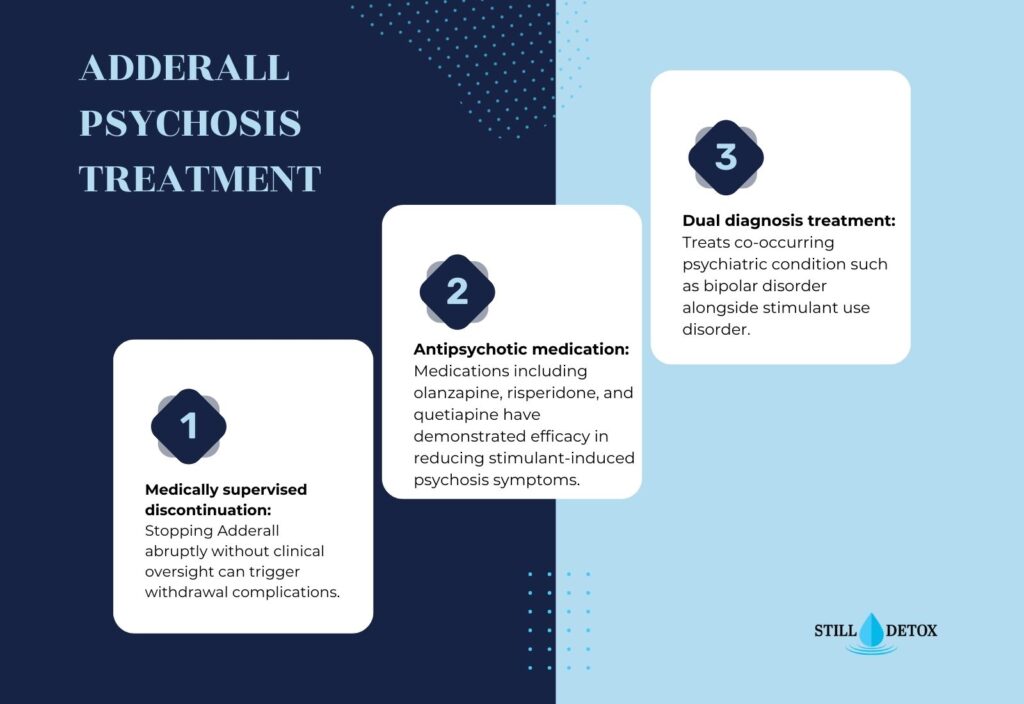
- Medically supervised discontinuation: Stopping Adderall abruptly without clinical oversight can trigger withdrawal complications. A structured Adderall addiction treatment program provides safe, monitored tapering and stabilization.
- Antipsychotic medication: Medications including olanzapine, risperidone, quetiapine, aripiprazole, and haloperidol have demonstrated comparable efficacy in reducing stimulant-induced psychosis symptoms. The treating psychiatrist selects the agent based on individual presentation and tolerance.
- Inpatient stabilization: Severe or prolonged psychosis warrants inpatient medical detoxification with 24-hour psychiatric monitoring. Inpatient care prevents harm, manages acute symptoms, and allows for comprehensive diagnostic evaluation.
- Dual diagnosis treatment: When a co-occurring psychiatric condition, such as bipolar disorder or a psychotic spectrum disorder, is identified alongside stimulant use disorder, integrated dual diagnosis treatment is the clinical standard for lasting recovery.
- Cognitive behavioral therapy (CBT): CBT addresses the behavioral patterns underlying stimulant misuse. It builds coping strategies, identifies relapse triggers, and supports sustained abstinence after acute psychiatric stabilization.
- Non-stimulant ADHD alternatives: For patients who cannot safely take amphetamines, non-stimulant options, including atomoxetine (Strattera), guanfacine (Intuniv), and clonidine (Kapvay), may manage ADHD symptoms without the psychosis risk associated with amphetamines.
For individuals whose psychosis stems from amphetamine misuse more broadly, specialized amphetamine addiction treatment in Florida offers a structured clinical pathway toward full recovery.
When to Seek Emergency Help
Adderall psychosis can escalate quickly and become dangerous. Certain presentations require immediate emergency intervention.
Call 911 or go directly to an emergency room if someone:
- Is experiencing active hallucinations or delusions and is unresponsive to reassurance
- Is exhibiting violent, self-harming, or threatening behavior
- Has become completely detached from reality and cannot maintain basic self-care
- Has taken an extremely large or unknown quantity of Adderall
Do not leave a person experiencing active psychosis alone. Ensure their physical safety while emergency services are contacted.
Frequently Asked Questions
Can Adderall cause paranoid delusions?
Yes. Paranoid delusions are a hallmark symptom of Adderall-induced psychosis. A person may develop a persistent, unfounded belief that others are watching, following, or planning to harm them. This occurs because excess dopamine in the brain’s mesolimbic pathway disrupts normal threat processing and reality testing. Delusions typically resolve after Adderall is discontinued under medical supervision.
Why does Adderall make me feel paranoid?
Adderall raises dopamine and norepinephrine levels beyond their normal baseline. At elevated levels, these neurotransmitters heighten alertness, anxiety, and threat sensitivity. Sleep deprivation caused by Adderall worsens this significantly. The combined effect of overstimulation and sleep loss can produce sustained paranoia even at prescribed doses, particularly with ongoing use or dose escalation.
Can Adderall trigger a manic episode?
Yes. Adderall can trigger manic or hypomanic episodes, particularly in people with bipolar disorder or a family history of mania. Research published in the American Journal of Psychiatry in 2024 found that high-dose amphetamine users face more than a 5-fold increased risk of psychosis or mania. Stimulants can destabilize mood even in people with no prior psychiatric history.
What does Adderall mania look like?
Adderall-induced mania typically presents as an elevated or intensely irritable mood, racing thoughts, rapid pressured speech, a dramatically reduced need for sleep, and impulsive or reckless behavior. Grandiose delusions may accompany these symptoms. The presentation closely resembles bipolar mania, which is why a thorough clinical history is required to distinguish drug-induced mania from an underlying mood disorder.
What happens when someone without ADHD takes Adderall?
In people without ADHD, Adderall does not provide the normalizing effect it produces in those with the condition. Dopamine levels spike more dramatically without a regulatory deficit to offset the surge. This increases the risk of anxiety, paranoia, agitation, and, in higher doses, psychotic symptoms. Repeated non-medical use significantly raises the probability of developing stimulant-induced psychosis.
References
- Moran, L. V., et al. (2024). Prescription amphetamine use and risk for first-episode psychosis or mania. American Journal of Psychiatry, 181(10).
- Murrie, B., Lappin, J., Large, M., and Sara, G. (2020). Transition of substance-induced, brief, and atypical psychoses to schizophrenia: A systematic review and meta-analysis. Schizophrenia Bulletin, 46(3), 505-516.
- Moran, L. V., et al. (2019). Psychosis with methylphenidate or amphetamine in patients with ADHD. New England Journal of Medicine, 380(12), 1128-1138.
- Coles, A. S., Marquez, J., and George, T. P. (2018). Stimulant-induced psychosis: An underappreciated and costly phenomenon. The Canadian Journal of Psychiatry, 63(12), 805-807.
- National Institute of Mental Health. (2023). Schizophrenia spectrum and other psychotic disorders. https://www.nimh.nih.gov/health/topics/schizophrenia