

The myth that you can sober up fast through cold showers, black coffee, or sheer willpower persists everywhere from college campuses to workplace advice. The reality is simpler and far more important for your safety.
According to research from the National Institute on Alcohol Abuse and Alcoholism (NIAAA), the human body processes alcohol at a fixed biological rate that cannot be accelerated by external interventions. This process is primarily managed by the liver through zero-order kinetics, meaning the rate of elimination remains constant regardless of the concentration of alcohol in the blood. Studies published in peer-reviewed journals, such as “Alcohol Metabolism” in Clinics in Liver Disease and “Alcoholic Liver Disease” in Biomedicines, confirm that factors like drinking coffee, taking cold showers, or exercising have no impact on the speed of alcohol metabolism.
For official institutional data, the National Institutes of Health (NIH) provides detailed breakdowns of these metabolic pathways on their Alcohol Metabolism Update page. These resources establish that for an average adult, the metabolic rate typically removes about 0.015% of blood alcohol concentration (BAC) per hour, a reality that serves as the scientific foundation for safe drinking guidelines and legal driving limits.
Key facts about sobering up fast from alcohol
- Time is the only factor that determines sobriety: According to Mount Sinai School of Medicine research on alcohol metabolism, your liver metabolizes approximately one standard drink per hour.
- A standard drink contains 0.6 ounces of pure alcohol: This means 12 ounces of beer at 5 percent alcohol, 5 ounces of wine at 12 percent alcohol, or 1.5 ounces of distilled spirits at 40 percent alcohol.
- Cold showers and coffee do not reduce blood alcohol concentration: Bowling Green State University research confirms these remedies make you feel more alert, but they do not change your actual BAC.
- Your liver operates at a consistent rate that cannot be accelerated: Medical research shows the liver eliminates alcohol at approximately 0.015 percent BAC per hour.
- Blood alcohol concentration peaks within 30 to 60 minutes: According to absorption studies, after consuming alcohol, your BAC typically reaches its highest point during this window, then begins decreasing at the fixed metabolic rate.
- A BAC of 0.08 percent takes approximately 5 to 6 hours to clear: This is the legal driving limit, and medical data confirms reaching zero BAC requires roughly 5 to 6 hours of metabolism time.
- Individual factors affect how quickly you become intoxicated: Research from the National Institute on Alcohol Abuse and Alcoholism shows body weight, sex, food in your stomach, liver health, and genetics all influence how rapidly your BAC rises, but they do not change the elimination rate.
- Alcohol withdrawal from heavy, chronic drinking requires medical supervision: The American Academy of Family Physicians emphasizes that quitting suddenly can trigger life-threatening withdrawal symptoms including seizures, rapid heart rate, and hallucinations.
How your liver actually processes alcohol
Understanding why there are no shortcuts to sobriety requires understanding how your liver functions. When alcohol enters your bloodstream, specialized enzymes in your liver begin breaking it down into less harmful compounds that your body can eventually eliminate through breath, sweat, and urine. Research from the National Institute on Alcohol Abuse and Alcoholism shows that about 90 percent of the alcohol you consume is processed through this liver pathway, with the remaining 10 percent exiting through breath and sweat.
The critical fact is that this enzymatic process operates at a fixed rate: according to Mount Sinai School of Medicine research, approximately 0.015 percent BAC per hour for most adults. Your liver cannot accelerate this process beyond its biological capacity. If you consume more than one drink per hour, the excess alcohol accumulates in your bloodstream because your liver simply cannot process it quickly enough. This is when your blood alcohol concentration rises and you become increasingly intoxicated.
The liver’s metabolism of alcohol operates at a constant rate regardless of how much is in your system. This linear elimination creates a predictable timeline. Because this metabolic rate is fixed, any claim about speeding up sobriety through external means misunderstands basic liver physiology. Nothing you do to your exterior changes what is happening inside your liver.
Why common sobering methods do not work
The appeal of “fast sobriety” tricks is understandable because they create the sensation of being more alert and awake. But sensation of alertness and actual sobriety are two different things.
Cold showers and cold water. A cold shower triggers your sympathetic nervous system, increasing your heart rate and creating a jolt of alertness. You feel sharper and more awake, which can create an illusion of sobriety. What actually happens: you become a wide awake drunk person. Your blood alcohol concentration remains unchanged; only your subjective feeling of drowsiness has decreased. Bowling Green State University research confirms that masking how drunk you are with false alertness can be dangerous. Someone who feels sharp after cold water might mistakenly believe they can drive safely when they are still significantly impaired.
Coffee and caffeinated beverages. Caffeine is a stimulant that increases alertness and makes someone feel more focused. This false sense of clarity has led to dangerous situations where someone believed they were sober enough to drive when they were actually significantly impaired. According to research on alcohol metabolism, one standard drink takes at least an hour to leave your body, and nothing accelerates that process.
Physical activity and exercise. Going for a walk or exercise might improve your mood and energy through genuine physical activity benefits, but according to Mount Sinai research on alcohol metabolism, your liver continues metabolizing alcohol at its fixed rate. Movement does not change blood alcohol concentration. The alcohol in your system continues circulating while your liver works at its predetermined pace, no matter how many times you circle the block or jog around the park.
Food and eating. Food can slow the absorption of alcohol into your bloodstream when you eat while drinking, which means your BAC rises more gradually. However, once alcohol has already been absorbed into your blood, eating afterward does not accelerate its elimination. The same applies to vitamins, greasy breakfasts, or any other food remedy offered to help you feel better.
Type of alcohol consumed. Beer, wine, and liquor all contain alcohol (EtOH). A 12 ounce beer at 5 percent alcohol, a 5 ounce glass of wine at 12 percent alcohol, and a 1.5 ounce shot of liquor at 40 percent alcohol all contain the same amount of pure alcohol and take the same time to metabolize. The type, brand, or price of your drink does not change your BAC or how long your liver requires to process it.
What actually affects your timeline to sobriety
While you cannot speed up liver metabolism, several factors influence how quickly your particular body reaches intoxication and how long you remain intoxicated relative to others. Understanding these factors can help you estimate how much time must pass before you are truly sober.
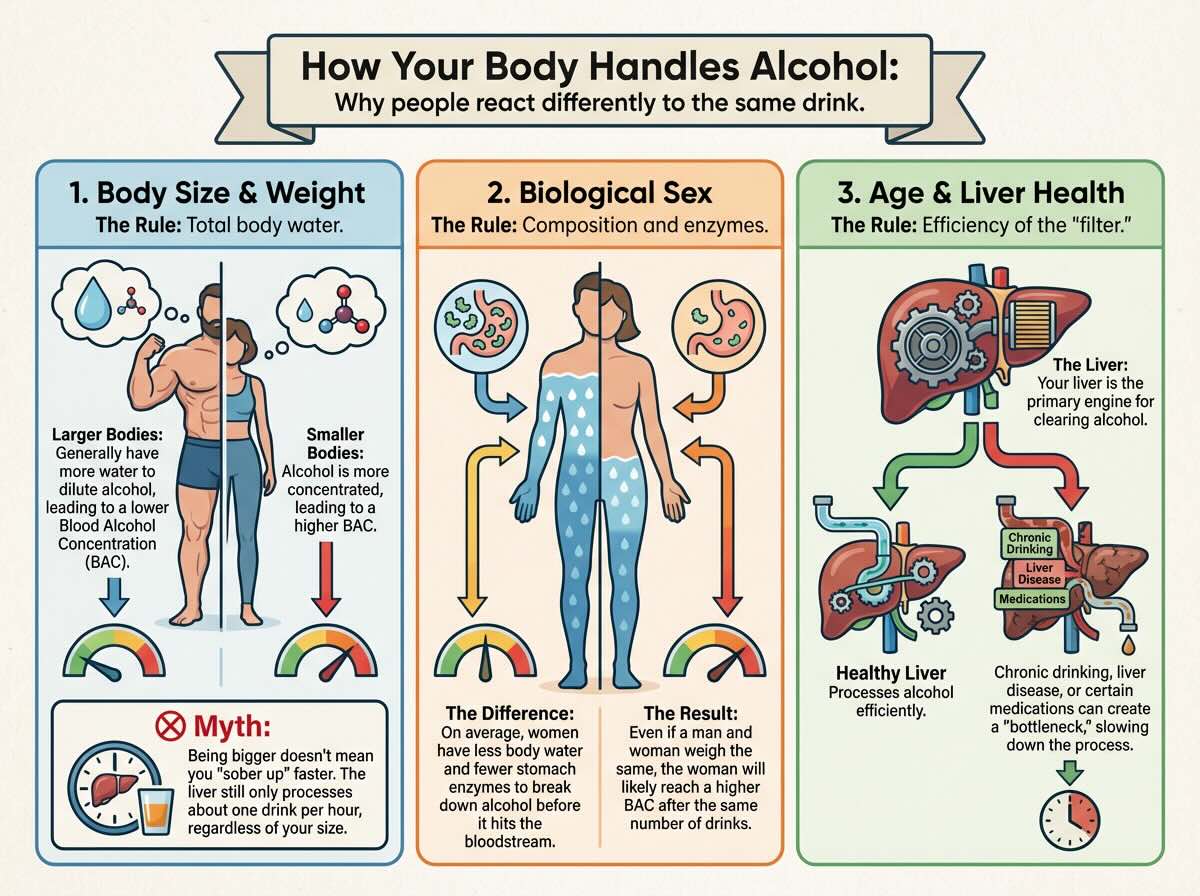
Body weight and composition. According to Mount Sinai research on alcohol distribution, heavier people typically have higher total body water, which dilutes alcohol across a larger volume, resulting in a lower BAC than a lighter person after drinking the same amount. However, this does not mean they sober up faster in terms of time. Their liver still processes alcohol at approximately one drink per hour.
Sex. Research from the National Institute on Alcohol Abuse and Alcoholism shows that on average, women reach higher BAC levels than men after drinking identical amounts of alcohol, even when body weight is controlled. Women typically have less total body water and lower levels of certain enzymes in the stomach lining that break down alcohol before it enters the bloodstream. This means more of the alcohol goes directly into the bloodstream and circulates at higher concentrations. However, their liver still metabolizes alcohol at roughly the same rate per hour as men.
Age and liver health. According to research on aging and alcohol metabolism, older adults and people with liver disease may metabolize alcohol more slowly than average. Chronic heavy drinking causes progressive liver damage that impairs metabolism over time. Young people with healthy livers metabolize alcohol more efficiently than those with compromised liver function. Medications can also slow alcohol metabolism by creating a bottleneck in the liver’s processing capacity.
Whether you have eaten. According to Bowling Green State University research on alcohol absorption, food in your stomach slows alcohol absorption, meaning your BAC rises more gradually if you eat before or during drinking. This can help you stay at a lower intoxication level if you pace yourself while eating. However, food does not affect how fast your liver processes alcohol already in your bloodstream.
Rate of consumption. Drinking slowly allows your liver time to metabolize alcohol as it enters your system, keeping your BAC lower. Drinking quickly means alcohol accumulates faster than your liver can process it, causing BAC to spike rapidly. This is why heavy consumption over a short time produces severe intoxication and higher overdose risk.
Timeline: how long does it take to sober up
Since your liver metabolizes approximately one standard drink per hour according to research from Mount Sinai School of Medicine, you can estimate how long you need to wait to reach sobriety based on consumption and blood alcohol concentration.
After consuming a single beer or glass of wine, most people approach baseline sobriety within 1 to 2 hours. After consuming five drinks over several hours, someone may require 5 to 8 hours or longer to fully clear alcohol from their bloodstream, depending on their body weight and other factors.
A BAC of 0.08 percent, the legal driving limit in all U.S. states, takes approximately 5 to 6 hours for an average adult to reach zero according to research on alcohol elimination. A BAC of 0.15 percent may require 10 hours or more. These timelines are determined by biological reality, not by how you feel or what external interventions you attempt.
It is important to recognize that “feeling sober” does not mean you are sober. Research on alcohol impairment shows that many people feel reasonably alert and functional at BAC levels where their motor coordination, judgment, depth perception, and reaction time are significantly impaired. Feeling sharp after coffee or a cold shower can dangerously mislead you about your actual level of intoxication and your ability to drive safely.
What actually helps while you wait
While nothing accelerates alcohol metabolism, there are practical ways to support your safety and comfort while time passes and your body processes alcohol.
Rest and sleep. Sleep allows time to pass while your liver works uninterrupted and your body recovers. If you sleep for 8 hours after drinking, your liver has had 8 uninterrupted hours to metabolize alcohol at its natural pace.
Staying hydrated. Alcohol has a dehydrating effect. Drinking water alongside alcohol and continuing to hydrate after you stop drinking helps counteract this dehydration and supports your body’s recovery, though hydration does not alter your BAC or speed up how your liver works.
Eating before and while drinking. According to research on alcohol absorption, food slows the absorption of alcohol into your bloodstream, meaning your BAC rises more gradually and you may feel less intoxicated than you would on an empty stomach. This does not reduce the total amount of alcohol your liver must eventually process, but it can prevent rapid spikes in intoxication and help you maintain clearer judgment throughout the evening.
Pacing your consumption. Drinking no more than one standard drink per hour allows your liver to keep pace with the alcohol entering your system, helping you maintain a lower BAC and clearer judgment.
Staying in a safe environment. The most effective protection while intoxicated is remaining in a safe place with people you trust, where you cannot drive or engage in risky behavior while your judgment is impaired.
Your liver processes alcohol at a fixed speed. It takes about 1 hour per drink, plus time for the alcohol to reach your blood.
The Alcohol Clearance Timer
~4 Hours
~7 Hours
12+ Hours
The Reality Check:
“Feeling fine” is a mental state. BAC is a biological measurement. Even if you feel sharp, your body physically cannot clear the alcohol any faster.
When occasional drinking becomes addiction
For occasional drinkers, understanding alcohol metabolism and sobering timelines provides practical safety guidance. However, for people who drink regularly, heavily, or find themselves unable to cut back, the focus shifts entirely from “how long until I’m sober” to addressing alcohol addiction.
If someone drinks most days, repeatedly drinks more than intended despite trying to cut back, or experiences consequences from drinking like relationship problems, work issues, legal problems, or physical health decline, they may have alcohol use disorder. In this case, the conversation around sobriety changes dramatically. Quitting or reducing alcohol after heavy, chronic use requires medical support because withdrawal can be medically serious.
According to the American Academy of Family Physicians, alcohol withdrawal from heavy daily drinking can begin as early as 6 hours after the last drink, with symptoms including anxiety, tremors, and nausea. More severe withdrawal, which can develop within 24 to 72 hours, may include hallucinations, seizures, confusion, rapid heart rate, high blood pressure, and a condition called delirium tremens that can be fatal. Research shows that about 1 to 4 percent of people going through severe alcohol withdrawal without treatment will experience delirium tremens, which carries a mortality rate of 1 to 4 percent if untreated.
Unlike acute intoxication, where time and patience solve the problem, alcohol withdrawal can require medication, medical monitoring, and professional supervision. Attempting to manage severe withdrawal alone or to “tough it out” carries real medical risks.
Resources
- Bowling Green State University: Alcohol Metabolism
- PubMed Central: Alcohol Metabolism (Mount Sinai School of Medicine)
- American Addiction Centers: Alcohol Withdrawal Symptoms, Detox, Timeline, and Treatment
- Healthline: Blood Alcohol Level Chart and Guide
- National Institute on Alcohol Abuse and Alcoholism (NIAAA)
- American Academy of Family Physicians (AAFP)