


The question “Is kratom an opioid?” sounds simple but has a complicated answer. Kratom is not an opioid, but it binds to the same opioid receptors in the brain that opioid drugs activate. Because it acts on opioid receptors, it can create dependence, cause withdrawal, and facilitate harmful polydrug combinations.
The real danger of kratom lies in its perception as a safe, natural alternative to prescription painkillers. Millions of people turn to it thinking they’re avoiding the risks of opioid dependence, only to develop dependence on kratom itself and sometimes alongside or prior to other opioid use. The fact that it’s legal in many places and readily available doesn’t make it benign.
Key Points
- Is Kratom an opioid? No, but it binds to opioid receptors. Kratom’s alkaloids are partial agonists, not full agonists like prescription opioids
- What is Kratom? Leaves from the kratom tree (Mitragyna speciosa), native to Southeast Asia, containing 54+ alkaloids including mitragynine and 7-hydroxymitragynine
- Legal status in U.S.: Currently legal and unscheduled federally in many areas; widely sold and marketed as a dietary supplement. FDA has issued import alerts; DEA considered Schedule I in 2016 but reversed decision
- How used: Ground powder mixed with liquid, brewed as tea, or taken in capsules. Smaller amounts are often described as more stimulating; larger amounts can produce more opioid-like sedation and analgesia
- Prevalence: Approximately 2 million Americans use kratom annually; 25.5% of regular users meet criteria for substance use disorder
- Addiction risk: 55% of regular kratom users become dependent; relapse rates following quit attempts reach 78–83% at three months
- Deaths linked: Poison center and public health reporting have linked kratom to thousands of harm reports over time, and overdose investigations often involve kratom alongside opioids or benzodiazepines
What Is Kratom?
Kratom is derived from the leaves of Mitragyna speciosa, a tree native to Southeast Asia that has been used traditionally for centuries to manage pain, boost energy, and ease fatigue. The dried leaves are crushed into powder or brewed as a tea and contain more than 54 alkaloid compounds, the most abundant being mitragynine and 7-hydroxymitragynine.
Why Kratom Is Called “Legal Opioid”?
Kratom is called a “legal opioid” because it is widely available to buy in many places while still producing opioid like effects through activity at opioid receptors. The phrase is informal, and it refers more to access and perception than to kratom being a regulated opioid medication.
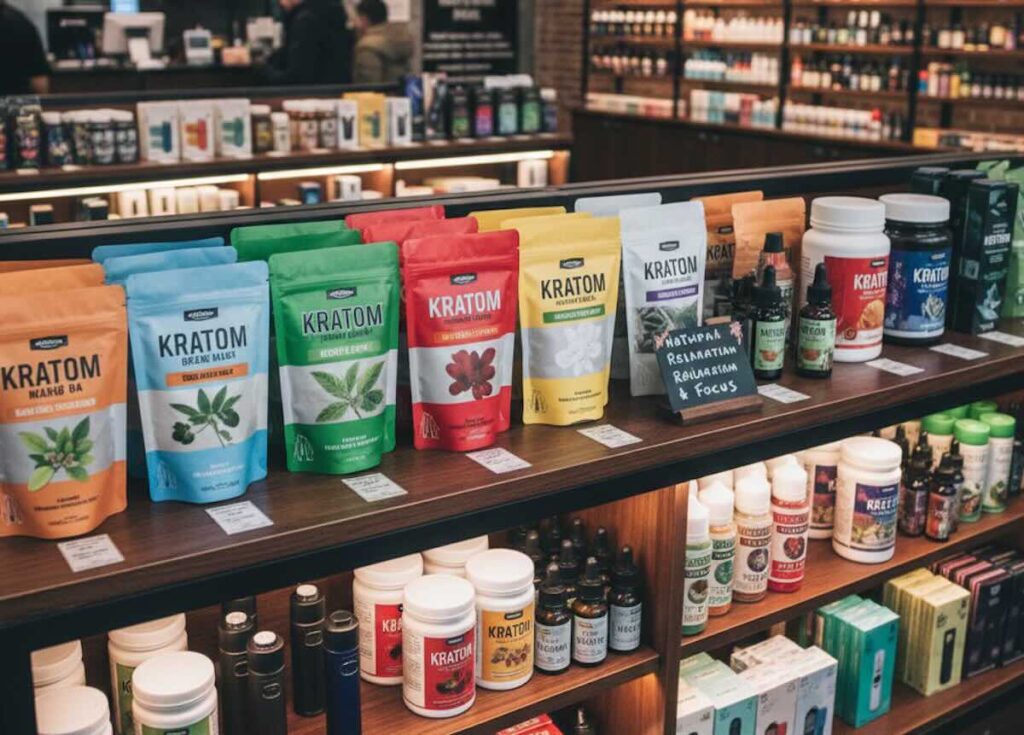
Kratom is sold in the United States as a product widely marketed as a dietary supplement, available online, in smoke shops, health food stores, and convenience stores. Unlike prescription opioids, which are carefully dosed and regulated, kratom’s potency varies widely depending on the source, how it was grown, and how it was processed.
How Kratom Causes Opioid Like Effects?
Kratom produces opioid like effects because its alkaloids interact with opioid receptors in the brain, which is why it can cause effects reminiscent of opioids, including pain relief, sedation, and euphoria. However, kratom’s alkaloids function as partial agonists, not full agonists. This means they bind to opioid receptors but don’t activate them as completely or forcefully as morphine, codeine, or heroin. The distinction matters pharmacologically, though the practical distinction for users is less clear-cut.
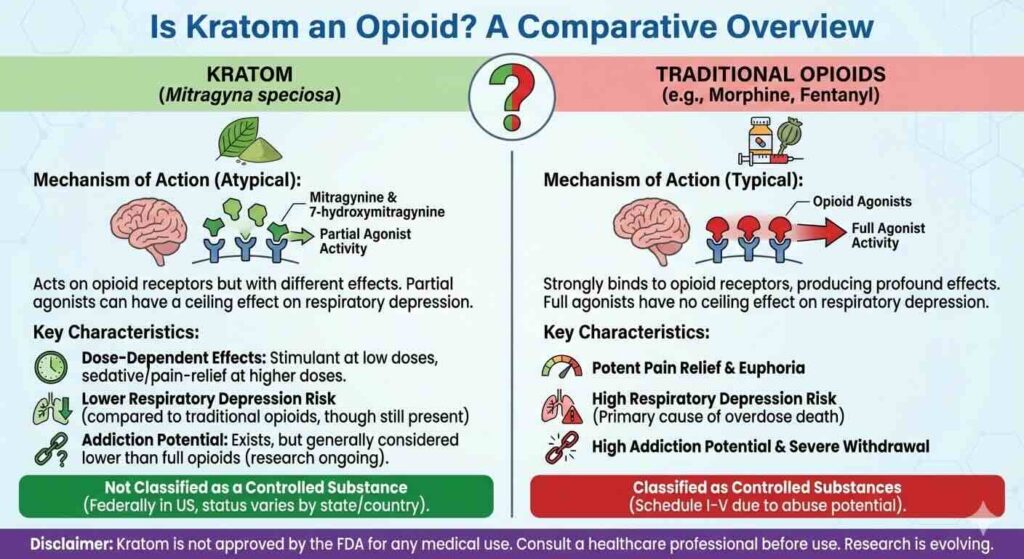
The pharmacology behind this effect involves mitragynine’s complex signaling properties. At lower doses, mitragynine preferentially activates certain neural pathways associated with stimulation. At higher doses or with more potent products, its opioid like effects dominate, producing sedation and analgesia.
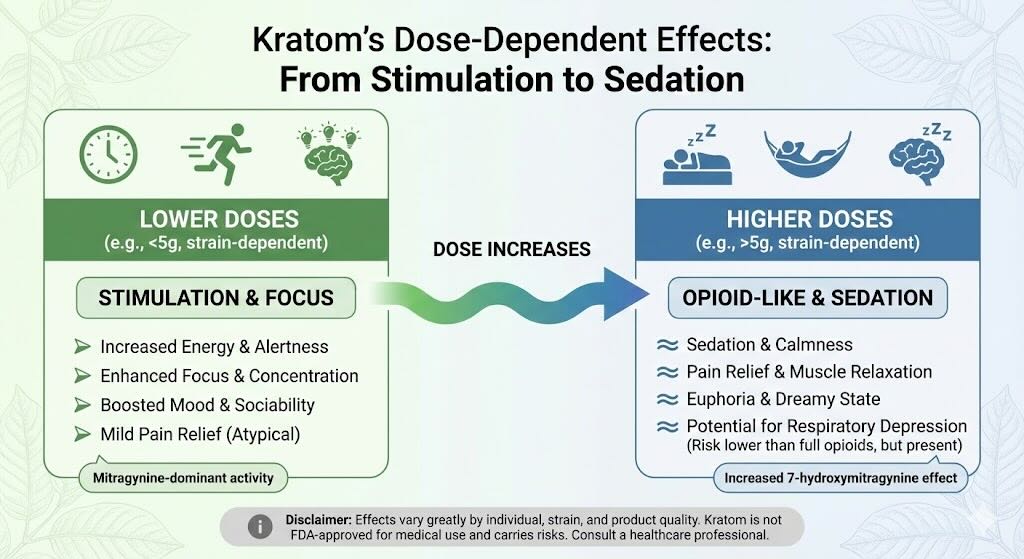
Additionally, when mitragynine is processed by the liver, it can convert into more opioid-active compounds, including 7-hydroxymitragynine and mitragynine pseudoindoxyl, which have stronger mu-opioid activity than the original alkaloid. This liver-driven conversion may help explain why kratom’s effects can feel more opioid like than people expect and why dependence risk can increase with frequent use or higher-potency products.
Does Kratom Help Opioid Withdrawal?
Some people use kratom to try to manage opioid withdrawal or reduce cravings, but that approach can still lead to dependence and withdrawal of its own. Kratom does not reliably help opioid withdrawal in a way that’s safe or predictable because it is not a regulated or approved withdrawal medication, it is not carefully dosed or standardized. Using Kratom during opioid withdrawal, when relapse rates are already high, can complicate recovery and can have serious consequences, especially if opioids are resumed or other depressants are involved.
More importantly, kratom works on opioid receptors, which means it can blunt symptoms in the short term while still reinforcing the same dependence pathway that withdrawal treatment is supposed to break.
While kratom withdrawal is typically not medically dangerous on its own (unlike alcohol or benzodiazepine withdrawal, which can cause seizures), it is psychologically distressing and creates high relapse risk. Studies show kratom relapse rates of 78–83% at three months following quit attempts without professional support.
Is Kratom Addictive Like an Opioid?
Research shows that kratom is addictive, with dependence rates that rival or exceed those of many prescribed opioids.
The mechanism mirrors opioid addiction: repeated activation of opioid receptors causes the brain to adapt, downregulating receptor sensitivity and altering dopamine and other neurotransmitter systems. The more frequently someone uses, the faster these adaptations occur, driving tolerance and physical dependence.
In one of the largest studies to date, 55% of regular kratom users became dependent, defined as developing tolerance (needing more to get the same effect), experiencing withdrawal symptoms when stopping, or continuing use specifically to avoid withdrawal. Another study found that 25.5% of regular kratom users meet the full DSM-5 criteria for substance use disorder.
Presence of Kratom in Opioid Overdose Deaths
Kratom alone rarely causes fatal overdose, which distinguishes it from prescription opioids and heroin. However, when combined with other central nervous system depressants such as alcohol, benzodiazepines, other opioids; kratom significantly increases overdose risk by slowing breathing and heart rate to dangerous levels.
According to the CDC, kratom has been identified in overdose death investigations, and the majority involve co-ingestion with other substances such as opioids or benzodiazepines . Additionally, the FDA has warned that kratom can cause liver damage and other serious toxicity with misuse.
Does Kratom Show Up as an Opioid on Drug Tests?
Kratom typically does not show up as an opioid on standard drug tests because routine opioid panels are designed to detect morphine-type opioids, not kratom’s alkaloids. However, kratom can be detected on specialized or expanded toxicology panels, so a negative opioid screen does not rule out kratom use. Test policies vary by setting, and any unexpected result should be confirmed with a more specific lab method.
Sources:
Washington University School of Medicine Kratom Alkaloids as Probes for Opioid Receptor Function
University of Washington – Alcohol and Drug Abuse Institute (ADAI) Kratom & 7-OH: What do we know about use, safety, and policy?
National Center for Biotechnology Information (NCBI) Kratom – StatPearls
National Institutes of Health (NIH) NIH Record – McCurdy Studies on Kratom & Opioid Withdrawal
Food & Drug Administration (FDA) FDA and Kratom safety warnings
Food & Drug Administration (FDA) Import alerts
Centers for Disease Control & Prevention (CDC) SUDORS Dashboard – Fatal Drug Overdose Data
Frontiers in Pharmacology The Chemical and Pharmacological Properties of Mitragynine and Its Diastereomers: An Insight Review
Frontiers in Pharmacology Kratom Withdrawal: Discussions and Conclusions of a Scientific Consensus Panel
Frontiers in Pharmacology The Acute Adverse Health Effects of Kratom: An Evaluation
Frontiers in Public Health Kratom as a Potential Substance Use Disorder Harm Reduction Strategy
JAMA Network Kratom-Related Deaths (Adolescent Medicine)
PubMed Central Self-Treatment of Opioid Withdrawal Using Kratom (Mitragyna speciosa)