


Urge surfing is a mindfulness-based technique that teaches you to observe a craving without acting on it. Rather than fighting an urge, you ride it like a wave and let it pass on its own.
Developed by Dr. Alan Marlatt in 1985, urge surfing is used widely in addiction treatment, relapse prevention, DBT, and ACT programs. It is one of the most accessible, evidence-backed coping tools in behavioral health.
Key Takeaways
- Urge surfing is a clinically validated mindfulness skill used in DBT, ACT, and Mindfulness-Based Relapse Prevention programs.
- Research found that college smokers who practiced urge surfing reduced smoking by 26%, more than double the rate of a control group (Bowen and Marlatt, 2009).
- Cravings typically peak and subside within 15 to 30 minutes when not acted on.
- The technique is effective for alcohol, drugs, binge eating, and any compulsive behavioral urge tied to emotional triggers.
- Urge surfing does not try to eliminate cravings. It changes your relationship with them so they lose their power over your choices.
What Is Urge Surfing?
Urge surfing is a mindfulness skill that trains you to observe an urge as a temporary experience rather than a command you must obey. Dr. Alan Marlatt, a clinical psychologist at the University of Washington, coined the term and built the technique into his Mindfulness-Based Relapse Prevention model.
The core idea is straightforward: cravings behave like ocean waves. They build, they peak, and they fall. When you stop fighting them and start observing them with curiosity, you interrupt the automatic response cycle and reduce their hold on your behavior.
Urge surfing does not ask you to suppress the craving or escape the discomfort. You stay present with it, breathe through it, and allow it to move through you without reacting.
How Long Does an Urge Last?
Most urges peak and subside within 15 to 30 minutes when not acted on. This is one of the most important facts in craving management: cravings have a natural ceiling, and they always fall.
Many people in early recovery believe an urge will only grow until they give in. Urge surfing directly challenges that belief. Each time you ride out a craving without acting, you weaken the brain’s learned association between the trigger and the habitual behavior.
With consistent practice, craving cycles become shorter, less intense, and easier to manage.
The Science Behind Urge Surfing
Cravings originate in the brain’s reward circuitry. When a trigger appears, the brain fires urgent signals toward familiar behaviors. Those signals feel powerful, but they are sensations, not facts.
Urge surfing introduces a mindful pause between the trigger and the action. This pause disrupts the automatic habit loop of trigger, behavior, and reward. Research supports mindfulness-based approaches as effective tools for reducing impulsivity, improving emotional regulation, and lowering relapse risk in addiction recovery.
Neuroscience also shows that consistently pausing before reacting gradually rewires how the brain responds to cravings. This is the principle of neuroplasticity applied to habit change.
Is Urge Surfing a DBT or CBT Skill?
Urge surfing appears in both frameworks, but it is most closely associated with DBT and Mindfulness-Based Relapse Prevention. In DBT, it falls under the distress tolerance module. It teaches clients to tolerate intense emotional discomfort without impulsive action.
In CBT, the technique targets the automatic thought patterns that lead to substance use. Both frameworks use urge surfing to help clients recognize that discomfort is manageable without substances.
Urge surfing is also a foundational skill in ACT, where it fits within the acceptance and defusion principles of the approach.
How to Do Urge Surfing: A Step-by-Step Guide
You do not need a clinical setting or special tools to practice urge surfing. The technique is available the moment a craving begins, wherever you are.
The following are the steps to do urge surfing:
Step 1: Pause and Notice the Urge
The moment a craving appears, stop and acknowledge it without judgment. Say to yourself quietly: “I notice an urge right now.” Do not evaluate it as good or bad. Do not fight it or give in. Simply name what is happening in your experience.
Step 2: Locate the Sensation in Your Body
Shift your attention inward and ask where you feel this urge physically. You might notice tightness in your chest, restlessness in your hands, a dry sensation in your throat, or tension in your jaw. Identify the exact physical location and quality of the sensation you are experiencing.
Step 3: Watch the Wave Rise
Breathe slowly and observe the craving as it builds. Remind yourself that this urge has a peak and a fall. You are not fighting the wave. You are watching it, the way you might observe a wave building from shore, knowing it will break and recede on its own.
Step 4: Stay Present Without Reacting
Keep breathing and stay with the sensation. Do not try to escape or suppress what you are feeling. Resistance amplifies urges. Observation weakens them. This step is the heart of the technique: learning to tolerate discomfort fully without reacting to it.
Step 5: Ride It Out Until It Fades
Continue breathing and observing as the intensity decreases. When the craving begins to recede, take a moment to notice what just happened. You experienced a strong urge and did not act on it. That is a meaningful, trainable skill that builds each time you practice it.
Urge Surfing Techniques and Exercises
Practicing urge surfing during low-intensity moments strengthens the skill before a high-intensity craving arrives. Several structured exercises accelerate this process.
The following are the urge surfing techniques and exercises:
Body Scan
A daily body scan from head to toe builds the internal awareness you need to recognize where cravings show up physically before they peak. Practice for 5 to 10 minutes each morning to map your body’s tension and sensation patterns. This shortens your response time significantly when a real urge appears.
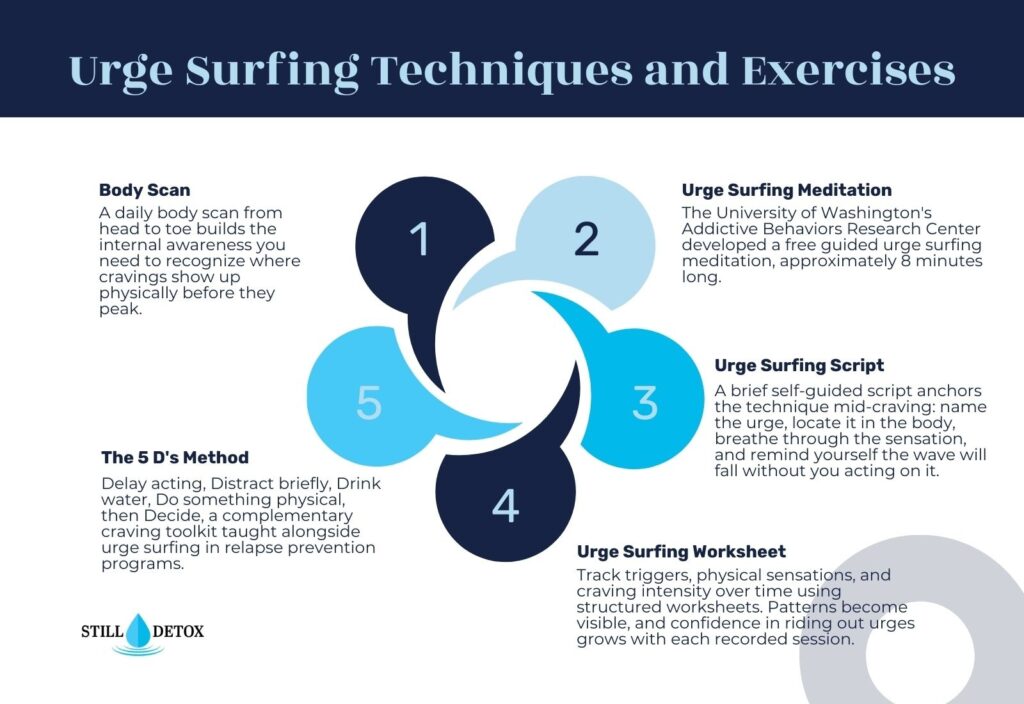
Urge Surfing Meditation
The University of Washington’s Addictive Behaviors Research Center developed a free guided urge surfing meditation, approximately 8 minutes long. It walks you through each step of the practice and is widely used in both clinical and self-directed recovery settings to reinforce the technique with audio support.
Urge Surfing Script
A short self-guided script can help anchor the process during an active craving: “I notice this urge. It is here, and it will pass. I feel [sensation] in [body part]. I am breathing through it. I do not have to act on this. The wave is rising. It will fall.” Repeating this quietly overrides reactive impulses.
Urge Surfing Worksheet
Structured worksheets prompt you to record the trigger, the physical sensations you noticed, the peak intensity on a numeric scale, and the outcome of the craving episode. Tracking this data over time reveals patterns in your triggers and builds measurable confidence in the technique. Therapist Aid offers a widely used free version used in clinical settings.
Urge Surfing for Alcohol and Drug Cravings
Alcohol and substance cravings are often tied to powerful physical sensations, specific emotional states, and environmental cues from past use. Stress, certain social settings, and negative emotions are the most common triggers in addiction recovery.
For people working toward reducing or stopping alcohol use, urge surfing provides a structured moment to pause before reacting. Many people pursuing 30 days without alcohol use urge surfing as a daily tool during the hardest phases of early sobriety when cravings are most frequent and intense.
Those managing alcohol addiction benefit most from urge surfing when it is part of a broader treatment plan with professional medical and therapeutic support, not as a standalone solution in the absence of clinical care.
Urge Surfing for Binge Drinking and Behavioral Urges
Urge surfing extends well beyond substance use. It is equally effective for managing urges connected to binge drinking patterns, binge eating, compulsive spending, and impulsive phone use.
The process is identical regardless of the trigger: notice the urge, locate it physically, breathe through it, and observe it until the intensity fades without acting. Building this skill during lower-stakes moments is what makes it accessible when a high-intensity craving arrives. Consistency is the variable that determines effectiveness.
When Urge Surfing Alone Is Not Enough
Urge surfing is a powerful coping skill, but it is not a substitute for professional care when physical dependence is present. If cravings are severe, constant, or accompanied by physical symptoms, medical support is essential.
People stopping alcohol or benzodiazepine use after prolonged heavy use often experience withdrawal symptoms that mindfulness alone cannot address. Understanding the alcohol withdrawal timeline helps clarify when medically supervised detox is necessary alongside behavioral coping strategies.
Emotional symptoms like rebound anxiety after stopping substances are clinical issues that require targeted treatment, not only mindfulness practice. Drug and alcohol recovery is most effective when evidence-based coping skills are integrated into a comprehensive plan with qualified clinical support.
Frequently Asked Questions
How does urge surfing work?
Urge surfing works by training you to experience cravings as temporary physical and emotional sensations rather than commands you must obey. You observe the bodily experience of the urge, breathe through the discomfort, and allow the intensity to rise and fall naturally. Each time you ride out a craving without acting on it, the brain’s automatic reactive response weakens and your tolerance for discomfort grows stronger over time.
What are the 5 D’s of urge surfing?
The 5 D’s are a complementary craving management tool: Delay acting on the urge, Distract yourself with a brief neutral task, Drink water or a non-alcoholic beverage, Do something physically different, and Decide to reassess once the intensity peaks. These steps are commonly taught alongside urge surfing in relapse prevention programs as part of a broader behavioral toolkit for managing cravings.
Is urge surfing CBT or DBT?
Urge surfing is most closely associated with DBT and Mindfulness-Based Relapse Prevention, though it appears in CBT frameworks as well. In DBT, it is classified as a distress tolerance skill used to manage emotional discomfort without impulsive action. It also appears in ACT as an acceptance-based strategy for responding to unwanted internal experiences without reacting to them.
How do you sit with urges without acting on them?
Sitting with an urge requires mindful attention and slow deliberate breathing. Focus on exactly where the urge is located in your body. Label the sensations you notice without judgment. Remind yourself the feeling is temporary and that cravings typically peak within 30 minutes. Breathe steadily and observe the intensity as it rises and falls, resisting the impulse to escape the discomfort by acting on it.
References
- Bowen, S., and Marlatt, A. (2009). Surfing the urge: Brief mindfulness-based intervention for college student smokers. Psychology of Addictive Behaviors, 23(4), 666-671.
- Marlatt, G. A., and Gordon, J. R. (1985). Relapse Prevention: Maintenance Strategies in the Treatment of Addictive Behaviors. Guilford Press.
- Witkiewitz, K., and Marlatt, G. A. (2004). Relapse prevention for alcohol and drug problems. American Psychologist, 59(4), 224-235.
- National Institute on Alcohol Abuse and Alcoholism. (2023). Understanding alcohol use disorder. U.S. Department of Health and Human Services. https://www.niaaa.nih.gov/publications/brochures-and-fact-sheets/understanding-alcohol-use-disorder