

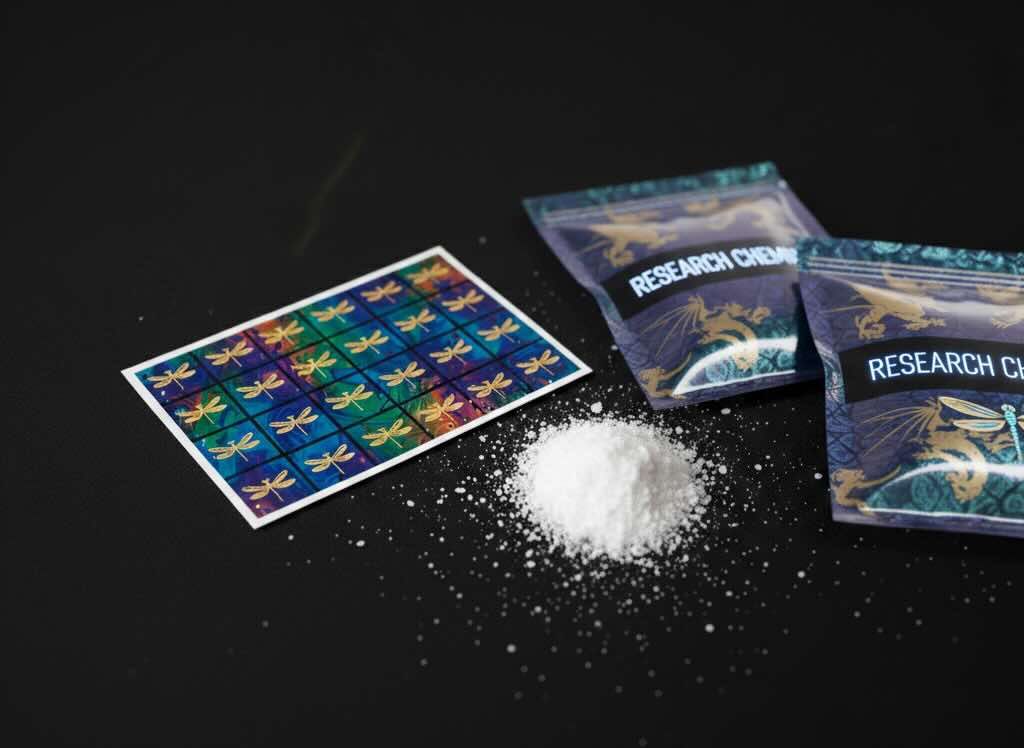
Bromo-DragonFLY is an extremely potent, ultra-long-lasting hallucinogenic research chemical that has been diverted into the recreational drug market, where it is used to produce an unusually prolonged psychedelic high that can last for two or even three days from a single dose. It is widely regarded as one of the most dangerous modern hallucinogens due to its toxicity, delayed onset, and the very small margin between a “typical” dose and a life-threatening overdose.
What Is Bromo Dragonfly?
Bromo dragonfly (often written Bromo-DragonFLY or BDF) is a synthetic psychedelic belonging to the phenethylamine and benzodifuran (“FLY”) families. It was originally developed as a research tool, not a street drug. The compound’s nickname comes from its rigid chemical structure: the fused dihydrofuran rings create a shape that resembles a dragonfly’s wings when chemists draw the molecule, hence the “dragonfly” name.
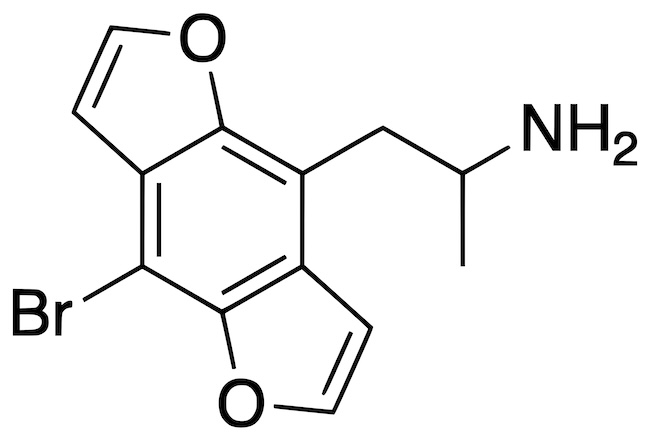
Bromo dragonfly is known by a number of street names, including Dragonfly, Bromo-Dragonfly / DragonFLY, B‑Fly, BDF, and DOB‑Dragonfly. It belongs to a cluster of related “FLY” compounds – benzodifuran synthetics whose structures all share the dragonfly‑like fused ring system – and at least five other related synthetic molecules have been identified in this family.
Bromo dragonfly works on the same brain receptors that classic psychedelics like LSD and psilocybin use, but it also affects other receptors that create dangerous effects on blood vessels and the heart. This combination explains why it produces intense psychedelic effects while at the same time causing severe vasoconstriction and cardiovascular stress.
Origin, Research Use, and Scheduling
Bromo dragonfly was first synthesized in 1998 by Matthew A. Parker in the laboratory of David E. Nichols at Purdue University as a research chemical for studying brain signaling. It was never intended or tested for human use. By the early 2000s, it began appearing on the designer-drug market, sold online as a “research chemical” or “not for human consumption” while clearly being marketed for recreational use.
As reports of severe toxicity, hospitalizations, limb amputations due to necrosis, and multiple deaths accumulated in Europe and the United States, authorities moved to control the substance. It has since been classified as a controlled drug comparable to a Schedule I substance in numerous countries, including Sweden, Denmark, Finland, Norway, and others, based on its lack of medical use and high risk of serious harm.
In the United States, Bromo-Dragonfly falls under Schedule I–type control via federal analog and emergency scheduling rules, reflecting its recreational nature and high abuse potential. The DEA treats it as a prohibited hallucinogen with no accepted therapeutic application.
Recreational Use and Drug Testing Escape
Today, Bromo dragonfly has no legitimate medical indication and is used purely recreationally by a small subset of experienced hallucinogen users who seek unusually long and intense psychedelic experiences. One of the reasons it gained traction in these communities is that it is extremely rare and not included in standard workplace or probation drug-screening panels, meaning that typical immunoassay tests for “hallucinogens” or “drugs of abuse” will not detect it. This makes it particularly attractive for people with a history of hallucinogen addiction or heavy psychedelic use who are subject to regular drug testing but still want access to powerful mind-altering experiences.
How Bromo Dragonfly Is Sold and Taken
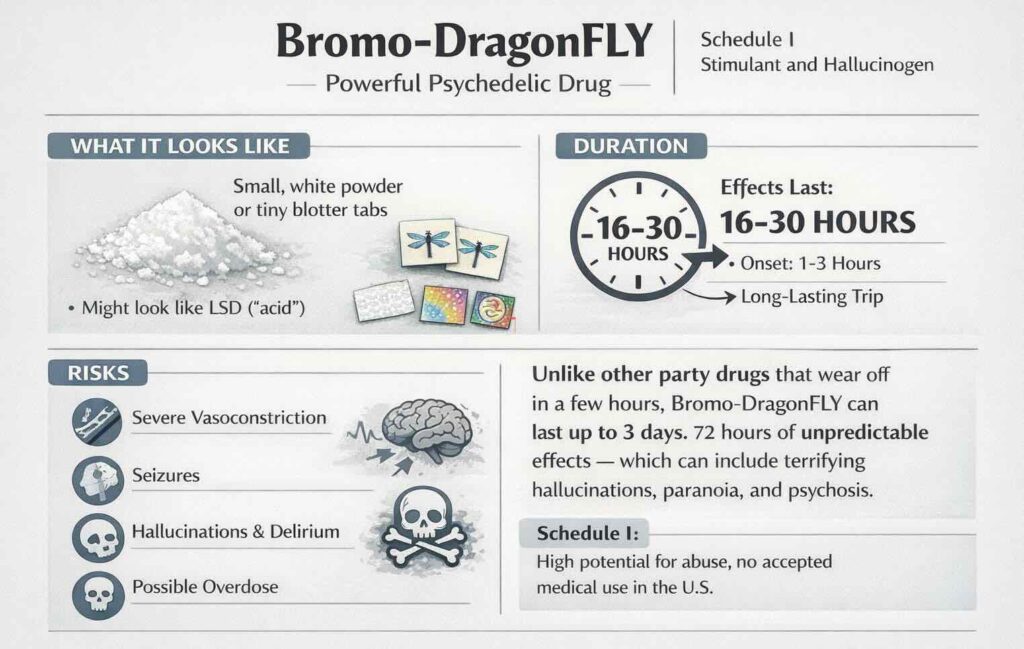
Bromo dragonfly is generally synthesized in clandestine labs and then sold online or through underground networks in ultra‑small-dose formats. Because the active dose is on the order of 100–1000 micrograms, it is impractical and unsafe to sell as bulk powder to end users. Instead, it is most often sold as:
- Blotter paper squares (similar in appearance to LSD blotters, dosed with microgram quantities)
- Liquid (drops of concentrated solution placed on paper or sugar cubes)
- Less commonly, small tablets or capsules for oral ingestion
The primary route of administration is oral, either by swallowing blotter or allowing it to absorb sublingually before swallowing. Because the difference between a heavy dose and a lethal one can be less than a milligram, even minor errors in laying liquid onto blotter sheets can multiply the eventual dose severalfold. This makes home-dosed or non-laboratory-dosed blotter particularly risky, as users have no way of knowing whether they are taking a so‑called “normal” amount or an overdose that could cause vasospasm, seizures, or death.
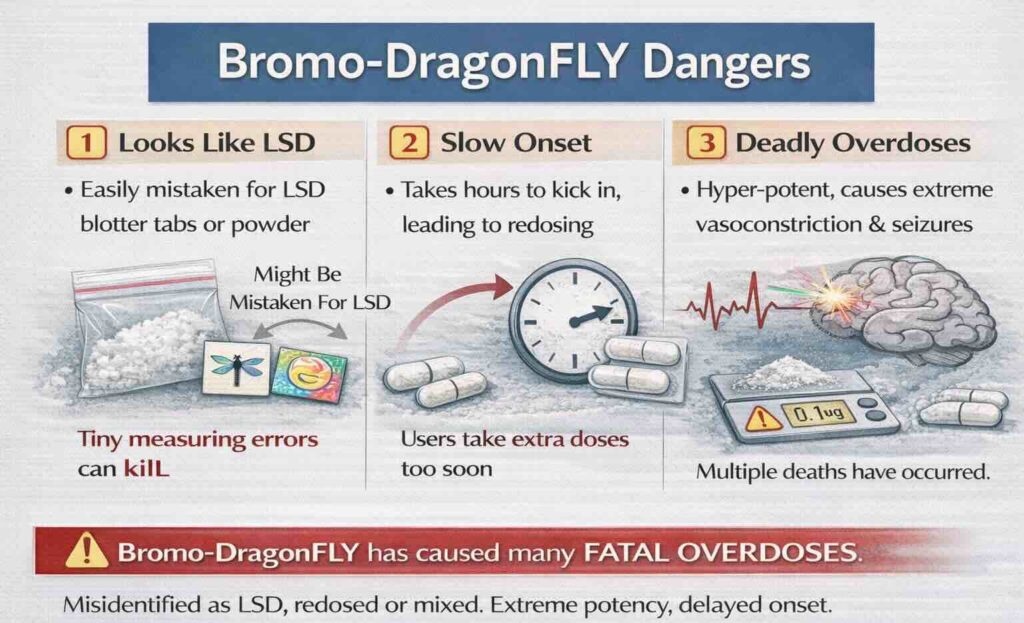
Slight dosing mistakes, mislabeling, or misidentification (for example, when it is sold as LSD or 2C‑B‑FLY) have repeatedly led to mass overdoses, severe poisonings, and fatalities.
Onset, Dose, and Overdose
One of the most distinctive and hazardous features of Bromo dragonfly is its pharmacokinetic profile: the onset is very slow, and the duration is remarkably long. After oral ingestion, effects may take as long as six hours to appear, and in some cases users do not feel full psychedelic effects until several hours after dosing. This delay has led many recreational users to assume the first dose was too small or inactive and to take additional doses, not realizing that the initial dose simply has not yet taken effect.
The exact “safe” dosage of Bromo dragonfly in humans is not clearly established. User reports and limited literature suggest that “typical” oral doses lie somewhere between 100 and 1000 micrograms, often cited in the 200–800 microgram range, but there are documented deaths around 700 micrograms. This razor-thin safety window means that even experienced users cannot reliably “eyeball” or trust blotter strength.
Some overdose incidents involved people who thought they were taking a different designer drug such as 2C‑E or 2C‑B‑FLY and therefore ingested doses appropriate for those much less potent substances, effectively taking 50–100 times the intended Bromo-DragonFly dose.
Psychedelic Effects
Subjectively, Bromo dragonfly is often described as an intensely powerful, immersive psychedelic that feels “too long” even to seasoned users. Some people call it “a ride to the moon” that lasts so long it leaves them emotionally and physically exhausted. The core psychedelic effects are similar in broad outline to those of LSD or other psychedelics but are typically reported as more draining and more prolonged.
Commonly reported effects include:
- Profound visual hallucinations and distortions – geometric patterns, intense colors, light trails, and shifting shapes
- Altered sound perception, echoing or distortion of noises, and occasional synesthesia
- A powerful sense of detachment from ordinary reality and significant time distortion
- Experiences of “other realities,” encounters with entities, and near‑death experience–like themes
- Being unable to sleep, feeling trapped inside the trip
- Becoming increasingly anxious or confused as the hours stretch on
Once the drug finally “kicks in,” strong psychedelic effects can last 12–24 hours, with residual or moderate effects persisting for 48–72 hours, and in some cases up to three days.
Adverse Reactions and Toxicity
Bromo dragonfly is notable not just for its psychedelic effects but for its unusually high toxicity compared to better-known hallucinogens. A series of hospitalizations and deaths in Scandinavia, the UK, and the United States has highlighted the drug’s capacity to cause catastrophic medical complications even at doses within the purported “recreational” range.
Commonly reported adverse reactions include:
- Nausea, vomiting, and gastrointestinal cramps or diarrhea
- Headache, muscle tension, tremor, and body temperature fluctuations
- Tachycardia (rapid pulse), elevated blood pressure, and palpitations
- Arrhythmias, heart murmurs, and in severe cases cardiac arrest
- Anxiety, panic attacks, agitation, and paranoid ideation
- Confusion, disorientation, and delirium
- Convulsions and tonic‑clonic seizures
- Slight to marked pupil dilation and visual disturbances
- Hallucinations, flashbacks, and persistent memory disturbances
Poison centers and toxicology reports describe cases where patients experienced seizures, vomiting blood, respiratory compromise, and near-fatal asphyxia after aspiration of vomit.
Vasoconstriction, Necrosis, and Amputations
Arguably the most distinctive and frightening effect of Bromo dragonfly is its severe, prolonged vasoconstriction—dangerous narrowing of blood vessels. The drug dramatically reduces blood flow to fingers, toes, and internal organs, sometimes for days.
In overdose situations, this blood flow cutoff can last many hours or even days.
Clinical reports document cases where users developed critically reduced circulation in fingers and toes, leading to tissue death (necrosis). In at least one high-profile Swedish case, a user who took multiple blotters later required amputation of the front part of both feet and several fingers after gangrene set in from prolonged lack of blood flow. Other reports describe limb-threatening blood flow loss, organ damage, and kidney failure following Bromo-dragonFLY overdose.
The combination of racing heart, high blood pressure, and long-lasting blood vessel spasm makes Bromo-DragonFLY far more dangerous. Even with aggressive hospital treatment, including medications to open blood vessels and intensive care, outcomes can be poor, and tissue loss may be irreversible.
Protracted Effects and Aftermath
Bromo-DragonFLY is considered “likely the most long-lasting drug known today” in the hallucinogen category which makes management more complex.
After the vivid hallucinations and acute physiological symptoms subside, many users experience:
- Profound exhaustion and sleep disruption
- Low mood, anxiety, and emotional instability
- Lingering confusion or cognitive “fog”
- Residual visual phenomena and occasional flashbacks
- Intrusive memories of intense or terrifying parts of the trip
For some individuals, particularly those who experienced medical crises, the experience can be traumatic, leading to ongoing anxiety, panic, or PTSD‑like symptoms. The line between drug-induced psychosis and post‑trip psychological fallout can be hard to draw, but in both cases the person may need professional psychiatric support.
Polydrug Use and Dangerous Combinations
Bromo dragonfly is often used in combination with other substances, either deliberately or inadvertently, and these polydrug patterns raise toxicity to an even higher level. Many users add other drugs while waiting for effects, misjudging how impaired they already are and creating complex intoxication pictures.
Particularly concerning combinations include:
- Co‑use with ketamine or other dissociatives, which has been linked to severe agitation, intense hallucinations, delirium, and tonic‑clonic seizures requiring emergency care.
- Combination with other psychedelics like LSD or 2C‑series drugs, which can produce overwhelming psychedelic overload and make it difficult to manage the trip safely.
- Combination with stimulants (such as MDMA), which further stress the cardiovascular system and may amplify vasoconstriction and hyperthermia.
These mixtures have been implicated in a number of acute intoxication cases and fatalities, particularly when Bromo-DragonFLY was mistaken for a shorter-acting or less potent drug and dosed accordingly.
Why Bromo Dragonfly Is Unusually Dangerous
Even among other designer drugs, Bromo dragonfly is unusually hazardous because of three specific factors working together. First, its active dose is so small (micrograms) that even tiny errors in manufacturing or measurement can turn a “recreational” amount into a fatal overdose. Second, the slow onset fools users into redosing just as the first dose is kicking in, creating accidental massive overdoses. Third, its unique combination of psychedelic brain effects and extreme blood vessel constriction creates medical emergencies that classic hallucinogens like LSD simply don’t cause.
These factors have led to multiple deaths and severe poisonings despite the drug’s relative rarity. No other commonly used psychedelic has this exact combination of extreme potency, delayed onset, prolonged duration, and vascular toxicity.
Understanding the Risks and Seeking Help
Bromo dragonfly occupies a small but uniquely alarming niche in the world of hallucinogens. It is a laboratory research tool that escaped into the recreational market, where its ultra-long duration, extreme potency, and severe toxicity have made it responsible for a disproportionate number of catastrophic outcomes, including deaths. For individuals with a history of psychedelic or hallucinogen use, its apparent advantages – evasion of standard drug tests and long lasting effects – are far outweighed by the unpredictable, often devastating risks.
If you or someone you care about is experimenting with obscure research chemicals like Bromo-DragonFly, or if there is a pattern of hallucinogen use that is starting to feel out of control, specialized addiction treatment and medical guidance are critical. Professional support can help address both the psychological drivers of hallucinogen use and the unique dangers that come with powerful, poorly studied substances.
References
- Bromo-DragonFLY – Wikipedia
- Tennessee Poison Center – Vanderbilt University Medical Center
- ADME of Bromo-DragonFLY – National Library of Medicine
- Bromo-dragonfly Resistance to Metabolism – National Institutes of Health
- Novel Psychoactive Substances Adverse Events – National Library of Medicine Designer Drugs Mechanism of Action – National Library of Medicine
- Psychedelic and Dissociative Drugs – National Institute on Drug Abuse