



Gray area drinking describes a pattern of alcohol consumption that exceeds recommended guidelines but does not meet DSM-5 clinical diagnostic criteria for alcohol use disorder (AUD).
It occupies the space between casual social drinking and diagnosable alcohol dependence, a territory where millions of people quietly struggle without identifying themselves as having a problem.
The term was popularized by Jolene Park, a Colorado-based functional nutritionist and health coach, through her 2017 TEDx Talk “Gray Area Drinking.” Park described gray area drinkers as people whose alcohol use produces internal anxiety, guilt, or cycling behavior, but who appear fully functional to the outside world. If you regularly drink more than you intend, use alcohol to manage stress, or cycle between heavy use and attempts to quit, understanding where you fall on the alcohol use spectrum is the first step toward change.
Key Takeaways
- Gray area drinking falls between social drinking and alcohol use disorder on the DSM-5 spectrum. People in this zone exceed NIAAA recommended limits but do not meet the 2-criterion diagnostic threshold for mild AUD.
- According to SAMHSA’s 2022 National Survey on Drug Use and Health, 29.5 million Americans had an alcohol use disorder that year. Millions more drink in ways that cause internal distress without meeting formal AUD criteria.
- The AUDIT-C (Alcohol Use Disorders Identification Test, Consumption), a validated three-question clinical screening tool, identifies hazardous drinking patterns consistent with gray area drinking before they progress to diagnosable AUD.
- DSM-5 mild alcohol use disorder requires meeting 2 to 3 of 11 diagnostic criteria within a 12-month period. Gray area drinkers typically meet 0 to 1, placing them in a clinically significant pre-diagnostic risk zone.
- Gray area drinking responds to earlier intervention more completely than moderate to severe AUD because physical dependence has not yet developed in most cases.
What Is Gray Area Drinking?
Gray area drinking is alcohol consumption that causes internal distress, guilt, cycling behavior, or health concern but does not meet the formal DSM-5-TR diagnostic criteria for alcohol use disorder (AUD). It is not a clinical diagnosis. It is a behavioral pattern occupying the wide, largely unaddressed middle ground of the alcohol use spectrum.
Where the Term Comes From: Jolene Park and the TEDx Talk
Jolene Park, a Colorado-based functional nutritionist and health coach, coined the term “gray area drinking” and popularized it through her 2017 TEDx Talk of the same name. Park described her own decade-long experience of nightly wine use that appeared socially normal but produced persistent internal anxiety, cycling abstinence attempts, and mounting psychological dependence without crossing into visible impairment.
Park’s framework challenged the clinical binary that treated alcohol use as either normal or pathological. She argued that a massive proportion of drinkers occupy an unaddressed middle space where their alcohol use damages health and wellbeing without meeting the threshold for addiction treatment. This framing gave language to an experience millions of people recognized in themselves but had no clinical vocabulary to describe.
Grey Area Drinking and Other Spelling Variants
Grey area drinking (with an “e”) and gray area drinking (with an “a”) describe the same phenomenon. Both spellings appear across clinical literature, harm-reduction resources, and consumer health media. Other search variants including gray drinking, grey drinker, gray drinker, and gray alcohol refer to the same behavioral pattern as described by Park’s framework and subsequent alcohol use researchers. These spelling variants capture the same clinical and behavioral territory covered in this article.
Who Is a Gray Area Drinker? The Profile
A gray area drinker is someone whose alcohol consumption exceeds recommended intake limits and generates internal concern, guilt, or cycling behavior, while maintaining functional appearances in work, relationships, and social settings.
Functional Appearance With Internal Struggle
The defining characteristic of a gray area drinker is the gap between external presentation and internal experience. From the outside, gray area drinkers maintain employment, sustain relationships, meet parenting responsibilities, and show no overt signs of alcohol dependency. Internally, they carry persistent preoccupation with drinking, private shame, repeated failed attempts to moderate, and escalating anxiety about their relationship with alcohol.
This hidden functional presentation distinguishes gray area drinkers from those with moderate to severe AUD, whose impairment eventually becomes visible through workplace performance deterioration, relationship breakdown, or measurable health decline. Gray area drinkers typically do not experience physical alcohol withdrawal when they stop drinking, but they report increased anxiety, sleep disruption, restlessness, and irritability during abstinence periods.
NIAAA Drinking Guidelines and the Gray Zone
The National Institute on Alcohol Abuse and Alcoholism (NIAAA) defines low-risk drinking as no more than 3 drinks on any single day and no more than 7 drinks per week for women, and no more than 4 drinks on any single day and no more than 14 drinks per week for men. Gray area drinkers regularly exceed at least one threshold without crossing into the physical dependency that characterizes moderate to severe AUD.
Binge drinking, defined by NIAAA as 4 or more drinks within approximately 2 hours for women and 5 or more for men, producing blood alcohol concentration at or above 0.08%, is a frequent pattern in gray area drinkers. For a clinical overview of how binge drinking develops and produces withdrawal even without chronic dependence, the binge drinking and withdrawal guide at Still Detox covers the full physiological progression.
Gray Area Drinking: 10 Questions to Ask Yourself
The AUDIT-C (Alcohol Use Disorders Identification Test, Consumption) is a validated three-item WHO screening instrument that identifies hazardous and harmful alcohol use patterns before they progress to diagnosable AUD. A positive AUDIT-C screen is not a diagnosis; it is a clinical signal warranting honest evaluation.
These questions help identify gray area drinking patterns:
Honest assessment questions for gray area drinking include:
- Do you regularly drink more than you initially intended in a given session?
- Have you made genuine attempts to cut back or stop and been unable to sustain them?
- Do you use alcohol to manage stress, anxiety, sadness, or loneliness?
- Do you think about drinking before social events, after difficult days, or as a self-reward?
- Have you minimized or concealed how much you drink from a partner, family member, or physician?
- Do you cycle between heavy drinking periods and guilt-driven abstinence or reduction attempts?
- Has alcohol affected your sleep quality, morning productivity, or exercise consistency?
- Do you feel anxious, irritable, or restless on days when you cannot drink?
- Have you experienced shame, regret, or embarrassment about your drinking on repeated occasions?
- Do you privately question whether your relationship with alcohol is healthy?
Three or more “yes” answers indicate behavioral patterns consistent with gray area drinking that warrant honest evaluation and, for many people, professional support.
Signs of Gray Area Drinking
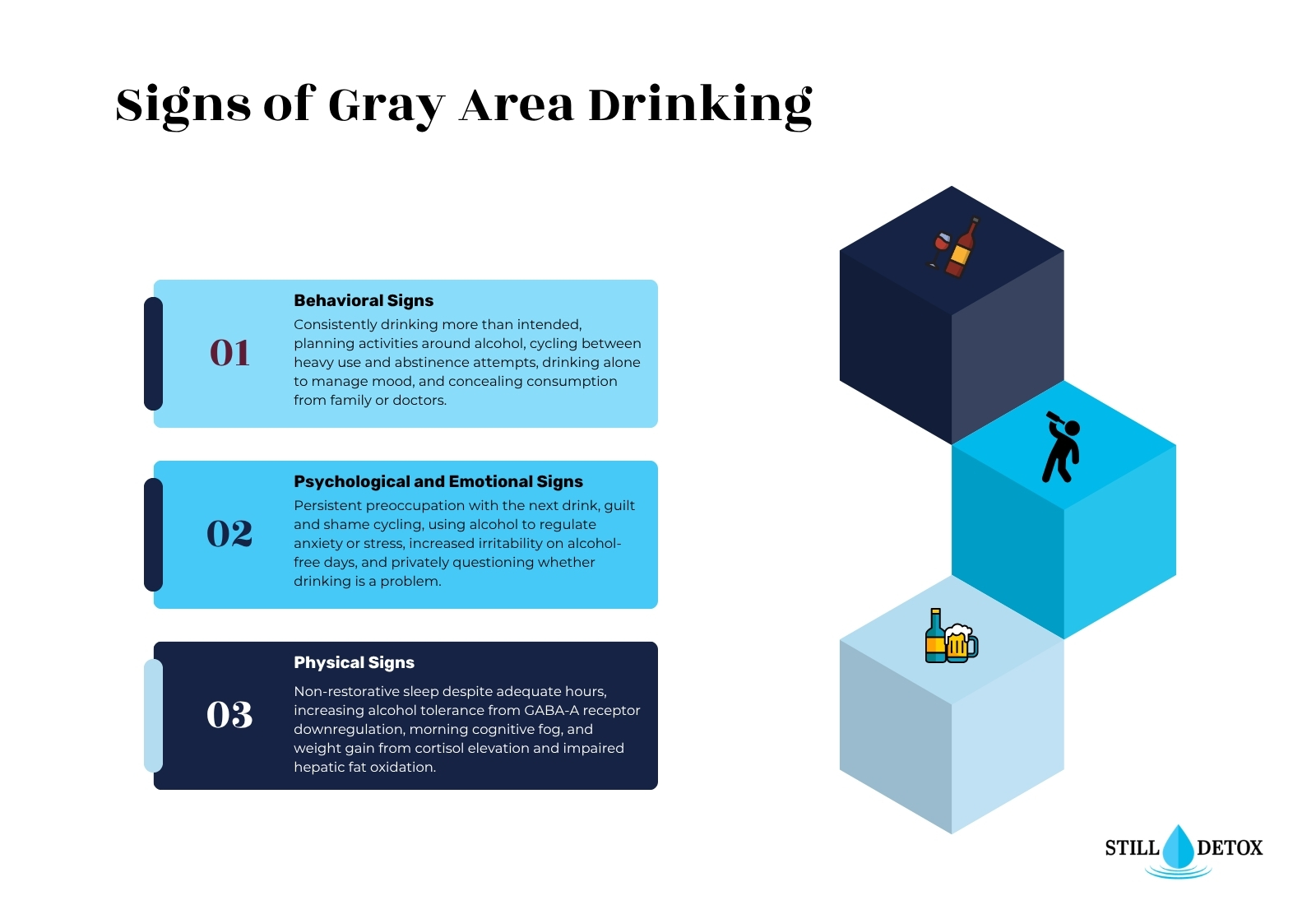
Gray area drinking produces signs across three categories: behavioral, psychological, and physical. Because gray area drinkers appear high-functioning externally, these signs tend to be internally felt before they become detectable to others.
Behavioral Signs
Behavioral signs of gray area drinking reflect compulsive patterns in drinking frequency and quantity that erode voluntary control over consumption:
Behavioral signs of gray area drinking include:
- Consistently drinking more than intended: Starting with one glass and finishing a bottle on most occasions indicates progressive erosion of voluntary consumption control, a behavioral hallmark of dopaminergic reinforcement driving drinking above the level of conscious choice
- Planning activities around alcohol availability: Choosing restaurants, social gatherings, or end-of-day routines based on whether alcohol is present reflects preoccupation characteristic of early psychological dependence
- Cycling between moderation and heavy use: Alternating between controlled drinking periods and episodes of significant excess is one of the most consistent behavioral signatures of gray area drinking, distinct from the steady heavy consumption of diagnosable AUD
- Regular solo drinking: Drinking alone, particularly to manage mood or decompress from stress, signals alcohol functioning as a primary emotional regulation mechanism rather than a social facilitator
- Concealing or minimizing consumption: Hiding drinks, underreporting quantities to physicians, or drinking before social events to maintain “moderate” visible consumption reflects awareness that the behavior exceeds acceptable norms
Psychological and Emotional Signs
Psychological signs of gray area drinking frequently precede any behavioral impairment and represent the subjective experience that most gray area drinkers recognize most clearly:
Psychological signs of gray area drinking include:
- Persistent preoccupation with the next drink: Regular mental focus on when and how the next drinking occasion will occur signals alcohol-driven mesolimbic dopamine reinforcement operating above the level of deliberate choice
- Guilt and shame cycling: Genuine remorse following drinking episodes, resolved temporarily through abstinence, followed by resumed use despite the resolution, is the defining psychological cycle of gray area drinking
- Emotional regulation through alcohol: Reaching consistently for alcohol to process difficult emotions, numb anxiety, or recover from stress indicates psychological dependence that precedes physical dependence
- Anxiety and irritability during abstinence: Heightened anxiety, restlessness, and mood instability on alcohol-free days reflects neuroadaptive changes in GABA-A receptor sensitivity produced by regular alcohol exposure suppressing inhibitory neurotransmission
- Persistent internal questioning: Privately wondering whether drinking constitutes a problem is itself a clinically meaningful signal. Gray area drinkers spend significant cognitive resources monitoring and rationalizing their alcohol use precisely because their awareness of the problem precedes their willingness to address it
Physical Signs
Gray area drinking produces physical signs often attributed to stress, aging, or sleep disruption rather than alcohol:
Physical signs of gray area drinking include:
- Non-restorative sleep: Alcohol-induced suppression of REM sleep produces morning fatigue, daytime cognitive fog, and progressive executive function decline even when total sleep hours appear adequate
- Increasing tolerance: Requiring progressively more alcohol to achieve the same psychological effect reflects GABA-A receptor downregulation, an early pharmacological signal that the neurobiological process underlying alcohol use disorder has begun
- Weight gain and metabolic disruption: Regular alcohol consumption elevates cortisol, disrupts insulin sensitivity, and impairs hepatic fat oxidation, producing metabolic effects independent of caloric excess from the alcohol itself
- Morning cognitive impairment: Diminished focus, impaired memory encoding, and reduced executive function the day following heavy consumption accumulate into chronic cognitive degradation with sustained gray area drinking patterns
Gray Area Drinking vs. Alcohol Use Disorder: How to Tell the Difference
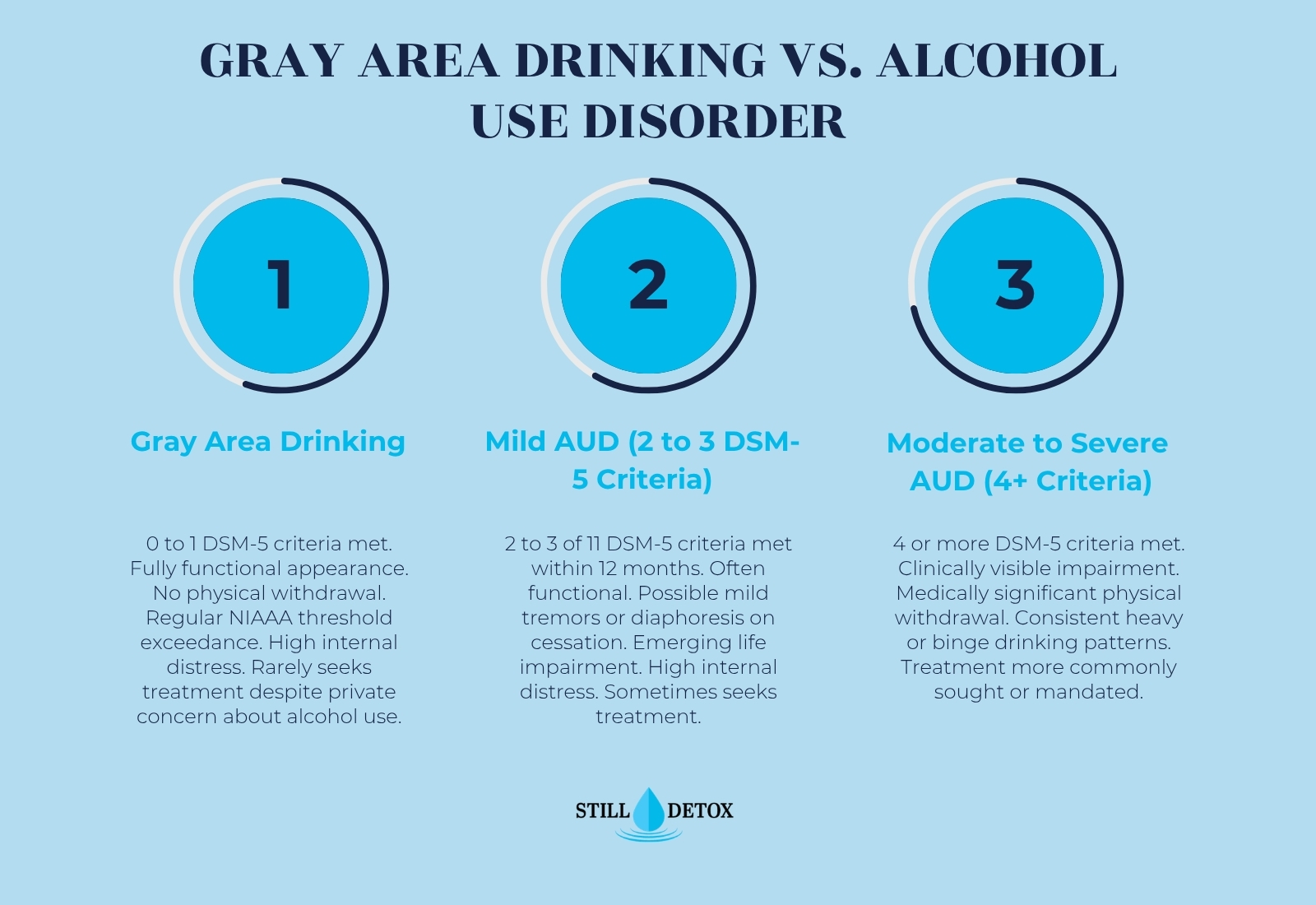
Gray area drinking and alcohol use disorder (AUD) exist on a continuum rather than as distinct categories. The key distinguishing factor is the DSM-5-TR diagnostic threshold: AUD requires meeting 2 or more of 11 specified criteria within a 12-month period.
| Feature | Gray Area Drinking | Mild AUD (2 to 3 criteria) | Moderate to Severe AUD (4+ criteria) |
|---|---|---|---|
| DSM-5-TR criteria met | 0 to 1 | 2 to 3 | 4 to 11 |
| Physical withdrawal on cessation | Rare; mild anxiety or restlessness | Possible; mild tremors or diaphoresis | Yes; medically significant |
| External life impairment | Minimal or hidden | Emerging; variable by domain | Clinically visible |
| NIAAA threshold exceedance | Regular | Regular to heavy | Consistent heavy or binge |
| Functional appearance to others | Fully maintained | Often maintained | Increasingly compromised |
| Internal distress | High | High | Variable |
| Treatment typically sought | Rarely | Sometimes | More commonly |
DSM-5 mild AUD is frequently indistinguishable from gray area drinking in clinical presentation. Many gray area drinkers who resist professional support because they “are not an alcoholic” would, on formal assessment with the AUDIT-C or full AUDIT, meet criteria for mild AUD. The alcohol addiction program at Still Detox serves the full diagnostic spectrum including mild AUD that has been minimized or unrecognized.
Health Risks When Gray Area Drinking Escalates
Gray area drinking that continues without intervention produces measurable organ-level damage, often before the drinker recognizes the trajectory or seeks clinical support.
First Signs of Liver Damage from Alcohol
The liver processes approximately 90% of consumed alcohol. Chronic alcohol exposure above NIAAA heavy drinking thresholds produces progressive hepatocellular damage across three stages: alcoholic fatty liver (hepatic steatosis), alcoholic hepatitis, and alcoholic cirrhosis.
Early signs of alcohol-related liver damage include:
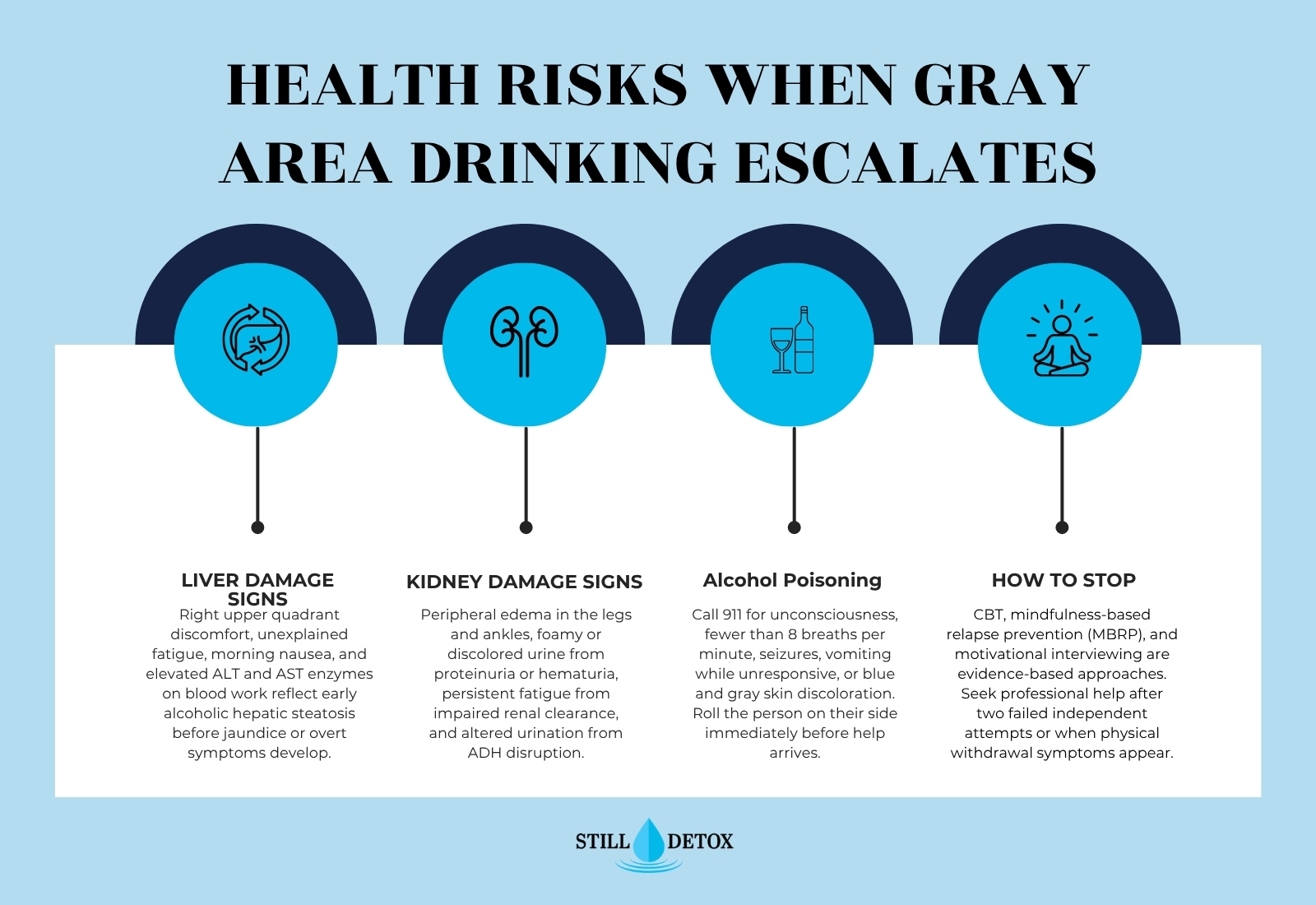
- Right upper quadrant discomfort: Dull aching or pressure under the right rib cage reflects hepatic inflammation and early hepatomegaly (liver enlargement) from alcohol-driven steatosis
- Unexplained persistent fatigue: Impaired hepatic gluconeogenesis and protein synthesis produce fatigue disproportionate to activity level, frequently attributed to stress or poor sleep rather than hepatic dysfunction
- Morning nausea and appetite loss: Early hepatic dysfunction disrupts bile production and metabolic processing, producing nausea particularly during morning hours in regular heavy drinkers
- Elevated liver enzymes without symptoms: Alanine aminotransferase (ALT) and aspartate aminotransferase (AST) elevate in blood work before symptomatic liver disease develops; gray area drinkers frequently carry mildly abnormal hepatic panels without connecting them to alcohol use
- Skin and eye changes: Jaundice (yellowing of the skin and whites of the eyes) and spider angiomas (dilated surface blood vessels on the torso and chest) appear in more advanced hepatic involvement requiring immediate clinical evaluation
First Signs of Kidney Damage from Alcohol
Alcohol directly impairs renal tubular function by disrupting antidiuretic hormone (ADH) secretion, promoting pathological diuresis, and altering acid-base balance. Chronic alcohol exposure also elevates systemic blood pressure, the primary driver of progressive chronic kidney disease (CKD) through sustained glomerular hypertension.
Early signs of alcohol-related kidney damage include:
- Peripheral edema: Swelling in the legs, ankles, and feet from impaired renal filtration capacity and fluid retention
- Foamy or discolored urine: Proteinuria produces foamy urine; hematuria produces tea-colored discoloration, both reflecting glomerular membrane damage from alcohol-mediated hypertensive injury
- Fatigue and cognitive fog disproportionate to sleep: Subclinical uremic waste accumulation from impaired renal clearance produces systemic fatigue and impaired concentration even before creatinine elevates on standard blood panels
- Altered urination patterns: ADH disruption from chronic alcohol use produces both increased frequency and reduced efficiency of urination; persistent disruption contributes to cumulative renal tubular damage over time
Signs of Alcohol Poisoning That Require Emergency Care
Alcohol poisoning occurs when blood alcohol concentration reaches levels at which brainstem control of breathing and consciousness is suppressed. Call 911 immediately if any of the following are present:
Emergency signs of alcohol poisoning requiring immediate 911 response:
- Unconsciousness or inability to be woken: unresponsive to stimulation, calling their name, or sternal rub
- Slow, shallow, or irregular breathing: fewer than 8 breaths per minute or pauses of 10 seconds or more between breaths
- Seizures: tonic-clonic movements during or immediately following heavy alcohol consumption
- Vomiting while unconscious: aspiration risk is fatal; roll the person onto their side immediately before emergency services arrive
- Pale, blue, or gray skin discoloration: cyanosis at the lips, fingernails, or fingertips indicates oxygen deprivation from respiratory depression
How to Stop Gray Area Drinking
Gray area drinking responds to intervention earlier and more completely than moderate to severe AUD because the physical dependence component is typically absent or minimal at this stage.
Evidence-Based Approaches
Evidence-based strategies for gray area drinking include:
- Cognitive behavioral therapy (CBT): CBT targets automatic associations between stress, negative affect, and alcohol use by restructuring the cognitive appraisal patterns that make drinking feel necessary. Multiple controlled trials establish CBT as the most extensively validated behavioral intervention for problem drinking across severity levels
- Mindfulness-based relapse prevention (MBRP): MBRP builds metacognitive awareness of alcohol craving without reactive behavioral response, reducing both craving intensity and automatic drinking behavior in randomized controlled trials
- Motivational interviewing (MI): MI helps individuals identify the discrepancy between their personal values and current drinking behavior without confrontation, increasing autonomous motivation for change; particularly effective in gray area drinkers who have not yet accepted the need for external support
- Structured self-monitoring: Using validated consumption tracking tools and NIAAA-standard drink counters makes invisible excess visible, frequently reducing consumption through awareness alone in early-stage gray area drinkers
For people experiencing persistent cravings when attempting to reduce or stop, evidence-based strategies to stop alcohol cravings covers medication-assisted and behavioral approaches including naltrexone, acamprosate, and CBT-based craving management in clinical detail.
When to Seek Professional Help
Professional evaluation is warranted when gray area drinking has produced any of the following:
Indicators that professional support is needed:
- Failed independent attempts to reduce or stop on more than two separate occasions
- Physical symptoms during abstinence including tremors, diaphoresis, elevated heart rate, or severe anxiety suggesting nascent physical dependence
- Alcohol interfering with professional performance, parenting, or primary relationships in a sustained pattern
- Drinking functioning primarily as a response to grief, trauma, anxiety, or depression requiring concurrent psychiatric assessment
- Any combination of the above persisting for more than 90 days without self-directed resolution
Treatment at Still Detox
Still Detox in Boca Raton, Florida provides medically supervised treatment for alcohol use disorder, gray area drinking that has escalated to clinical levels, and co-occurring mental health conditions that alcohol use masks or worsens. Same-day assessments are available.
Alcohol Addiction Treatment
The alcohol addiction treatment program at Still Detox delivers evidence-based care including CBT, motivational interviewing, and medication-assisted treatment (MAT) with naltrexone, acamprosate, or disulfiram where clinically indicated. The program serves the full AUD spectrum, from mild presentations consistent with escalated gray area drinking through severe physical dependence.
Medical Detox
Individuals whose gray area drinking has progressed to physical dependence require medically supervised withdrawal management before behavioral treatment. The inpatient medical detox program at Still Detox provides 24-hour nursing and physician oversight with pharmacological support including benzodiazepine taper protocols and management of alcohol withdrawal seizure risk.
Dual Diagnosis Treatment
Gray area drinking frequently co-occurs with generalized anxiety disorder (GAD), major depressive disorder (MDD), post-traumatic stress disorder (PTSD), and ADHD, all of which drive alcohol self-medication and complicate recovery without concurrent psychiatric care. The dual diagnosis program at Still Detox delivers integrated psychiatric and addiction treatment addressing both the alcohol use disorder and the underlying conditions sustaining it. The long-term residential treatment program supports patients requiring structured inpatient recovery beyond outpatient services.
Frequently Asked Questions
What Does It Mean to Be a Gray Area Drinker?
A gray area drinker is someone whose alcohol consumption exceeds NIAAA recommended limits and generates internal distress, guilt, or cycling behavior without meeting DSM-5-TR diagnostic criteria for alcohol use disorder. The term, coined by functional nutritionist Jolene Park in her 2017 TEDx Talk, describes the wide middle ground between casual social drinking and diagnosable alcohol dependence where millions of people privately struggle. (62 words)
What Are the First Signs of Liver Damage from Alcohol?
The first signs of alcohol-related liver damage include right upper quadrant abdominal discomfort, unexplained persistent fatigue, morning nausea, reduced appetite, and elevated ALT and AST liver enzymes on blood work appearing before overt symptoms develop. These reflect early alcoholic hepatic steatosis (fatty liver disease). Regular drinking above NIAAA heavy drinking thresholds produces measurable hepatic enzyme elevation without jaundice or other visible signs. (63 words)
What Are the Five Signs of Alcohol Poisoning?
The five critical signs of alcohol poisoning requiring immediate 911 response are: unconsciousness or inability to be woken, slow or irregular breathing fewer than 8 breaths per minute, seizures, vomiting while unconscious, and pale, blue, or cold skin from oxygen deprivation. Any single sign warrants an immediate 911 call. Place an unconscious person on their side before emergency services arrive to prevent fatal aspiration. (65 words)
What Are the First Signs of Kidney Damage from Alcohol?
Early signs of alcohol-related kidney damage include peripheral edema in the legs and ankles, foamy or tea-colored urine from protein or blood in urine, persistent fatigue from impaired metabolic waste clearance, and altered urination patterns. Chronic alcohol use also elevates blood pressure, which directly drives progressive chronic kidney disease through sustained glomerular hypertension and reduced filtration capacity over time. (59 words)
References
- National Institute on Alcohol Abuse and Alcoholism. (2023). Drinking levels defined. National Institutes of Health. https://www.niaaa.nih.gov/alcohol-health/overview-alcohol-consumption/moderate-binge-drinking
- Substance Abuse and Mental Health Services Administration. (2023). 2022 National Survey on Drug Use and Health: Results. https://www.samhsa.gov/data/release/2022-national-survey-drug-use-and-health-nsduh-releases
- Centers for Disease Control and Prevention. (2024). Alcohol and public health: Frequently asked questions. https://www.cdc.gov/alcohol/faqs.htm
- Saunders, J. B., Aasland, O. G., Babor, T. F., de la Fuente, J. R., & Grant, M. (1993). Development of the Alcohol Use Disorders Identification Test (AUDIT). Addiction, 88(6), 791–804.
- American Psychiatric Association. (2022). Diagnostic and statistical manual of mental disorders (5th ed., text rev.). DSM-5-TR. APA Publishing.


