




“Roofied” means having flunitrazepam (Rohypnol) or another sedating drug covertly placed in your drink or food without your knowledge or consent.
The term derives from Rohypnol, a high-potency benzodiazepine 10 times stronger than diazepam that produces rapid sedation, physical incapacitation, and anterograde amnesia within 15 to 30 minutes of ingestion. Rohypnol and similar substances are classified as date rape drugs because perpetrators use them specifically to incapacitate victims for drug-facilitated sexual assault (DFSA).
Understanding what being roofied means, its neurological mechanism, its symptoms, and the correct immediate response protects lives and supports both criminal prosecution and clinical recovery.
Key Takeaways
- “Roofied” describes covert flunitrazepam or other sedative administration to produce incapacitation and anterograde amnesia, most commonly to facilitate drug-facilitated sexual assault (DFSA).
- According to a study of 1,179 urine specimens from suspected DFSA victims across 49 U.S. states published by the Office of Justice Programs, 38% tested positive for alcohol and 8% tested positive for benzodiazepines, making alcohol and benzodiazepines combined the most common agents detected.
- Rohypnol’s anterograde amnesia effect begins within 15 to 30 minutes of ingestion and blocks hippocampal memory consolidation throughout the 4 to 8 hour effect period.
- Standard hospital urine drug screens do not detect Rohypnol: a specific flunitrazepam metabolite assay must be ordered by the treating provider, and the detection window closes within 72 hours of ingestion.
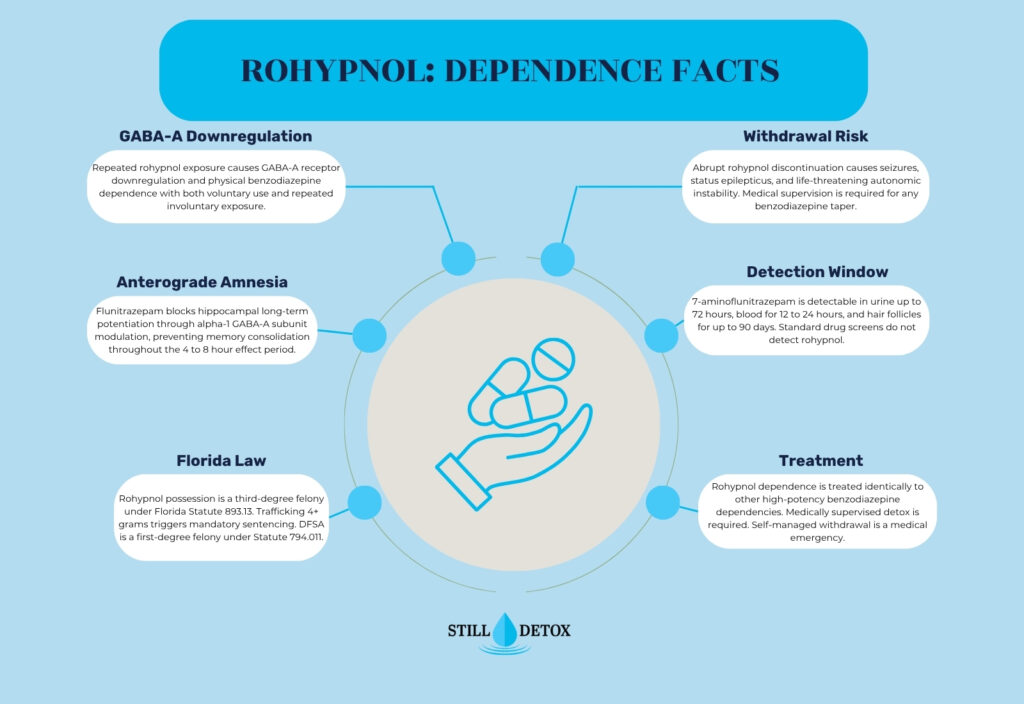
- Rohypnol is a benzodiazepine; repeated exposure produces GABA-A receptor downregulation and physical dependence requiring medically supervised detoxification to safely discontinue.
What Does “Roofied” Mean?
“Roofied” means having been secretly drugged with Rohypnol (flunitrazepam) or a similar CNS depressant administered without the victim’s knowledge or consent. The term entered common use in the 1990s after documented Rohypnol misuse in drug-facilitated sexual assault cases across the United States, with trafficking through Florida and Texas from Mexico and Colombia identified as a primary supply route. Today “roofied” is also used broadly to describe covert administration of GHB, ketamine, or any sedating agent into a person’s drink.
The clinical and legal term for this act is drug-facilitated sexual assault (DFSA). Under Florida Statute 794.011, sexual battery of a physically helpless or mentally incapacitated victim is a first-degree felony punishable by life imprisonment. Flunitrazepam-induced incapacitation constitutes mental helplessness under this statute, meaning the victim cannot legally provide consent under any circumstance while the drug is active.
What Are Roofies?
Rohypnol is the brand name for flunitrazepam, a Schedule IV benzodiazepine manufactured by Roche that is approved for short-term insomnia treatment in approximately 60 countries but is not FDA-approved and not legally manufactured in the United States. It is imported from Mexico and Colombia, where it is legally produced, and has been documented as entering the United States primarily through South Florida ports and land border crossings. The DEA has noted that flunitrazepam trafficking through Florida is particularly accessible due to proximity to Latin American supply.
The original white tablet was reformulated by Roche in 1997 following widespread DFSA misuse. The reformulated tablet contains a blue dye that turns clear beverages blue when dissolved and reveals a green speckled core when broken. Generic flunitrazepam from other manufacturers lacks this dye reformulation and dissolves into drinks without visual trace. Street names include roofie, forget-me pill, Mexican Valium, R2, Roche, rib, rope, and circles. The drug appears in 1mg and 2mg tablet strengths.
Other Drugs Used to Roofie Someone
GHB, ketamine, and alcohol are the most frequently detected agents in confirmed DFSA toxicology reports. The National Drug Intelligence Center has identified GHB as having surpassed Rohypnol as the most commonly used DFSA substance in the United States because it is cheaper, more accessible, and clears the body faster. Emerging agents including designer benzodiazepines such as bromazolam now appear in confirmed DFSA toxicology reports, producing sedation and amnesia identical to flunitrazepam but without triggering standard rohypnol-specific immunoassay tests.
| Drug | Street Names | Appearance in Drink | Onset | Duration | Distinguishing Feature |
|---|---|---|---|---|---|
| Rohypnol (flunitrazepam) | Roofie, forget-me pill, R2 | Blue tint (reformulated) or clear | 15 to 30 min | 4 to 8 hours | Anterograde amnesia, muscle relaxation |
| GHB (gamma-hydroxybutyrate) | Liquid X, G, Grievous Bodily Harm | Clear or colorless, salty taste | 15 to 30 min | 3 to 6 hours | Rapid unconsciousness, very short detection window |
| Ketamine | Special K, Vitamin K | Clear liquid or white powder | 1 to 5 min | 1 to 2 hours | Dissociation, hallucination, immobility |
| Alcohol | Multiple | Odor partially detectable | 10 to 30 min | Dose-dependent | Disinhibition, memory blackout |
How Does Rohypnol Work in the Brain?
Rohypnol (flunitrazepam) enhances GABA-A receptor function by binding the benzodiazepine recognition site on the chloride ionophore complex, allosterically increasing chloride ion conductance across the neuronal membrane. This hyperpolarization reduces neuronal excitability simultaneously across brainstem, limbic, and cortical circuits, producing sedation, anxiolysis, muscle relaxation, anterograde amnesia, and respiratory depression as concurrent pharmacological effects.
GABA-A Receptor Modulation and CNS Depression
Flunitrazepam’s binding at the alpha-1 subunit of the GABA-A receptor specifically mediates sedation and amnesia at doses lower than those required for anxiolysis. Benzodiazepine-induced respiratory depression is dose-dependent and escalates to lethal levels when flunitrazepam is combined with alcohol, GHB, or opioids through additive CNS depressant synergy. This synergy is the primary cause of rohypnol-related fatalities.
Flunitrazepam’s potency differential from commonly prescribed benzodiazepines including clonazepam and alprazolam arises from its exceptionally high alpha-1 subunit binding affinity relative to its total receptor activity profile. Diazepam, clonazepam, and alprazolam have comparatively lower alpha-1 selectivity. This explains why flunitrazepam produces more pronounced sedation and amnesia at lower absolute milligram doses than most pharmaceutical benzodiazepines prescribed clinically.
How Rohypnol Produces Anterograde Amnesia
Anterograde amnesia describes the inability to form new memories after drug exposure without affecting previously stored memory. Flunitrazepam disrupts hippocampal long-term potentiation through alpha-1 subunit-mediated GABA enhancement, preventing memory consolidation at the synaptic level. The victim consciously experiences events during the rohypnol effect period but cannot encode those experiences into retrievable long-term memory.
This dissociation between experiencing events and being able to later recall them is the feature most exploited in DFSA. The victim may appear partially interactive and not visibly incapacitated to bystanders while hippocampal encoding is fully suppressed. Normal pharmaceutical benzodiazepines produce similar anterograde amnesia but at higher absolute doses and with slower onset than the illicit dosing levels used in drink spiking.
What Does Being Roofied Feel Like? Symptoms and Timeline
Being roofied produces rapid, disorienting sedation disproportionate to any alcohol consumed, beginning within 15 to 30 minutes of ingestion and reaching full incapacitation within 30 to 60 minutes. Effects typically begin within 30 minutes and can last up to 8 hours, with blackouts potentially lasting 8 to 24 hours. The central distinguishing feature is incapacitation far beyond what the victim’s known alcohol intake explains.
Hour-by-Hour Timeline of Rohypnol Effects
The following timeline describes typical flunitrazepam effects at spiking doses combined with social alcohol consumption:
- 0 to 15 minutes: Sudden unexpected dizziness, warmth, and heavy drowsiness arriving faster and more intensely than the drinks consumed could explain. Many victims describe the sensation as a wall of fatigue with no gradual lead-up.
- 15 to 30 minutes: Pronounced sedation, pronounced muscle weakness, impaired coordination, and difficulty forming coherent sentences. Anterograde amnesia begins during this window. Victims cannot later recall what they said or did despite being physically present.
- 30 to 60 minutes: Physical incapacitation in most exposure cases. Inability to stand or resist physical movement without assistance. Respiratory rate decreases measurably. Some victims lose consciousness completely during this phase.
- 1 to 4 hours: Deepest sedation and greatest physical vulnerability. Anterograde amnesia is complete. Combining rohypnol with alcohol or other CNS depressants produces maximum respiratory depression risk during this specific window.
- 4 to 8 hours: Gradual sedation reduction with persistent disorientation, confusion, and muscle weakness. Retrograde amnesia may extend hours before drug ingestion in some cases. The victim has no continuous accessible memory of the preceding 4 to 8 hours.
- 8 to 24 hours post-ingestion: Residual sedation, severe headache, nausea, and confusion resembling disproportionate hangover. The victim may not yet recognize they were drugged rather than simply intoxicated. Urinary 7-aminoflunitrazepam metabolite concentration is declining during this phase.
How Being Roofied Differs from Alcohol Intoxication
Normal alcohol intoxication produces gradual sedation proportional to the volume and alcohol content consumed over time. Being roofied produces abrupt incapacitation that arrives faster and more severely than the volume of alcohol consumed can explain. A person who consumed one or two drinks and cannot maintain consciousness, cannot stand independently, or cannot form coherent sentences is not experiencing normal alcohol intoxication.
Key distinguishing characteristics of rohypnol exposure versus alcohol-only intoxication include abrupt onset rather than a gradual impairment build, physical incapacitation disproportionate to drinks consumed, complete memory gaps rather than the patchy reconstructable memories associated with alcohol-only blackouts, and persisting disorientation lasting 12 to 24 hours beyond what the drinks consumed should produce.
How to Tell If You Were Roofied
The most reliable indicator of rohypnol exposure is amnesia and incapacitation disproportionate to alcohol consumed, especially when combined with physical evidence of assault you have no memory of consenting to. Physical and clinical indicators persist for hours after peak drug effect, providing a window for forensic testing and medical assessment. Acting within this window preserves detection probability.
Common Signs You May Have Been Roofied
Common indicators suggesting involuntary sedative exposure include:
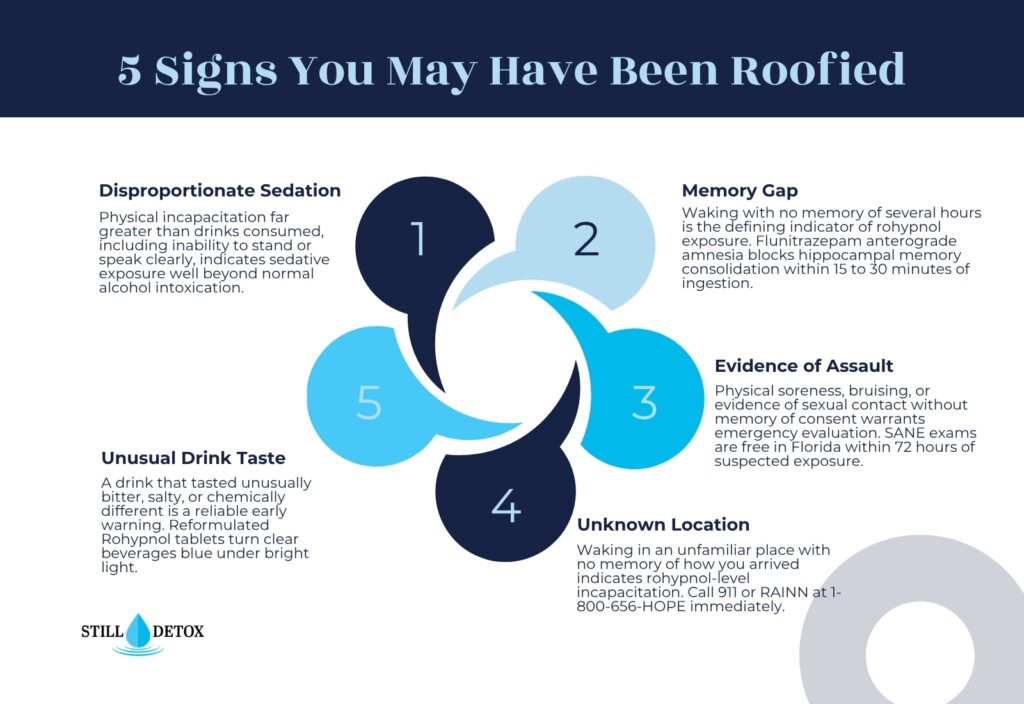
- Waking in an unfamiliar location with no memory of how you arrived there
- Memory gaps spanning multiple hours that others can describe but you cannot access
- Physical incapacitation during the event significantly greater than your known alcohol intake explains
- Evidence of sexual contact you have no memory of consenting to, including physical soreness, bruising, or disturbed clothing
- A drink that tasted unusually bitter, salty, or chemically different from the ordered beverage
The reformulated Rohypnol tablet turns clear drinks blue under lighting. Trusting an immediate perception that a drink tastes wrong and never accepting drinks from strangers or leaving a beverage unattended are the primary individual prevention measures that can prevent exposure before it occurs.
Severe Indicators Requiring Emergency Medical Care
Go to an emergency room immediately or call 911 if any of the following apply:
- You cannot account for multiple hours of time and suspect sexual contact occurred without your consent
- You experienced difficulty breathing, unconsciousness, vomiting, or seizure-like activity
- You have physical injuries inconsistent with your last clear memory of events
- Your drink appeared discolored, tasted abnormal, and you are now experiencing disproportionate sedation
- You are experiencing worsening sedation, severe confusion, or inability to stay awake
Hospital emergency departments in Palm Beach and Broward counties are required to provide Sexual Assault Nurse Examiner (SANE) access. SANE exams are free under Florida law for assault survivors and do not require you to file a police report immediately. The forensic evidence collection window is ideally within 72 hours, though collection is possible beyond this timeframe in many cases.
Long-Term Physical and Psychological Effects of Being Roofied
Being roofied produces durable psychological harm well beyond the pharmacological event itself. Post-traumatic stress disorder (PTSD) following drug-facilitated sexual assault presents with intrusive re-experiencing, hypervigilance, emotional numbing, dissociation, and avoidance behaviors that significantly impair daily functioning. Florida sexual assault survivors qualify for free PTSD treatment through the Department of Health’s Victims of Crime Act (VOCA) funding.
Long-term effects from rohypnol exposure and DFSA include:
- Post-traumatic stress disorder with intrusive flashbacks, sleep disruption, hyperarousal, and emotional dysregulation lasting months to years
- Complex trauma responses including chronic dissociation, identity disruption, and shame-based cognitive patterns
- Substance use disorder developing as victims self-medicate trauma-associated anxiety, insomnia, and PTSD hyperarousal
- Panic disorder and generalized anxiety disorder emerging 1 to 6 months post-assault from trauma-sensitized limbic circuits
- Physical benzodiazepine dependence in individuals with repeated or voluntary rohypnol exposure requiring medically supervised detoxification
What to Do If You Were Roofied
The immediate priority following suspected rohypnol exposure is reaching a safe location with a trusted person before symptoms progress to full incapacitation. The six-step protocol below covers the clinical, forensic, and legal actions that most effectively protect safety and preserve the ability to pursue legal accountability.
The six immediate response steps are:
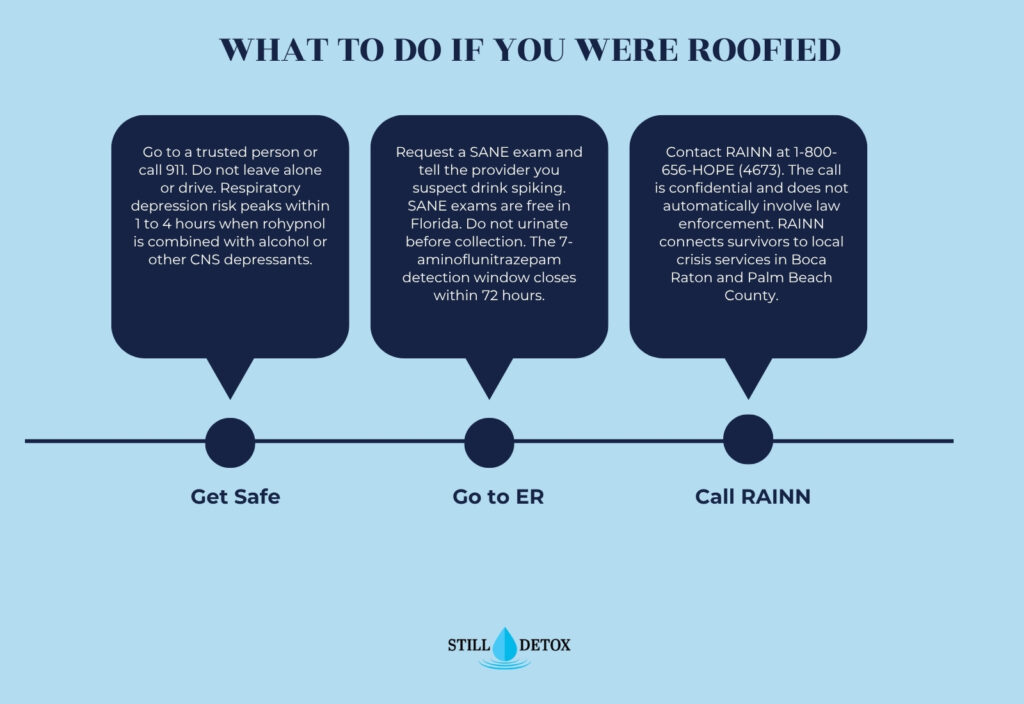
- Get to a trusted person or call 911. Inform them you believe your drink was spiked. Do not leave alone, do not drive, and do not return to the environment where exposure occurred. Respiratory depression risk is greatest when rohypnol is combined with alcohol and peaks within 1 to 4 hours.
- Go to an emergency room or crisis center. Tell the receiving provider you suspect drug-facilitated assault. Request a SANE exam. In Florida, SANE exams are provided free of charge at designated hospitals under the Sexual Violence Elimination Act and do not require immediate law enforcement involvement.
- Do not urinate before urine collection at the hospital. The 7-aminoflunitrazepam metabolite is the primary rohypnol urinary marker and its concentration declines from the moment of exposure. Early collection maximizes forensic detection probability within the 72-hour window.
- If sexual assault occurred, do not shower, change clothing, or clean the affected area before the SANE exam. Physical forensic evidence on your body, clothing, and hair provides documentation that supports both criminal prosecution and any subsequent protective order proceedings.
- Contact RAINN at 1-800-656-HOPE (4673). RAINN connects survivors to the National Sexual Assault Hotline and to local crisis services in the Boca Raton and Palm Beach area. The call is confidential and does not automatically initiate law enforcement contact unless you request it.
- Document everything you can recall as soon as you are medically stable. Written or recorded accounts created close to the event carry greater forensic weight than later reconstructions. Record what you drank, who served you, who was present, when symptoms began, and the last clear memory you retain.
How Long Does Rohypnol Stay in Your System?
Rohypnol detection windows determine whether toxicological testing can confirm exposure and support criminal prosecution. The 7-aminoflunitrazepam urinary metabolite is the primary forensic marker, with a detection window significantly longer than parent flunitrazepam itself. Critically, standard hospital urine drug screens do not include rohypnol; the treating provider must specifically order a flunitrazepam metabolite assay.
Detection Windows for Rohypnol and Other Date Rape Drugs
| Drug | Blood Detection | Urine Detection | Hair Detection |
|---|---|---|---|
| Rohypnol (flunitrazepam) | 12 to 24 hours | Up to 72 hours (7-aminoflunitrazepam) | Up to 90 days |
| GHB (gamma-hydroxybutyrate) | 4 to 8 hours | 4 to 12 hours | Not clinically reliable |
| Ketamine | 24 to 48 hours | 48 to 72 hours | Up to 14 days |
| Alcohol (via EtG marker) | 12 to 24 hours | 24 to 48 hours | Up to 90 days |
Hair follicle testing provides the longest retrospective detection window and is ordered when victims do not present for testing within the standard urine and blood windows. Hair testing for rohypnol requires a minimum of 3 centimeters of hair representing approximately 3 months of exposure history. Forensic toxicology labs specializing in DFSA analysis perform this test; it is not part of standard clinical hospital panels.
GHB has the shortest detection window of all common date rape drugs at 4 to 12 hours in urine, meaning a victim who sleeps through the night before seeking testing may have a negative GHB result despite confirmed exposure. This is one reason DFSA cases are chronically underdetected: the detection window for the most commonly used agent closes before most victims report for testing.
Rohypnol Possession and Penalties Under Florida Law
Possessing, trafficking, or using rohypnol to facilitate assault carries distinct criminal penalties under Florida and federal law. Florida has enacted specific provisions addressing DFSA beyond its general assault statutes, reflecting documented flunitrazepam trafficking through the state.
Under Florida Statute 893.13, possessing any quantity of flunitrazepam is a third-degree felony. Under Florida Statute 893.135, trafficking 4 grams or more of flunitrazepam triggers a minimum mandatory 3-year prison sentence and a $50,000 fine. Federal law under 21 U.S.C. 841 doubles the standard Schedule IV penalty for flunitrazepam distribution due to congressional findings about its systematic DFSA misuse history.
Sexual battery of a physically helpless or mentally incapacitated victim under Florida Statute 794.011 is a life felony when the victim is under 12 and a first-degree felony for all other victims. Physical helplessness produced by rohypnol administration constitutes the mental incapacitation standard under this statute. Florida law does not require proof of which specific drug was administered: incapacitation from any substance satisfies the statutory standard when established through clinical or forensic evidence.
Rohypnol Dependence and Dual Diagnosis Treatment at Still Detox
Rohypnol is a benzodiazepine. All benzodiazepines produce GABA-A receptor downregulation and physical dependence with repeated use, and rohypnol’s high alpha-1 binding affinity makes it among the more physically dependence-producing agents in its class. No discussion of rohypnol in the clinical literature adequately addresses this pharmacological reality. Both individuals who use rohypnol voluntarily and those with repeated involuntary exposure face benzodiazepine physical dependence requiring medical management.
Abrupt benzodiazepine discontinuation causes seizures, status epilepticus, autonomic instability, and death. Medically supervised taper protocols are required to safely reduce benzodiazepine dose over weeks to months depending on dose, duration of exposure, and co-occurring medical conditions. Self-managed rohypnol or benzodiazepine withdrawal is a medical emergency regardless of whether dependence developed through voluntary or involuntary use.
Illicit benzodiazepine supply chains serving South Florida routinely include counterfeit pharmaceutical benzodiazepines from Mexican manufacturers that may contain fentanyl contamination or variable active drug content. Individuals dependent on illicit benzodiazepines from these supply chains require comprehensive medical toxicology assessment before any taper or discontinuation attempt begins.
Trauma-associated substance use disorder frequently co-occurs with DFSA survivorship. Adults in South Florida managing benzodiazepine dependence, rohypnol withdrawal, substance use disorder secondary to trauma, or co-occurring PTSD and substance use can access medically supervised detoxification and residential dual diagnosis programming at Still Detox’s residential treatment program in the Boca Raton area. Same-day clinical assessments are available.
Frequently Asked Questions
What does “roofied” mean exactly?
“Roofied” means having Rohypnol (flunitrazepam) or another sedating drug secretly added to your food or drink without your consent. The drug produces rapid sedation, physical incapacitation, and anterograde amnesia that prevents memory formation during the assault. The term also applies to covert administration of GHB, ketamine, or other CNS depressants used for the same purpose. The clinical and legal term is drug-facilitated sexual assault (DFSA).
How do you know if you were roofied?
Key signs include waking with no memory of several hours, incapacitation far greater than drinks consumed explain, evidence of sexual contact you did not consent to, and a drink that tasted unusually bitter or salty. If any of these apply, go to an emergency room immediately, tell the provider you suspect drink spiking, and request a flunitrazepam metabolite urine test within 72 hours of suspected exposure.
What does being roofied feel like?
Being roofied typically produces sudden overwhelming sedation arriving faster and more intensely than alcohol explains. Within 15 to 30 minutes victims experience profound drowsiness, muscle weakness, difficulty speaking, and disorientation. Anterograde amnesia begins during this window. Many victims report a brief moment of recognizing something is wrong before losing the ability to respond, followed by a complete gap in memory they cannot later account for.
How long does rohypnol stay in your system?
The primary urinary rohypnol metabolite (7-aminoflunitrazepam) is detectable for up to 72 hours after ingestion. Blood detection closes within 12 to 24 hours. Hair follicle testing extends detection to 90 days but requires specialized forensic lab analysis. Standard hospital drug screens do not detect rohypnol; a specific flunitrazepam metabolite test must be explicitly ordered. Testing within 24 hours of suspected exposure provides the highest detection probability.
Is being roofied illegal in Florida?
Administering any substance to a person without their knowledge to facilitate sexual assault is a felony under Florida Statute 794.011. Possessing flunitrazepam is a third-degree felony under Florida Statute 893.13. Trafficking 4 grams or more carries minimum mandatory sentencing under Florida Statute 893.135. Federal law doubles the standard Schedule IV penalty specifically for flunitrazepam distribution based on congressional recognition of its systematic use in drug-facilitated sexual assault.
Can rohypnol cause addiction?
Yes. Rohypnol is a high-potency benzodiazepine and produces physical dependence through GABA-A receptor downregulation with repeated use. Both voluntary and repeated involuntary exposure can produce benzodiazepine dependence. Abrupt discontinuation causes seizures, status epilepticus, and potentially fatal autonomic instability. Medical supervision is required for any rohypnol taper, just as with any other high-potency benzodiazepine. Benzodiazepine dependence from rohypnol is clinically managed identically to other high-potency benzo dependencies.
References
- Drug Enforcement Administration. (2020). Rohypnol drug fact sheet. https://www.dea.gov/sites/default/files/2020-06/Rohypnol-2020.pdf
- National Institute on Drug Abuse. (2021). Drug-facilitated sexual assault DrugFacts. https://nida.nih.gov/publications/drugfacts/drug-facilitated-sexual-assault
- Negrusz, A., & Gaensslen, R. E. (2003). Analytical developments in toxicological investigation of drug-facilitated sexual assault. Analytical and Bioanalytical Chemistry, 376(8), 1192–1197.
- Slaughter, L. (2000). Involvement of drugs in sexual assault. Journal of Reproductive Medicine, 45(5), 425–430.
- American Psychiatric Association. (2022). Diagnostic and statistical manual of mental disorders (5th ed., text rev.). American Psychiatric Publishing.
- Florida Legislature. (2023). Florida Statute 794.011: Sexual battery. The Florida Senate.
- Florida Legislature. (2023). Florida Statute 893.135: Trafficking; mandatory sentences. The Florida Senate.
- LeBeau, M. A., & Mozayani, A. (Eds.). (2001). Drug-facilitated sexual assault: A forensic handbook. Academic Press.


