

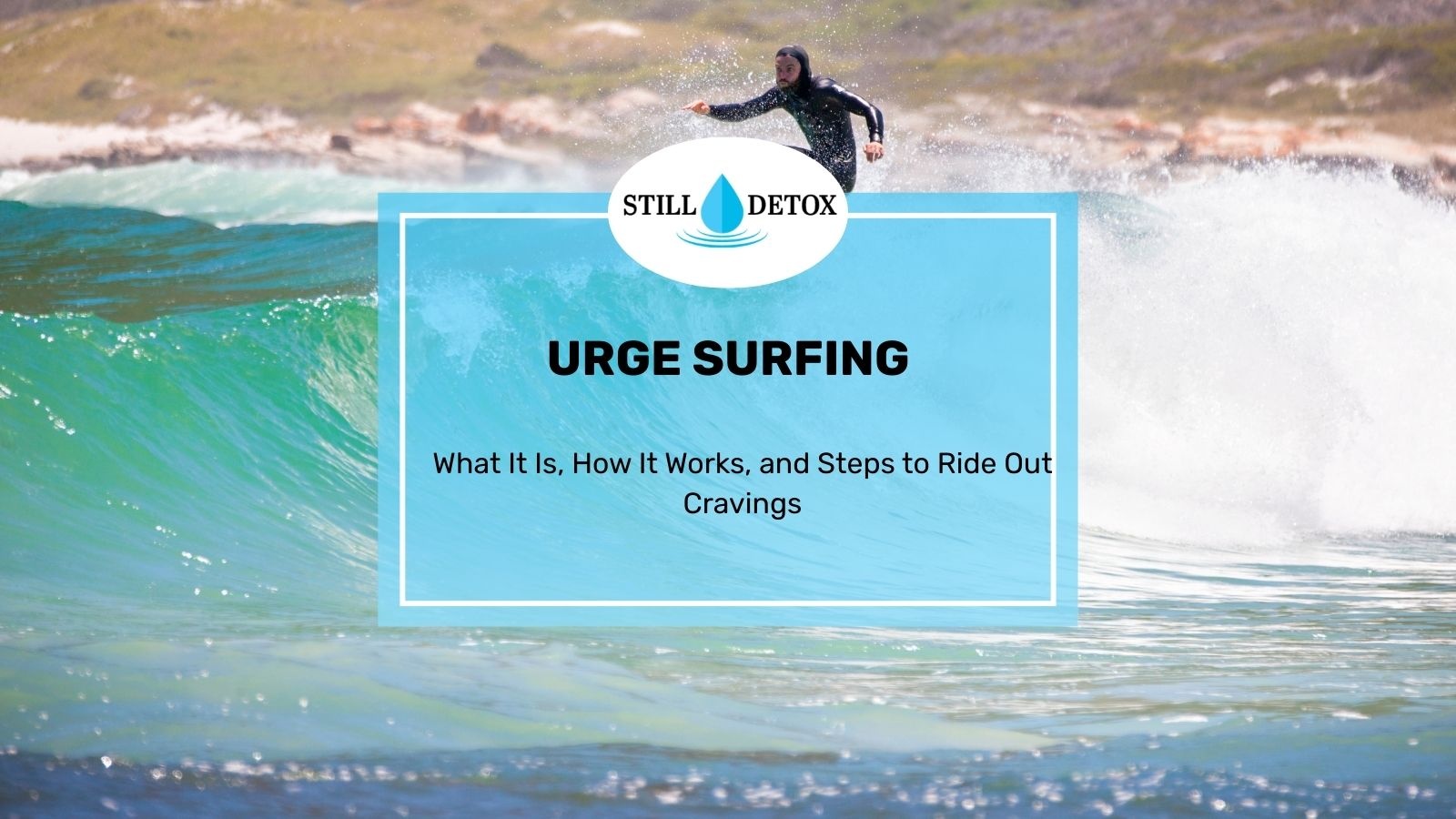
Urge surfing is a mindfulness-based technique that teaches you to observe a craving without acting on it.
Rather than fighting an urge or escaping the discomfort, you stay present, breathe through it, and allow the intensity to peak and fall on its own.
Developed by Dr. Alan Marlatt at the University of Washington, urge surfing is now embedded in Mindfulness-Based Relapse Prevention, Dialectical Behavior Therapy, and Acceptance and Commitment Therapy programs used in clinical settings worldwide.
The technique rests on a clinically documented fact: cravings are time-limited. They build, crest, and subside whether or not you act on them.
Key Takeaways
- Urge surfing is a clinically validated mindfulness skill embedded in Mindfulness-Based Relapse Prevention (MBRP), Dialectical Behavior Therapy (DBT), and Acceptance and Commitment Therapy (ACT) for substance use disorder and behavioral compulsions.
- According to Bowen and Marlatt (2009), smokers who practiced urge surfing reduced cigarette use by 26%, more than double the reduction seen in a matched control group.
- Research on craving neurobiology shows that most urges peak and subside within 15 to 30 minutes when not acted on, and the intensity weakens measurably with each successive ride.
- The technique builds prefrontal cortex inhibitory control, directly disrupting the conditioned stimulus-response pathway that drives compulsive behavioral responses.
- Urge surfing is effective for alcohol use disorder (AUD), opioid and benzodiazepine cravings, binge eating, and any compulsive pattern maintained by conditioned trigger-response cycles.
What Is Urge Surfing?
Urge surfing is a structured mindfulness skill that trains you to experience a craving as a temporary, observable sensation rather than a directive requiring action. Dr. Alan Marlatt, a clinical psychologist at the University of Washington’s Addictive Behaviors Research Center, coined the term and formalized it as a cornerstone component of Mindfulness-Based Relapse Prevention (MBRP).
The core premise mirrors how ocean waves behave. Cravings rise, reach a peak, and recede on their own. Urge surfing trains you to observe that arc with deliberate, non-judgmental attention rather than interrupting it through avoidance, suppression, or compliance.
The technique applies across substance use disorders and behavioral compulsions. It is effective for alcohol use disorder (AUD), opioid and benzodiazepine cravings, binge eating disorder, and gambling disorder. It requires no clinical setting, no equipment, and no preparation beyond directing attention inward at the moment a craving begins.
How Urge Surfing Works: The Brain Science of Cravings
Urge surfing disrupts a neurological habit loop that runs through the brain’s mesolimbic dopamine pathway. When a conditioned stimulus, such as a location, smell, emotional state, or social context associated with past substance use, activates this pathway, dopamine activity surges and generates the subjective experience of craving.
That signal feels urgent and directive. Neurobiologically, it is a conditioned learned response, not a physiological emergency requiring action.
The Role of the Prefrontal Cortex in Craving Inhibition
The prefrontal cortex governs inhibitory control, the cognitive capacity to evaluate and delay a behavioral response to impulse-driven signals from the mesolimbic system. Prolonged substance use suppresses prefrontal cortex activity, reducing the brain’s ability to override dopamine-driven craving signals in real time.
Urge surfing rebuilds prefrontal cortex inhibitory control by repeatedly training the deliberate pause between stimulus and behavioral response. Each time a person observes a craving without acting, they reinforce the prefrontal inhibitory circuit and progressively weaken the automatic conditioned link between the trigger and the action. Neuroplasticity research confirms that this kind of consistent practice restructures functional connectivity in the prefrontal-limbic network across weeks of training.
How Interoceptive Awareness Reduces Craving Intensity
Urge surfing develops interoceptive awareness, the capacity to notice and precisely label internal physical sensations, to reduce the subjective power of a craving. Directing attention to the exact bodily location of the urge, whether tightness in the chest, restlessness in the hands, dry mouth, or jaw tension, converts a diffuse sense of urgency into a set of discrete, observable physical events.
Research in affective neuroscience shows that labeling a bodily sensation with specific language reduces its emotional intensity by activating prefrontal regulatory processes. When a craving is identified as a collection of named physical sensations rather than an undifferentiated emergency, the mesolimbic urgency signal loses its command over behavioral output.
How Long Do Urges Last? What the Evidence Shows
Urge duration is one of the most clinically important and consistently misunderstood facts in craving management. Most people in early recovery believe a craving will escalate without limit until they give in. The research contradicts this directly.
The 15-to-30-Minute Craving Window
Research on craving neurobiology consistently shows that untreated urges, those observed without being acted on, peak and begin to subside within 15 to 30 minutes. The Mindfulness-Based Relapse Prevention protocol developed at the University of Washington uses this documented time ceiling as the structural foundation of urge surfing practice: if a person can remain present through the peak, the craving will fall without requiring any action.
According to the National Institute on Drug Abuse, understanding the temporary and predictable nature of cravings is a core component of evidence-based relapse prevention education. The craving is not a permanent state. It is a wave with a ceiling, and that ceiling is measurable.
How Urge Surfing Changes Craving Strength Over Time
Each urge that is observed without action produces measurable weakening of the craving response through conditioned stimulus-response inhibition. The mesolimbic dopamine activation associated with a trigger gradually diminishes as the brain learns the conditioned stimulus no longer reliably produces the expected reward. This is the same neurobiological mechanism underlying exposure-based therapies across clinical psychology.
With consistent practice, craving cycles become shorter in duration, lower in peak intensity, and easier to observe without reacting. This is not willpower. It is neuroplasticity applied to the reward circuit.
People navigating Xanax and benzodiazepine dependence or alcohol withdrawal may experience heightened craving intensity in early recovery due to post-acute withdrawal syndrome (PAWS), which extends neuroadaptive dysregulation beyond the acute detox window. The 15-to-30-minute ceiling still applies, but professional clinical support during this period is indicated.
How to Do Urge Surfing: Step-by-Step
Urge surfing requires no therapist, no app, and no preparation. The technique is available the moment a craving begins, in any environment.
Step 1: Pause and Name the Urge
The moment a craving appears, stop and acknowledge it without judgment. Say to yourself quietly: “I notice an urge.” Do not label it as dangerous, shameful, or unmanageable. Do not act on it and do not fight it. Naming the urge without evaluation activates prefrontal language processing, which immediately begins to reduce mesolimbic urgency signal intensity.
Step 2: Locate the Sensation in Your Body
Shift your attention inward and identify precisely where the craving registers physically. You might notice tension across your chest, restlessness in your hands, a dry sensation in your throat, or tightness in your jaw. Interoceptive specificity, naming not just “discomfort” but the exact location and quality, is what produces the clinical effect at this step.
Step 3: Observe the Wave as It Builds
Breathe slowly and watch the craving build without engaging with its content. Remind yourself it has a documented ceiling. You are not fighting the wave. You are observing it from the shoreline, tracking its rise the way you would watch a swell approach before it breaks. This observer stance disrupts the automatic trigger-response coupling at the center of conditioned substance use behavior.
Step 4: Stay Present Without Reacting
Keep breathing and remain with the sensation as it peaks. Suppression and resistance amplify craving intensity through rebound activation. Observation weakens it. This step is the functional core of surf the urge practice: tolerating peak discomfort fully, without escape and without compliance, until the intensity begins to fall.
Step 5: Ride It Out Until the Intensity Falls
Continue breathing and observing as the craving subsides. When the intensity decreases, register what occurred. You encountered a conditioned craving signal at full peak intensity and did not act on it. That is a trainable neurological skill, and each repetition reinforces prefrontal inhibitory control over the mesolimbic pathway while reducing the strength of the next craving cycle.
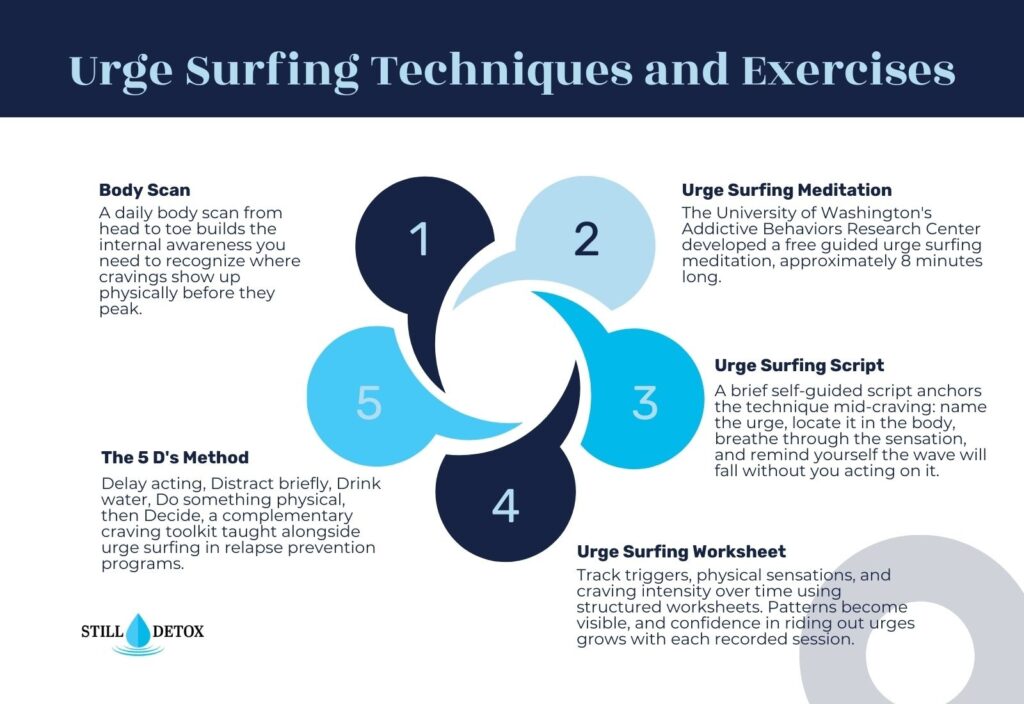
Urge Surfing Techniques and Exercises
Urge surfing becomes more accessible during high-intensity cravings when it has been practiced at low intensity first. The following exercises are used in MBRP and DBT programs to build the foundational skills:
- Body scan practice: A daily body scan from head to toe, performed for 5 to 10 minutes each morning, builds the interoceptive awareness needed to locate cravings quickly when they arrive. The University of Washington’s MBRP protocol recommends daily body scan practice as preparation for urge surfing training.
- Urge surfing script: A short self-directed script reinforces the technique during an active craving: “I notice an urge. It is here and it will pass. I feel [sensation] in [body location]. I am breathing. I do not have to act.” Repeating this quietly keeps the prefrontal language system engaged during mesolimbic craving activation and overrides reactive impulse.
- Urge surfing worksheet: Structured worksheets prompt you to record the trigger, the physical sensations noticed, peak intensity on a numeric scale, and the outcome. Tracking this data reveals trigger patterns over time and builds evidence-based confidence in the technique. Therapist Aid offers a widely used worksheet applied in clinical relapse prevention and Klonopin and benzodiazepine recovery settings.
- The 5 D’s: A complementary craving-management framework, the 5 D’s are Delay acting, Distract with a brief neutral task, Drink water or a non-alcoholic beverage, Do something physically different, and Decide to reassess once the peak passes. This framework pairs directly with urge surfing in DBT distress tolerance programming and MBRP relapse prevention curricula.
When Urge Surfing Is Not Enough
Urge surfing is a clinically validated coping skill, but it does not substitute for medical care when physical dependence is present.
People stopping alcohol or benzodiazepine use after prolonged heavy use may encounter physiological withdrawal symptoms that mindfulness-based techniques alone cannot address. Seizure risk, cardiovascular instability, and severe neurological rebound require medical evaluation, not behavioral coping strategies. Understanding the clinical progression of gabapentin and benzodiazepine withdrawal helps clarify when professionally supervised detox is the appropriate first step, not a complement to urge surfing but a prerequisite for it.
Urge surfing is most effective as one component of a structured treatment plan that provides neurobiological stabilization first. Medically supervised addiction treatment integrates evidence-based coping skills with the clinical foundation that makes them actionable. For individuals whose cravings are severe, constant, or accompanied by physical symptoms, that clinical foundation is where recovery begins.
Frequently Asked Questions
How long does an urge last?
Most urges peak and begin to subside within 15 to 30 minutes when not acted on. This ceiling is documented in the Mindfulness-Based Relapse Prevention literature developed at the University of Washington. Craving intensity decreases with each successive urge that is observed without action, as conditioned stimulus-response inhibition progressively weakens the mesolimbic dopamine signal.
What are the 5 D’s of urge surfing?
The 5 D’s are a complementary craving management framework: Delay acting, Distract with a brief neutral task, Drink water or a non-alcoholic beverage, Do something physically different, and Decide to reassess once the peak passes. They are commonly taught alongside urge surfing in Mindfulness-Based Relapse Prevention and DBT distress tolerance programs as a broader behavioral toolkit.
Is urge surfing a CBT or DBT skill?
Urge surfing is most closely associated with Mindfulness-Based Relapse Prevention and Dialectical Behavior Therapy, where it is classified as a distress tolerance skill. It also appears in CBT frameworks as a response-delay technique and is foundational to Acceptance and Commitment Therapy. The overlap reflects its cross-framework applicability to conditioned urge signals across behavioral health contexts.
How do you sit with urges without acting on them?
Locate the urge physically in your body and label the sensation with specific language. Breathe steadily and remind yourself that most cravings peak within 30 minutes. Suppression and resistance amplify intensity through rebound activation. Deliberate observation without reacting is what progressively weakens the conditioned mesolimbic pathway that generates the craving.
Does urge surfing work for alcohol cravings?
Yes. Bowen and Marlatt (2009) demonstrated significant craving reduction through urge surfing in a published randomized study. The technique directly targets the conditioned stimulus-response pathway underlying alcohol use disorder (AUD), the same pathway responsible for cue-triggered cravings in opioid, benzodiazepine, and stimulant use disorders. It is most effective as part of a comprehensive treatment plan.
What is the difference between an urge and a craving?
Urge and craving are used interchangeably in clinical literature, though some practitioners distinguish them by intensity. In the urge surfing framework developed by Marlatt, both refer to the conditioned internal experience that arises in response to a trigger associated with past substance use. The technique applies to both regardless of how the internal experience is labeled.
References
- Bowen, S., and Marlatt, A. (2009). Surfing the urge: Brief mindfulness-based intervention for college student smokers. Psychology of Addictive Behaviors, 23(4), 666-671.
- Marlatt, G. A., and Gordon, J. R. (1985). Relapse Prevention: Maintenance Strategies in the Treatment of Addictive Behaviors. Guilford Press.
- Witkiewitz, K., and Marlatt, G. A. (2004). Relapse prevention for alcohol and drug problems: That was Zen, this is Tao. American Psychologist, 59(4), 224-235.
- Bowen, S., Chawla, N., and Marlatt, G. A. (2011). Mindfulness-Based Relapse Prevention for Addictive Behaviors: A Clinician’s Guide. Guilford Press.
- National Institute on Drug Abuse. (2020). Drugs, brains, and behavior: The science of addiction. U.S. Department of Health and Human Services. https://nida.nih.gov/publications/drugs-brains-behavior-science-addiction
- National Institute on Alcohol Abuse and Alcoholism. (2023). Understanding alcohol use disorder. U.S. Department of Health and Human Services. https://www.niaaa.nih.gov/publications/brochures-and-fact-sheets/understanding-alcohol-use-disorder
- Mayo Clinic. (2022). Drug addiction (substance use disorder): Symptoms and causes. Mayo Foundation for Medical Education and Research.