



The M366 white oval pill is a generic hydrocodone bitartrate 7.5 mg and acetaminophen 325 mg tablet manufactured by Mallinckrodt Pharmaceuticals and classified as a DEA Schedule II controlled substance. Prescribed for moderate to moderately severe pain, it is the direct generic equivalent of the discontinued brand Norco.
The M366 imprint is an FDA-required identification code exclusive to Mallinckrodt’s 7.5 mg/325 mg hydrocodone-acetaminophen formulation. This pill is not Percocet, which contains oxycodone rather than hydrocodone. If you have found an unidentified white oval tablet marked M366, this guide covers its full identification, strength, effects, detection windows, counterfeit risks, and overdose warning signs.
Key Takeaways
- The M366 white oval pill contains hydrocodone bitartrate 7.5 mg and acetaminophen 325 mg, manufactured by Mallinckrodt Pharmaceuticals and classified as a DEA Schedule II controlled substance.
- According to the 2023 National Survey on Drug Use and Health, 3.6 million Americans misused hydrocodone that year, making it one of the most commonly misused prescription opioids in the United States.
- M366 is the generic equivalent of Norco; it is not Percocet (different opioid) and not interchangeable with Vicodin (different acetaminophen content).
- The DEA reported over 2 million counterfeit opioid pills seized in 2024; fake M366 tablets laced with illicitly manufactured fentanyl are in active circulation.
- DSM-5 opioid use disorder can develop from prescription hydrocodone use; medically supervised detoxification is required for safe discontinuation.
What Is the M366 White Oval Pill?
The M366 white oval pill is an FDA-regulated prescription tablet containing hydrocodone bitartrate 7.5 mg and acetaminophen 325 mg, stamped with the code “M366” on one side as required under federal drug identification law.
M366 Physical Description: White Oval Pill Identifier
Authentic M366 tablets have the following confirmed physical characteristics verified through the FDA drug database:
The M366 pill’s physical identifiers are:
- Shape and color: White, biconvex oval, approximately 15 mm in length with a uniform film coat
- Imprint: “M366” on one face; reverse side is plain or carries a single bisect score line
- Texture: Smooth surface with no pitting, chalky discoloration, irregular edges, or visible press seams
- Reverse markings: No numbers, letters, or additional codes appear on the plain side
The “M366” imprint is exclusive to Mallinckrodt Pharmaceuticals’ 7.5 mg/325 mg formulation and constitutes the most reliable authenticity marker when the pill is dispensed by a licensed US pharmacy.
Who Makes M366? Mallinckrodt and the “M” Imprint Series
Mallinckrodt Pharmaceuticals manufactures M366 as part of its sequential three-digit hydrocodone-acetaminophen imprint series. The letter “M” identifies the manufacturer; the three-digit code encodes the specific hydrocodone dose within that product line.
The DEA classifies all hydrocodone-containing combination products as Schedule II controlled substances. This classification requires a written, non-refillable prescription from a licensed US prescriber and prohibits telephone refills.
M336, M266, MB66, and Other Look-Alike Confusions
Several imprint codes are commonly misread as M366 in online searches and at the point of pill identification:
Common M366 look-alike imprint confusions include:
- M336: Not an active hydrocodone-acetaminophen product in the FDA drug database; a different Mallinckrodt formulation unrelated to opioids
- M266: A non-opioid Mallinckrodt tablet; M266 does not contain hydrocodone or acetaminophen in the standard M-series configuration
- MB66: The “MB” prefix indicates a different manufacturer entirely; MB66 is not a Mallinckrodt hydrocodone product
- M 366 / M3 66: Typographic spacing variants of the same M366 imprint; both refer to the identical Mallinckrodt 7.5/325 tablet
Any white oval tablet described as M366 that does not match the physical description above should be treated as potentially counterfeit until confirmed by a licensed pharmacist.
How the M366 Pill Works in the Body
M366 produces analgesia through two simultaneous pharmacological mechanisms: mu-opioid receptor agonism from hydrocodone and central prostaglandin synthesis inhibition from acetaminophen.
Hydrocodone bitartrate binds to mu-opioid receptors in the brain’s limbic system, brainstem, and spinal cord, suppressing ascending pain signal transmission and producing sedation. CYP2D6 liver enzymes metabolize hydrocodone into hydromorphone, an active metabolite with significantly stronger opioid activity that amplifies both analgesic effect and abuse potential.
Acetaminophen inhibits prostaglandin E2 synthesis in the central nervous system, lowering the pain sensitivity threshold through a pathway independent of opioid receptors. This dual mechanism produces greater analgesic efficacy than either compound alone at comparable doses, which is the pharmacological rationale for the fixed-combination formulation.
M366 Dosage, Strength, and How Long It Lasts
M366 occupies the mid-tier position within Mallinckrodt’s hydrocodone range, delivering 7.5 mg of hydrocodone per tablet with a standard acetaminophen load of 325 mg per dose.
M366 Mg: Hydrocodone 7.5 mg / Acetaminophen 325 mg
Each M366 tablet delivers a fixed-dose combination with the following prescribing parameters:
The M366 dosage specifications are:
- Hydrocodone bitartrate: 7.5 mg per tablet (opioid analgesic, Schedule II)
- Acetaminophen (APAP): 325 mg per tablet (non-opioid analgesic/antipyretic)
- Standard adult dosing: One tablet every 4 to 6 hours as clinically needed for pain
- Maximum daily acetaminophen threshold: 4,000 mg per day in healthy adults; 2,000 mg or less per day in patients with hepatic impairment or regular alcohol use
The APAP hepatotoxicity threshold is the daily acetaminophen accumulation point at which liver cell damage begins. Patients taking other acetaminophen-containing products alongside M366 must track total daily APAP load across all sources to avoid crossing this threshold.
How Long Does M366 Last? Effects Timeline and Detection Windows
M366 effects onset within 30 to 60 minutes of oral ingestion, with peak plasma concentration at approximately 1 to 1.5 hours. Analgesic effects last 4 to 6 hours per dose in most patients.
| Drug Test | Detection Window | Notes |
|---|---|---|
| Urine | 2 to 4 days | Up to 7 days with chronic heavy use; most common screening method |
| Blood | Up to 24 hours | Confirms recent acute exposure; not standard in routine panels |
| Saliva | 12 to 36 hours | GC-MS confirmation required for reliable results |
| Hair follicle | Up to 90 days | Reflects cumulative use history, not single-dose exposure |
Detection windows extend with chronic use, higher per-dose amounts, and slower CYP2D6 hepatic metabolism.
Is M366 Norco, Vicodin, or Percocet?
M366 is the generic equivalent of Norco. It is not Percocet, which contains a different opioid, and it is not interchangeable with Vicodin, which carries a different acetaminophen dose.
Is M366 a Norco? Is M366 Vicodin?
Norco was a branded hydrocodone 7.5 mg / acetaminophen 325 mg tablet. M366 contains the identical active ingredients at identical strengths and is the direct generic continuation of Norco following the brand’s discontinuation.
Vicodin was a separate brand of hydrocodone-acetaminophen at different specifications: standard Vicodin contained hydrocodone 5 mg paired with acetaminophen 300 mg. Vicodin ES contained hydrocodone 7.5 mg with acetaminophen 300 mg, which is the closest comparison to M366 in opioid strength but differs in acetaminophen content by 25 mg per dose. Both brands were discontinued; M366 is not a pharmacological substitute for either without prescriber confirmation.
Is M366 a Percocet?
No. Percocet contains oxycodone and acetaminophen. M366 contains hydrocodone and acetaminophen. Oxycodone and hydrocodone are distinct opioid compounds with different receptor binding profiles, metabolic enzymes, and clinical potency equivalences.
People searching “m366 percocet” are typically attempting to identify a found pill. If the tablet carries the M366 imprint, it is definitively hydrocodone-acetaminophen, not oxycodone. Treating M366 as a Percocet equivalent creates serious dosing miscalculation risk.
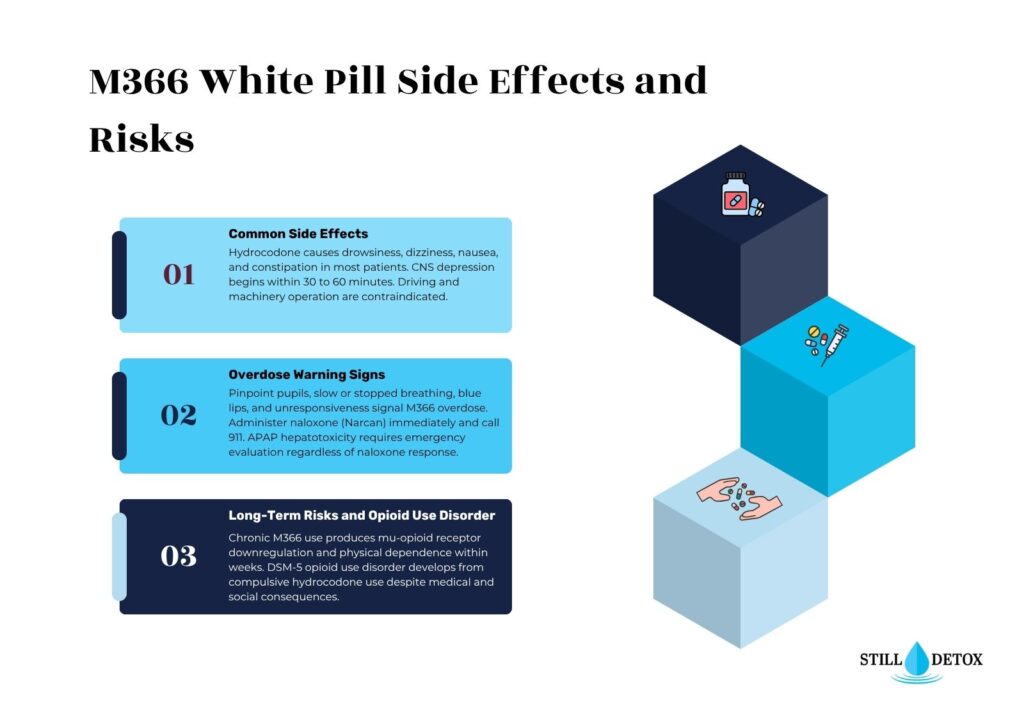
M365 vs M366 vs M367: Strength Comparison
Mallinckrodt manufactures three adjacent hydrocodone-acetaminophen strengths under the M-imprint series. All three contain 325 mg of acetaminophen; the opioid dose is the distinguishing variable:
| Imprint | Hydrocodone | Acetaminophen | Shape | Relative Strength |
|---|---|---|---|---|
| M365 | 5 mg | 325 mg | White capsule-shaped | Lowest in series |
| M366 | 7.5 mg | 325 mg | White oval | Mid-tier |
| M367 | 10 mg | 325 mg | White capsule-shaped | Highest in series |
M366 delivers 50% more hydrocodone than M365 and 25% less than M367. All three carry DEA Schedule II classification and identical APAP hepatotoxicity risk from cumulative acetaminophen accumulation.
Counterfeit M366 Pills and Fentanyl Risk
Counterfeit tablets pressed to resemble authentic M366 pills are in active circulation and cannot be visually distinguished from genuine Mallinckrodt tablets with the naked eye. The DEA confirmed over 2 million fake prescription opioid pills seized in 2024, with a substantial proportion pressed to mimic commonly recognized M-series hydrocodone tablets.
Counterfeit M366 pills contain illicitly manufactured fentanyl pressed into a white oval tablet matching authentic M366 dimensions. Fentanyl is approximately 100 times more potent than morphine; a dose miscalculation of a fraction of a milligram produces fatal respiratory depression. Comprehensive guidance on identifying counterfeit pills containing fentanyl is available on the Still Detox resource library.
Physical warning signs of a counterfeit M366 pill include:
Counterfeit M366 red flags are:
- Irregular, uneven, or chipped edges inconsistent with Mallinckrodt’s uniform film coat
- Chalky, crumbling, or powdery texture visible at break points or pill surface
- Imprint that is faint, shallow, inconsistently deep, or visibly off-center on the tablet face
- Any pill obtained outside a licensed US pharmacy with a valid written prescription
Fentanyl test strips detect fentanyl contamination in dissolved pill material in under two minutes and are available without a prescription in most US states.
M366 White Pill Side Effects and Risks
M366 produces adverse effects through both its opioid and non-opioid components, with hydrocodone driving central nervous system and respiratory effects and acetaminophen generating hepatic risk at elevated cumulative daily doses.
Common Side Effects
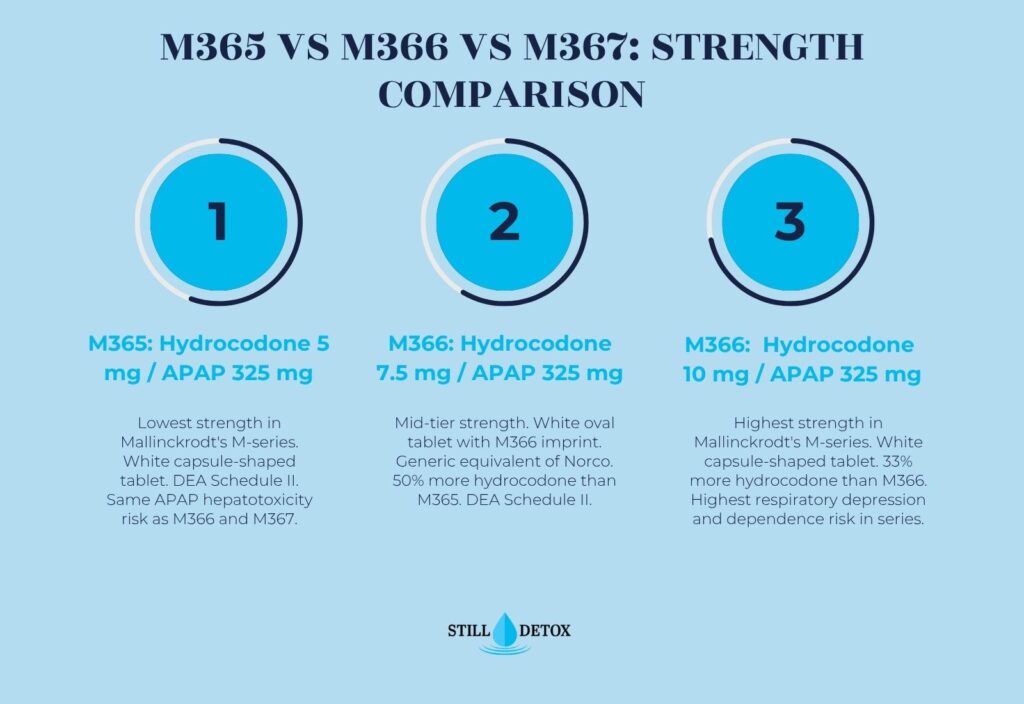
Hydrocodone-acetaminophen combination tablets produce predictable CNS depressant effects in the majority of patients at therapeutic doses:
Common M366 side effects include:
- CNS effects: Drowsiness, dizziness, lightheadedness, and cognitive slowing appearing within 30 to 60 minutes of ingestion; driving and machinery operation are contraindicated
- Gastrointestinal effects: Constipation affecting up to 40% of opioid users with continued use, alongside nausea, vomiting, and reduced gastric motility
- Respiratory effects: Mild respiratory rate reduction at standard therapeutic doses; respiratory rate depression that becomes clinically dangerous with dose escalation, combination with CNS depressants, or use in opioid-naive patients
Overdose Warning Signs
M366 overdose results from hydrocodone-mediated respiratory depression, acetaminophen-mediated hepatotoxicity at excessive cumulative doses, or both simultaneously. Administer naloxone (Narcan) immediately and call 911 if any of the following signs are present:
M366 overdose warning signs requiring immediate emergency response:
- Pinpoint pupils (miosis) that do not dilate in response to reduced light
- Slow, shallow, or stopped breathing — fewer than 12 breaths per minute or extended pauses between breaths
- Blue or gray discoloration of lips, fingernails, or fingertips (cyanosis from oxygen deprivation)
- Unresponsiveness or inability to be woken despite vigorous attempts
- Gurgling or choking breathing sounds indicating airway compromise
Naloxone reverses hydrocodone-mediated respiratory depression within 2 to 5 minutes when administered via nasal spray or injection. Naloxone’s effect lasts 30 to 90 minutes and may require re-dosing before emergency services arrive. Naloxone does not reverse APAP hepatotoxicity — emergency evaluation is mandatory regardless of apparent naloxone response.
Long-Term Risks and Opioid Use Disorder
Chronic M366 use produces mu-opioid receptor downregulation and physical dependence within weeks of consistent daily dosing. DSM-5 opioid use disorder (OUD) is defined as a pattern of hydrocodone use producing clinically significant impairment, including compulsive drug-seeking behavior, failed cessation attempts, and continued use despite adverse medical and social consequences.
Abrupt M366 discontinuation after physical dependence triggers opioid withdrawal symptoms including diaphoresis, anxiety, myalgia, gastrointestinal cramping, and insomnia beginning within 6 to 12 hours of the last dose and peaking at 48 to 72 hours. Medically supervised discontinuation eliminates the risks of abrupt cessation and dramatically improves sustained abstinence outcomes.
Treatment at Still Detox
Still Detox in Boca Raton, Florida provides medically supervised treatment for opioid use disorder, hydrocodone dependence, and co-occurring mental health conditions linked to prescription opioid misuse. Same-day assessments are available.
1- Hydrocodone Addiction Treatment
The opioid dependence treatment program at Still Detox delivers evidence-based care using cognitive behavioral therapy (CBT), medication-assisted treatment (MAT) with buprenorphine or naltrexone where clinically indicated, and trauma-informed individual therapy. The program directly addresses the compulsive use patterns and neurobiological changes produced by long-term hydrocodone misuse.
2- Medical Detox
Hydrocodone withdrawal requires clinical management to reduce discomfort and prevent dangerous complications including severe dehydration and cardiovascular instability. The inpatient medical detox program at Still Detox provides 24-hour nursing coverage and physician oversight throughout withdrawal, with pharmacological support protocols tailored to opioid withdrawal severity.
3- Residential Treatment
Patients requiring structured recovery support beyond detoxification transition to Still Detox’s long-term residential treatment program. The supervised inpatient environment integrates CBT, DBT, relapse prevention training, and peer support in a clinically managed residential setting.
Frequently Asked Questions
How Long Does the M366 Pill Last?
M366 pain relief onset occurs within 30 to 60 minutes of oral ingestion and lasts approximately 4 to 6 hours per dose. Peak analgesic effect appears at approximately 1 to 1.5 hours post-dose. Hydrocodone’s 3.8-hour elimination half-life means the drug persists in the system after analgesic effects diminish. Never take an additional dose because pain has returned before the prescribed dosing interval. (68 words)
Which Pill Is Stronger, M365 or M366?
M366 is stronger than M365. M365 contains hydrocodone 5 mg; M366 contains hydrocodone 7.5 mg, a 50% higher opioid dose. Both tablets contain 325 mg of acetaminophen. The higher hydrocodone content in M366 increases both pain-relieving efficacy and the risk of respiratory depression, physical dependence, and opioid use disorder compared to M365. (55 words)
Does the M366 White Pill Get You High?
Hydrocodone activates mu-opioid receptors in the brain’s mesolimbic reward pathway, producing euphoria alongside analgesia. At therapeutic doses in opioid-naive individuals, M366 generates sedation and mild euphoria. Euphoric effects diminish rapidly as mu-opioid receptor tolerance develops, which drives the dose escalation cycle characteristic of prescription opioid use disorder. (49 words)
Does Hydrocodone 7.5/325 mg Make You Sleepy?
Yes. Hydrocodone suppresses CNS arousal through mu-opioid receptor binding in the brainstem, producing clinically significant drowsiness in most opioid-naive patients at the 7.5 mg dose. Sedation intensifies substantially when M366 is combined with benzodiazepines, alcohol, or other CNS depressants, substantially elevating respiratory depression risk at doses that would not be dangerous alone. (55 words)
References
- Drug Enforcement Administration. (2024). Drug scheduling. U.S. Department of Justice. https://www.dea.gov/drug-information/drug-scheduling
- Substance Abuse and Mental Health Services Administration. (2024). 2023 National Survey on Drug Use and Health: Results. https://www.samhsa.gov/data/release/2023-national-survey-drug-use-and-health-nsduh-releases
- National Institute on Drug Abuse. (2023). Prescription opioids drug facts. National Institutes of Health. https://nida.nih.gov/publications/drugfacts/prescription-opioids
- U.S. Food and Drug Administration. (2023). Opioid medications. https://www.fda.gov/drugs/information-drug-class/opioid-medications
- American Psychiatric Association. (2022). Diagnostic and statistical manual of mental disorders (5th ed., text rev.). DSM-5-TR. APA Publishing.


