

7-OH withdrawal is the set of opioid-type symptoms, including body aches, chills, diarrhea, anxiety and strong cravings, that starts when a person who takes 7-hydroxymitragynine (7-OH) products every day stops or cuts back.
7-OH withdrawal follows a recognizable course: first symptoms within hours, a peak over the next few days, then lingering sleep and mood problems. Medical detox treats 7-OH withdrawal the way physicians treat opioid withdrawal.
What is 7-OH withdrawal?
7-OH withdrawal, also called 7-hydroxymitragynine withdrawal, is an opioid-type withdrawal syndrome that develops when a body adapted to daily 7-OH loses its opioid effect. 7-OH withdrawal produces the same physical pattern as withdrawal from short-acting opioids such as oxycodone.
7-hydroxymitragynine is an alkaloid of the kratom plant (Mitragyna speciosa), and the FDA describes concentrated 7-OH as a kratom byproduct, separate from natural kratom leaf. Federal regulators moved against 7-hydroxymitragynine (7-OH) in 2025 and 2026 because of its opioid potency.
How doctors diagnose 7-OH dependence
The Diagnostic and Statistical Manual of Mental Disorders, Fifth Edition, Text Revision (DSM-5-TR) contains no 7-OH or kratom diagnosis. Clinicians apply the 11 standard substance use disorder criteria instead, as Smith, Epstein and Weiss (2024) describe for kratom use disorder in Current Psychiatry Reports.
DSM-5-TR rates a substance use disorder as mild with 2 to 3 criteria, moderate with 4 to 5, and severe with 6 or more. Withdrawal counts as one of the 11 criteria, so a person in 7-OH withdrawal already meets part of the diagnosis.
The next question is why 7-OH produces this level of dependence in the first place.
Why does 7-OH cause withdrawal?
7-OH causes withdrawal because 7-OH activates the brain’s mu-opioid receptors, the same receptors morphine acts on, and daily use teaches the brain to depend on that signal. Removing 7-OH leaves the nervous system overactive until the brain readjusts.
Kruegel and colleagues (2019) showed in ACS Central Science that human and mouse liver preparations convert mitragynine, kratom’s main alkaloid, into 7-OH. In mice, this 7-OH accounts for most of mitragynine’s opioid pain-relieving effect. Concentrated 7-OH products skip that conversion and deliver the potent compound directly.
How concentrated products speed up dependence
Concentrated 7-OH builds tolerance faster than kratom leaf because each dose delivers far more of the active opioid compound. In the 2026 JAPhA case, Lybik and colleagues reported that the patient switched from kratom to 7-OH for stronger, faster effects and because smaller amounts kept withdrawal away.
How people end up taking 7-OH without realizing it
7-OH products look like wellness items, which hides their opioid strength from buyers. The FDA reports 7-OH sold as tablets, gummies, drink mixes and shots through gas stations, corner stores, vape shops and online retailers, including fruit-flavored products.
A person who takes a 7-OH “relaxation” or “energy” product every day builds the same physical dependence as a person who knows the product is an opioid. Product photos and labels help a detox team identify what a person was taking.
What makes 7-OH withdrawal more intense
There are 3 factors that intensify 7-OH withdrawal:
- Dose: Higher daily amounts of 7-OH produce deeper tolerance and stronger withdrawal.
- Frequency: Dosing several times a day keeps opioid receptors constantly occupied, which leaves a sharper drop when 7-OH stops.
- Other substances: Alcohol and benzodiazepines add sedation risk, and the National Institute on Drug Abuse (NIDA) reports that nearly all kratom-related deaths involved other drugs.
These factors shape which symptoms a person feels and how strong those symptoms become.
What are the symptoms of 7-OH withdrawal?
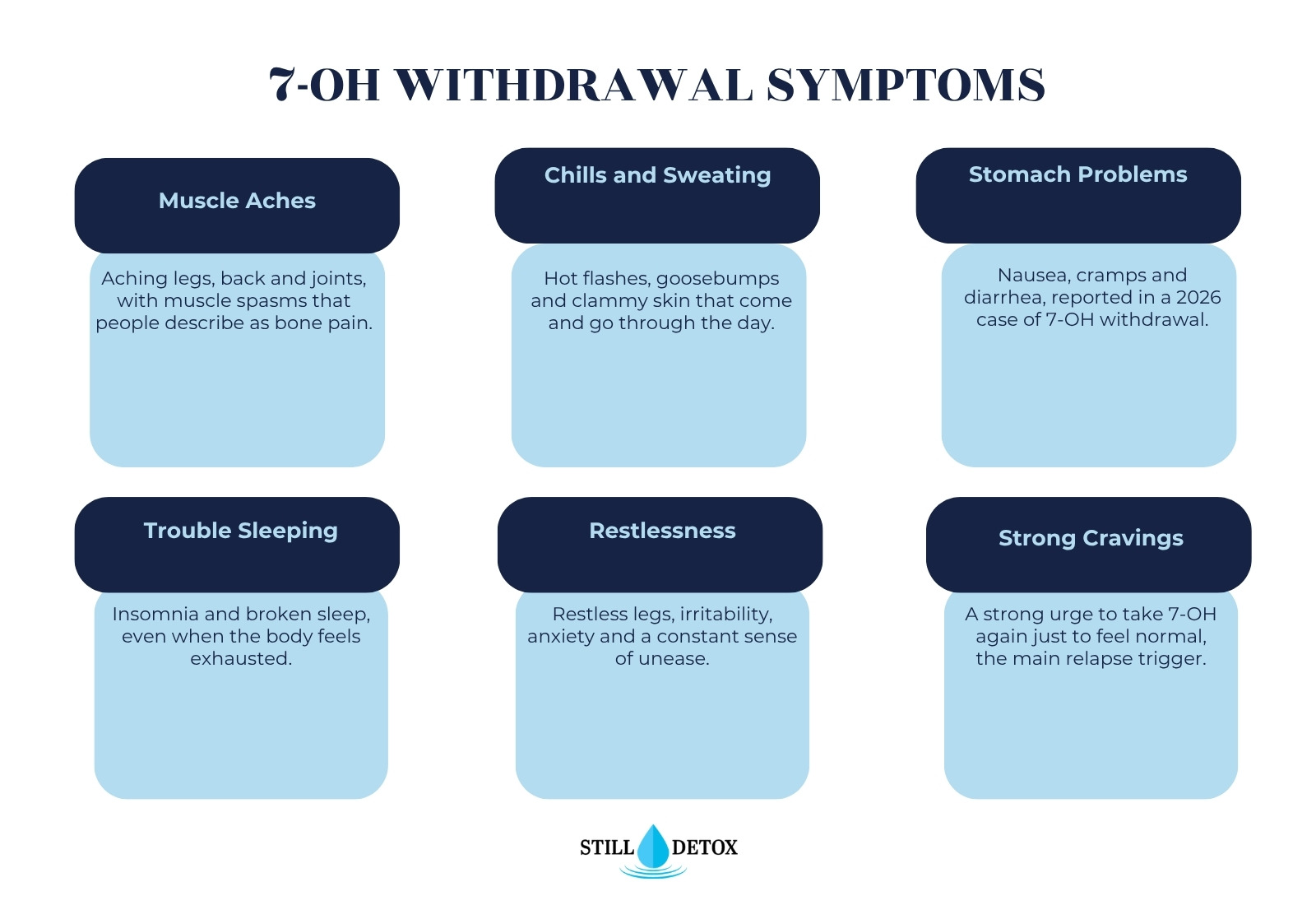
The main 7-hydroxymitragynine withdrawal symptoms are muscle aches, chills and sweating, runny nose, nausea and diarrhea, trouble sleeping, restlessness, anxiety and strong cravings for 7-OH. These symptoms match opioid withdrawal and appear in published 7-OH and kratom studies.
Singh, Müller and Vicknasingam (2014) recorded the physical and emotional withdrawal symptoms of 293 regular kratom users in Drug and Alcohol Dependence. Case reports of concentrated 7-OH describe the same symptoms arriving faster and hitting harder.
Common 7-OH withdrawal symptoms
The 7 common symptoms of 7-OH withdrawal are:
- Muscle aches and spasms: Aching legs, back and joints that people in withdrawal describe as “bone pain.”
- Chills and sweating: Hot flashes, goosebumps and clammy skin that alternate through the day.
- Runny nose and watery eyes: Cold-like symptoms that start early in 7-OH withdrawal.
- Stomach problems: Nausea, cramps and diarrhea, the symptoms the 2026 JAPhA patient reported.
- Trouble sleeping: Insomnia and broken sleep, even when the body feels exhausted.
- Restlessness and anxiety: Restless legs, irritability and a constant sense of unease.
- Cravings: A strong urge to take 7-OH again just to feel normal.
Severe 7-OH withdrawal symptoms
Severe 7-OH withdrawal reaches past discomfort into medical danger. Sharma, Nair and Pemminati (2025) reported in Cureus on a man taking about 800 mg of 7-OH tablets a day. His withdrawal, combined with nicotine pouch withdrawal, progressed to severe agitation, disorientation and breathing problems that required intubation and intensive care.
The 4 warning signs that need emergency care during 7-OH withdrawal are:
- Dehydration: Vomiting or diarrhea that stops a person from keeping fluids down.
- Racing heart: A fast heartbeat with chest discomfort or fainting.
- Confusion or hallucinations: Disorientation, seeing or hearing things, or not recognizing people.
- Slowed breathing: Shallow or slow breathing after a person takes 7-OH again, a sign of overdose.
Lingering symptoms after 7-OH withdrawal
Lingering symptoms outlast the physical phase of 7-OH withdrawal. Poor sleep, low mood, low energy and cravings continue after the aches and stomach symptoms fade, and Singh and colleagues measured ongoing craving in regular kratom users. Cravings are the main relapse trigger, which makes the timing of each phase important.
How long does 7-OH withdrawal last?
7-OH withdrawal starts within 6 to 48 hours of the last dose in published case reports, and acute symptoms resolved over 72 to 96 hours with treatment in the one case that reports duration. Sleep problems and cravings last longer. No study has followed a group of people through 7-OH withdrawal, so the timeline below comes from individual case reports.
7-OH withdrawal timeline
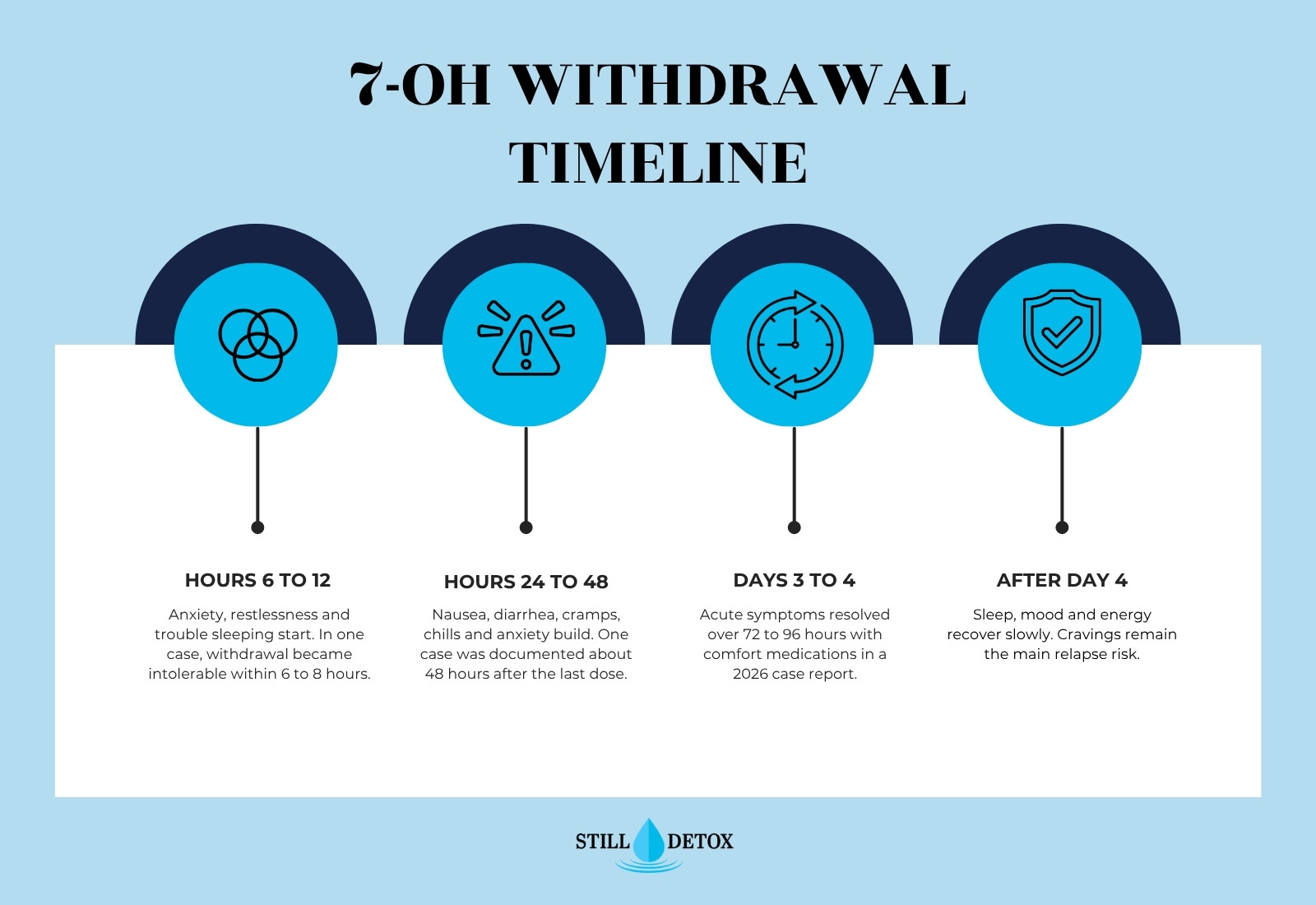
There are 4 phases in the 7-OH withdrawal timeline:
- Hours 6 to 12, early withdrawal: Anxiety, restlessness and trouble sleeping begin. Sharma and colleagues (2025) reported that withdrawal became intolerable within 6 to 8 hours when a man taking about 800 mg a day tried to stop on his own.
- Hours 24 to 48, building symptoms: Nausea, diarrhea, cramps, chills and anxiety build. Lybik and colleagues (2026) documented these symptoms about 48 hours after the last dose.
- Days 3 to 4, acute symptoms resolve with treatment: Physical symptoms ease with medical care. Stanciu (2026) treated the acute withdrawal of a patient who moved from 7-OH tablets to mitragynine pseudoindoxyl, a related compound, with comfort medications over 72 to 96 hours.
- After day 4, lingering phase: Sleep, mood and energy recover slowly, and cravings remain the main risk for relapse.
| Phase | Timing after last dose | What happens |
|---|---|---|
| Early withdrawal | 6 to 12 hours | Anxiety, restlessness, trouble sleeping |
| Building symptoms | 24 to 48 hours | Nausea, diarrhea, cramps, chills, muscle aches |
| Acute symptoms resolve | Days 3 to 4 | Physical symptoms ease with treatment; poor sleep and cravings continue |
| Lingering phase | After day 4 | Low mood, broken sleep, low energy, cravings |
Why the 7-OH withdrawal timeline differs from person to person
The 7-OH withdrawal timeline shifts with the daily dose, the length of use and any other substances in the picture. A person taking several hundred milligrams a day starts withdrawal sooner and feels it harder than a person taking a small daily amount, which is also why 7-OH and kratom leaf withdrawal differ.
How is 7-OH withdrawal different from kratom and opioid withdrawal?
7-OH withdrawal looks closer to withdrawal from short-acting prescription opioids than to kratom leaf withdrawal, with faster onset and a wider range of severity. NIDA describes kratom leaf withdrawal as mild to moderate for most people, while 7-OH case reports range from mild (COWS 5) to intensive care.
| Feature | Kratom leaf | Concentrated 7-OH | Short-acting opioids |
|---|---|---|---|
| Onset | Slower, delayed | Within hours to 2 days | Within hours |
| Severity | Mild to moderate for most people | Mild to severe in case reports | Mild to severe |
| Main medical risk | Dehydration, relapse | Dehydration, confusion, relapse and overdose | Dehydration, relapse and overdose |
| Medical treatment | Opioid withdrawal approach | Opioid withdrawal approach | Opioid withdrawal medications |
How long kratom withdrawal lasts depends on the same dose and frequency factors, on a slower clock than 7-OH. Snorting 7-OH changes the risk picture again.
The Severe Dangers of Snorting 7-OH (7-Hydroxymitragynine)
Snorting 7-OH raises the risk of overdose, nasal damage and fast dependence compared with swallowing the same product. Intranasal use, or snorting, is an especially high-risk method of taking any substance, and this danger grows with a compound as potent as 7-hydroxymitragynine (7-OH). Users and families need to understand the severe and unique health hazards of this practice.
Risk of Profound Overdose is Greatly Increased
The primary danger of snorting 7-OH is a sharply increased risk of overdose. The FDA states that 7-OH “can be more potent than morphine,” and rapid absorption of a drug that strong is dangerous. Snorting bypasses the slower digestive process and delivers a sudden, high-concentration dose into the bloodstream through the nasal membranes.
That intense peak raises the risk of respiratory depression, meaning dangerously slowed or stopped breathing, and NIDA reports that 7-OH slowed breathing in laboratory studies. Concentrated 7-OH products are unregulated, so the strength of each powder is unknown, and accurate dosing is impossible.
Immediate and Long-Term Physical Damage
Beyond the overdose risk, snorting a concentrated 7-OH powder harms the nose and airways directly. Repeated snorting irritates and erodes the nasal lining, which leads to nosebleeds, damage to the nasal septum (the cartilage dividing the nostrils) and repeated sinus and respiratory infections.
Snorting an unregulated powder also delivers every contaminant in that powder straight into the airway. The FDA has warned about kratom products contaminated with Salmonella and concerning levels of heavy metals.
Accelerated Path to Dependence
The faster a substance reaches the brain, the stronger its pull toward dependence. Snorting 7-OH creates a rapid, intense effect that reinforces repeated use. A person who snorts 7-OH develops physical dependence faster and faces the opioid-like withdrawal symptoms of restlessness, intense body aches and severe anxiety sooner.
That faster dependence makes stopping harder, especially for a person who tries to quit all at once.
What happens if you quit 7-OH cold turkey?
Quitting 7-OH cold turkey brings on the full withdrawal syndrome within 6 to 48 hours, with nothing to soften the symptoms, and raises the risk of relapse and overdose. Stopping 7-OH is the right goal; stopping without medical support makes the hardest days harder. A supervised taper is the safer way to quit 7-OH.
There are 4 risks of quitting 7-OH cold turkey without medical care:
- Full-strength symptoms: Aches, vomiting, diarrhea and insomnia hit at their peak with no medication to ease them.
- Dehydration: Ongoing vomiting and diarrhea drain fluids and electrolytes, which strains the heart and kidneys.
- Relapse: Cravings at the peak of withdrawal pull a person back to 7-OH to stop the symptoms.
- Overdose after relapse: Tolerance falls during withdrawal, so returning to a previous 7-OH dose overwhelms the body.
Self-treating with alcohol, sleeping pills or kratom adds new risks rather than ending withdrawal. Supervised treatment replaces guesswork with monitoring and medication.
How is 7-OH withdrawal treated?
Physicians treat 7-OH withdrawal like opioid withdrawal, with medical monitoring, withdrawal scoring, medications for comfort and cravings, and therapy that continues after detox. Stanciu and colleagues (2019) reached this conclusion in a systematic review of kratom withdrawal in the Journal of Psychoactive Drugs.
Medical detox and withdrawal monitoring
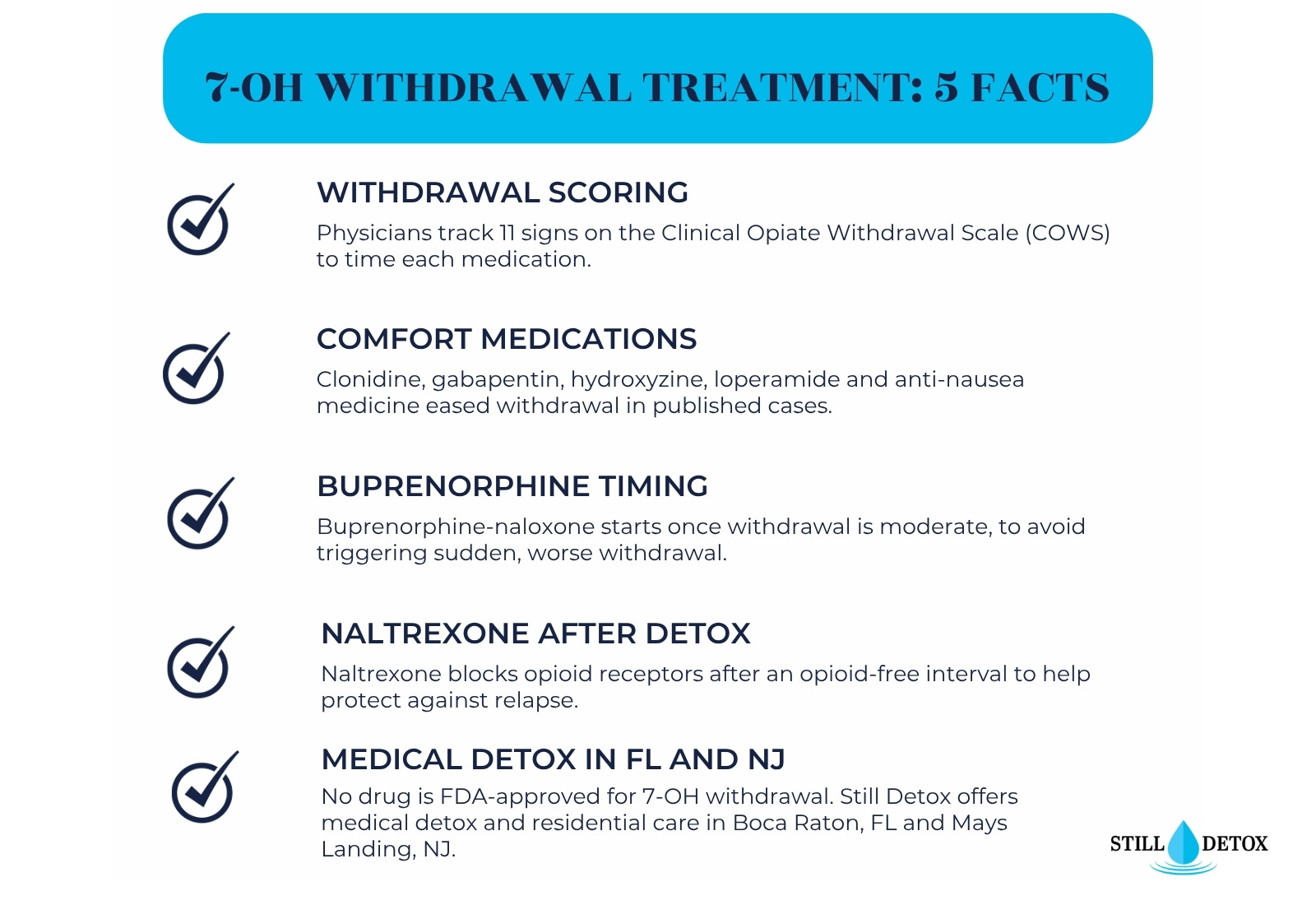
Medical detox gives 7-OH withdrawal around-the-clock observation, fluids and medication adjustments. The Clinical Opiate Withdrawal Scale (COWS) scores 11 signs, including pulse, sweating, pupil size and anxiety, and rates withdrawal from mild (5 to 12) to severe (above 36). The 2026 JAPhA patient scored 5 on the COWS at presentation.
A structured medical detox program uses these scores to time each medication, rather than waiting for symptoms to become unbearable.
Medications used for 7-OH withdrawal
The FDA has not approved any drug product containing kratom or its alkaloids, and no medication is approved for 7-OH withdrawal, so physicians use opioid withdrawal medications. NIDA reports that researchers have treated kratom withdrawal with buprenorphine and clonidine, and 2026 case reports add the rest of this list.
There are 6 medications physicians used for 7-OH withdrawal in published cases:
- Buprenorphine-naloxone: Eases withdrawal and cravings; Lybik and colleagues timed it to moderate withdrawal to avoid triggering sudden, worse withdrawal.
- Clonidine: Calms sweating, racing heart, anxiety and restlessness.
- Gabapentin: Treats restlessness and poor sleep, as part of the comfort medications in the Stanciu (2026) case.
- Hydroxyzine: Relieves anxiety and helps sleep.
- Loperamide and anti-nausea medicine: Control diarrhea, nausea and vomiting.
- Naltrexone: Blocks opioid receptors after detox ends to protect against relapse.
The medical team chooses among these medications based on the COWS score, health history and other substances involved.
Therapy after 7-OH detox
Therapy treats the habits, stress and triggers behind daily 7-OH use, which detox alone leaves untouched. Cognitive behavioral therapy (CBT) builds skills for handling cravings, and dialectical behavior therapy (DBT) builds skills for managing distress without 7-OH.
What researchers are still learning about 7-OH treatment
7-OH treatment research is still at the case-report stage. No controlled trial has compared medications for 7-OH withdrawal. Regulation is moving faster than research. The DEA published a notice of intent in July 2026 to temporarily place 7-OH above a specified threshold in Schedule I, and in August 2026 temporarily scheduled 3 related compounds, including mitragynine pseudoindoxyl.
How does Still Detox treat 7-OH withdrawal?
Still Detox treats 7-OH withdrawal through medical detox followed by residential treatment, with 7-OH listed among the substances that need medical detox and specialized testing. Still Detox runs the same levels of care at its Boca Raton, Florida and Mays Landing, New Jersey locations.
“7-OH withdrawal is not something to push through alone. In detox, our nurses check vital signs every 4 hours and give comfort care through the hardest days.”
Britney Marshall, RN, Director of Nursing, Still Detox
Medical detox for 7-OH in Boca Raton
Still Detox Boca Raton sits on the University Hospital campus, next to Boca Regional Hospital, so hospital services are immediately available during 7-OH detox. The medical team checks vital signs every 4 hours and oversees medication management and tapers, with a comfort-care focus throughout the detox phase.
People in South Florida start kratom and 7-OH detox in Boca Raton with a medical assessment and specialized 7-OH testing.
Residential treatment after 7-OH detox
Residential treatment at Still Detox continues care once 7-OH detox ends, with individual therapy, group therapy and case management. Clients move between detox and residential care based on individual needs, and Medication-Assisted Treatment (MAT) is available as part of the program.
7-OH detox in New Jersey
Still Detox New Jersey in Mays Landing offers the same medical detox and residential care for 7-OH withdrawal. Kratom and 7-OH detox in Atlantic County, New Jersey serves people near Atlantic City, about a 26-minute drive from the Mays Landing facility.
What else do people ask about 7-OH withdrawal?
How long does it take for 7-OH to get out of your system?
No published study has set a detection window for 7-OH. Routine drug screens miss 7-OH, so detecting 7-OH requires specialized testing, and Still Detox lists 7-OH among the substances that need that testing.
Does gabapentin help with 7-OH withdrawal?
Gabapentin was one of several comfort medications physicians used for withdrawal in a 2026 Cureus case report by Stanciu. Evidence stops at case reports, so gabapentin belongs in a physician-managed detox plan, not self-treatment.
Will mitragynine help with 7oh withdrawal?
No. Kruegel and colleagues (2019) showed that liver enzymes convert mitragynine into 7-OH, so mitragynine keeps the same opioid receptors active. Switching to mitragynine or kratom continues the dependence instead of ending it.
Is it safe to taper off 7-OH kratom?
A 7-OH taper is safest under a physician who controls each dose and tracks symptoms with the COWS. A self-taper relies on unregulated products with unverified strength, which makes accurate dose reductions impossible.
What is a typical taper schedule for 7-OH withdrawal?
No published guideline sets a standard 7-OH taper schedule. A physician sets each taper by daily dose, withdrawal score and health, and Lybik and colleagues (2026) started buprenorphine only once withdrawal reached a moderate level.
Is 7-OH withdrawal dangerous?
Yes. 7-OH withdrawal becomes dangerous through dehydration, confusion and relapse. Relapse after tolerance drops raises overdose risk, which is why physicians supervise 7-OH withdrawal.
Sources
- Kruegel, A. C., Uprety, R., Grinnell, S. G., et al. (2019). 7-Hydroxymitragynine is an active metabolite of mitragynine and a key mediator of its analgesic effects. ACS Central Science, 5(6), 992–1001.
- Lybik, N., Cone, B., Skelton, S., & Elfessi, Z. (2026). Management of acute withdrawal from 7-hydroxymitragynine after high-dose chronic use: A case report. Journal of the American Pharmacists Association, 66, 103047. https://doi.org/10.1016/j.japh.2026.103047
- National Institute on Drug Abuse. (2026). Kratom. National Institutes of Health.
- Sharma, A., Nair, B. S., & Pemminati, S. (2025). 7-Hydroxymitragynine and nicotine pouch withdrawal syndrome: A case report. Cureus, 17(12), e98386.
- Singh, D., Müller, C. P., & Vicknasingam, B. K. (2014). Kratom (Mitragyna speciosa) dependence, withdrawal symptoms and craving in regular users. Drug and Alcohol Dependence, 139, 132–137.
- Smith, K. E., Epstein, D. H., & Weiss, S. T. (2024). Controversies in assessment, diagnosis, and treatment of kratom use disorder. Current Psychiatry Reports, 26(9), 487–496.
- Stanciu, C. N. (2026). Severe early-onset withdrawal following intentional use of mitragynine pseudoindoxyl: A case report and emerging clinical considerations. Cureus, 18(3), e105224.
- Stanciu, C. N., Gnanasegaram, S. A., Ahmed, S., & Penders, T. (2019). Kratom withdrawal: A systematic review with case series. Journal of Psychoactive Drugs, 51(1), 12–18.
- U.S. Drug Enforcement Administration. (2026, July 6). Schedules of controlled substance: Temporary placement of 7-hydroxymitragynine above a specified threshold in Schedule I [Notice of intent]. Federal Register, 91, 40917.
- U.S. Food and Drug Administration. (2025, July 29). FDA takes steps to restrict 7-OH opioid products threatening American consumers [Press release].