



Methamphetamine appears in five physical forms: colorless-to-pale-blue crystalline shards, white-to-off-white powder, a waxy yellowish paste, pressed colored pills, and a clear liquid.
Crystal methamphetamine is the dominant form in U.S. markets, resembling broken glass or rock salt. Color, texture, and purity vary substantially based on synthesis route and adulterants. Understanding what methamphetamine looks like in each form helps parents, clinicians, and first responders identify the substance before methamphetamine use disorder causes irreversible dopaminergic damage.
Key Takeaways
- Methamphetamine’s appearance is directly determined by its synthesis route: pseudoephedrine reduction produces high-purity dextromethamphetamine shards while P2P synthesis produces racemic methamphetamine with lower CNS potency and an off-white to yellowish color.
- According to the DEA’s 2025 National Drug Threat Assessment, one in eight methamphetamine submissions to DEA forensic laboratories also contained fentanyl, with no visual difference distinguishable between pure and fentanyl-laced product without chemical testing.
- According to the CDC, methamphetamine and other synthetic stimulants were responsible for approximately 30% of the 107,941 drug-related deaths recorded in the United States in 2022.
- Crystal methamphetamine smoking delivers methamphetamine to peak plasma concentration within 3 to 5 seconds, triggering dopamine surges 3 to 5 times above baseline in the nucleus accumbens.
- Methamphetamine use disorder is a DSM-5 stimulant use disorder; no FDA-approved pharmacotherapy exists and structured residential treatment remains the evidence-based clinical standard.
What Is Methamphetamine?
Methamphetamine is a Schedule II phenethylamine stimulant that elevates synaptic dopamine, norepinephrine, and serotonin concentrations by triggering massive monoamine release from presynaptic terminals and blocking transporter-mediated reuptake. The Drug Enforcement Administration classifies methamphetamine as having high abuse potential with severely limited accepted medical use. Desoxyn, the sole FDA-approved methamphetamine formulation, is prescribed for severe obesity and ADHD at doses far below illicit use thresholds.
Methamphetamine is chemically related to benzedrine, the first commercially available amphetamine introduced in 1934. Benzedrine established the neurochemical template that clandestine methamphetamine production later exploited globally. Contemporary illicit methamphetamine is 20 to 30 times more potent per milligram than the amphetamine sulfate formulations that preceded it.
Street Names and Slang for Methamphetamine
Common street names for methamphetamine include ice, crystal, glass, speed, crank, Tina, chalk, and fire. “Ice” specifically identifies the high-purity monocrystalline shard form. “Crank” historically described lower-purity domestic powder product before Mexican cartel operations displaced small U.S. lab production.
Regional terms include blue, zoom, rocket fuel, scooby snax, and poor man’s cocaine. The name “Tina” identifies methamphetamine within chemsex and specific social communities. Clinicians and family members use this terminology to identify coded drug references in patient and household communications.
DEA Classification and Legal Status
The DEA classifies methamphetamine as a Schedule II controlled substance, acknowledging limited medical use while recognizing its high potential for severe psychological and physical dependence. Florida Statute 893.13 classifies unauthorized methamphetamine possession as a third-degree felony punishable by up to five years incarceration. Manufacturing methamphetamine within 1,000 feet of a school, daycare, or park triggers mandatory sentencing enhancements under Florida law.
What Determines Methamphetamine’s Appearance?
Methamphetamine’s color, texture, and purity are directly determined by synthesis route, post-synthesis processing, and adulterant content added during distribution. Two dominant production pathways produce methamphetamine with different enantiomeric compositions, baseline colorations, and potency profiles. Understanding how synthesis determines appearance allows clinicians and law enforcement to identify product origin and likely dosing characteristics.
Pseudoephedrine Reduction and Crystal Methamphetamine
Pseudoephedrine reduction synthesis converts pseudoephedrine, a pharmaceutical decongestant, into high-purity dextromethamphetamine (d-meth). Dextromethamphetamine is the pharmacologically active enantiomer, producing the full dopaminergic and noradrenergic stimulant effect. This synthesis route, dominant in Mexican cartel production, yields product with 90 to 99 percent purity as large transparent monocrystalline shards.
High-purity d-methamphetamine dissolves cleanly in water with minimal residue. Complete transparency with no discoloration indicates a pseudoephedrine reduction product with minimal post-synthesis processing. Color in crystal product results from residual precursor chemicals, post-synthesis adulterants, or deliberate coloring agents added by distributors.
P2P Synthesis and Racemic Methamphetamine
P2P (phenyl-2-propanone) synthesis uses phenylacetone as the primary precursor to produce racemic methamphetamine, a 50/50 mixture of d-methamphetamine and levomethamphetamine (l-meth). Levomethamphetamine contributes minimal CNS stimulant effect but produces significant cardiovascular stimulation. Racemic methamphetamine is less potent per milligram than pure d-methamphetamine for CNS effects despite containing the same total methamphetamine weight.
P2P methamphetamine typically presents as yellowed or off-white powder due to incomplete precursor removal during production. This synthesis route is more chemically accessible and is increasingly used by domestic producers. Experienced illicit users distinguish between pseudoephedrine-derived crystal and P2P-derived product based on color, potency, and residue profiles.
What Does Meth Look Like in Every Form?
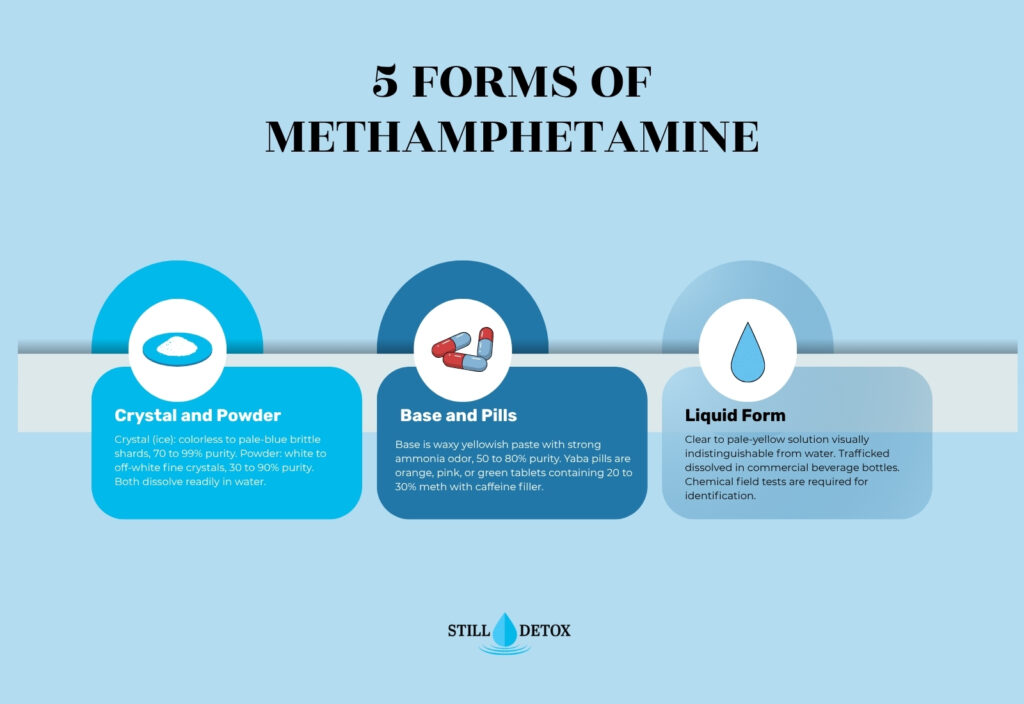
Methamphetamine appears in five distinct physical forms depending on processing stage and intended administration route. Each form has a characteristic color, texture, odor, and purity range. The table below summarizes all five forms followed by individual identification guides for each.
| Form | Color | Texture | Odor | Common Route | Purity Range |
|---|---|---|---|---|---|
| Crystal (ice) | Colorless to pale blue | Brittle glass-like shards | Minimal until heated | Smoking, crushing | 70 to 99% |
| Powder | White to off-white | Fine crystalline powder | Faint acidic chemical | Snorting, injection | 30 to 90% |
| Base | Yellowish-white to tan | Waxy, paste-like | Strong ammonia | Dabbing, smoking | 50 to 80% |
| Pill (yaba) | Orange, pink, red, green | Compact pressed tablet | Sweet or caffeine-like | Oral ingestion | 20 to 30% meth |
| Liquid | Clear to pale yellow | Fluid solution | None to faint solvent | Trafficking, injection | Variable |
Crystal Methamphetamine (Ice)
Crystal methamphetamine appears as colorless to pale-blue translucent shards resembling crushed glass, rock salt, or broken quartz crystal. Individual shards range from 1 to 10 millimeters in length for street-level quantities and grow to 1 to 2 centimeter formations in high-purity laboratory product. The material is brittle and fractures into smaller irregular fragments when compressed.
High-purity crystal methamphetamine is nearly transparent and often described as resembling ice cubes at small scale. Pale blue tinting results from trace mineral or precursor chemical contamination, not intentional coloring. The “blue meth” depicted in Breaking Bad is a fictional representation: real methamphetamine is never a consistent vivid blue, and blue coloration in genuine product indicates synthesis impurity rather than high purity.
Crystal methamphetamine dissolves rapidly in water with minimal cloudiness when purity is high. Users vaporize this form through a meth pipe, the borosilicate glass device specifically designed to sublimate methamphetamine without combustion. Smoking crystal meth delivers the drug to peak plasma concentration within 3 to 5 seconds.
Powder Methamphetamine
Powder methamphetamine appears as a fine white to off-white crystalline powder resembling confectioner’s sugar, table salt, or crushed chalk. This form results from crystal methamphetamine that has been ground, or from methamphetamine that was never crystallized during production. Powder form is more commonly adulterated with cutting agents than crystal due to the ease of mixing.
Purity ranges widely from 30 to 90 percent depending on production source and distribution chain length. High-purity powder dissolves cleanly in water. Impure powder produces cloudiness, visible particulates, or discoloration when dissolved, indicating the presence of binding agents, fillers, or active adulterants. Powder methamphetamine is the most common form used for insufflation (snorting) and injection.
Base Methamphetamine
Base methamphetamine is a moist, waxy, or paste-like substance with a yellowish-white to pale-tan color and a distinctively pungent ammonia odor. This form results from incomplete synthesis where methamphetamine is not fully converted to its hydrochloride salt form. Base meth is less common in the United States but remains prevalent in Australian illicit markets.
The putty-like texture of base methamphetamine immediately distinguishes it from powder and crystal forms. It does not dissolve cleanly in water and produces a turbid solution with visible oil separation. Base methamphetamine has a lower pH than hydrochloride salt forms, increasing mucosal tissue irritation across all administration routes.
Pill-Form Methamphetamine (Yaba)
Methamphetamine tablets called yaba (Thai for “crazy medicine”) are small pressed pills measuring 6 to 8 millimeters in diameter, available in orange, pink, red, and green colors with a slightly sweet caffeine scent. These tablets typically contain 20 to 30 percent methamphetamine by weight combined with caffeine as a filler. U.S. seizures of tablet-form methamphetamine are increasing as Southeast Asian trafficking routes expand.
Yaba tablets resemble over-the-counter medications or candy, creating accidental ingestion risk in homes with children. Their brightly colored, pill-like appearance makes them uniquely difficult to identify as methamphetamine without chemical testing. Law enforcement in South Florida has documented increasing yaba seizures at international mail facilities and port-of-entry inspections.
Liquid Methamphetamine
Liquid methamphetamine is methamphetamine dissolved in water or another solvent for concealed trafficking. It appears as a clear to pale-yellow solution visually indistinguishable from water, juice, or cleaning fluid. A common trafficking method involves dissolving methamphetamine in liquid to evade solid-substance detection.
Accidental skin contact or ingestion of liquid methamphetamine produces rapid stimulant toxicity. Trafficking organizations extract dissolved methamphetamine through evaporation to recover crystalline product at the destination. Chemical field test strips are the only reliable method for identifying methamphetamine in liquid form during field assessment.
What Do Different Quantities of Meth Look Like?
Methamphetamine is sold by weight, with distinct visual profiles for each common street quantity. These descriptions are based on high-purity crystal methamphetamine, the dominant U.S. market form. Quantity recognition helps clinicians, social workers, and law enforcement distinguish personal use amounts from distribution-level supplies.
What Does a Gram of Meth Look Like?
One gram of crystal methamphetamine forms a small pile of translucent shards roughly the volume of a large raisin or the contents of a single sugar packet. This quantity fits comfortably on a coin surface and represents 7 to 14 individual doses depending on tolerance and administration method. Street prices for one gram range from $5 to $40 depending on regional proximity to Mexican production centers.
In powder form, one gram of methamphetamine resembles a heaped teaspoon of salt. The same weight in crystal form appears more voluminous due to shard fracture creating air pockets within the pile. Either form fits inside a small resealable plastic bag or folded paper bindle used for street-level distribution.
What Does an 8-Ball of Meth Look Like?
An 8-ball of methamphetamine is 3.5 grams, the same weight measurement used in cocaine street markets. In crystal form, 3.5 grams fills roughly the volume of a standard marble or a heaped tablespoon. This quantity is associated with both personal use and low-level distribution activity.
Three-point-five grams of powder methamphetamine fills approximately one-third of a tablespoon. This quantity produces 25 to 50 doses for new users or 10 to 20 doses for individuals with established tolerance. Most U.S. jurisdictions classify 8-ball quantities as indicating distribution intent rather than personal use under sentencing guidelines.
What Does an Ounce of Meth Look Like?
One ounce (28 grams) of crystal methamphetamine fills approximately the volume of a golf ball when compressed, or a large loosely cupped handful when uncompressed. This quantity constitutes a trafficking amount in most U.S. states, triggering mandatory minimum sentencing in federal proceedings under 21 U.S.C. 841. One ounce represents 200 to 500 individual doses depending on tolerance and administration route.
What Does Meth Smell and Taste Like?
Methamphetamine’s sensory profile differs by form and synthesis route, providing additional identification markers beyond visual appearance. Clinicians, first responders, and concerned family members use smell and taste descriptions to support identification when visual evidence alone is inconclusive.
What Meth Smells Like by Form
Crystal methamphetamine in undisturbed solid form has minimal odor at room temperature. When heated, it produces sharp chemical vapor combining ammonia, acetone, burnt plastic, and industrial solvent notes. The smell of an active methamphetamine production environment is significantly more intense, combining pseudoephedrine, solvents, and synthesis byproducts into a pervasive chemical-ammonia odor detectable at distance outdoors.
Base methamphetamine carries the strongest individual drug odor of all five forms, with a pungent ammonia smell present without any heating required. Powder methamphetamine produces a faint acidic chemical smell distinguishable from talc or sugar through direct inhalation proximity. Users who smoke methamphetamine create secondhand vapor combining the drug’s chemical signature with residual borosilicate glass and combustion byproducts.
What Meth Tastes Like
Methamphetamine hydrochloride produces an intensely bitter, metallic taste with a slight mucosal numbing effect on contact. This taste profile is consistent across crystal, powder, and base forms. The bitter-metallic combination is characteristic of amphetamine-class stimulants and distinguishes methamphetamine from most common adulterants and look-alike household substances.
Heavily cut methamphetamine may taste less bitter than pure product when fillers dilute the methamphetamine concentration. Sweet or fruity flavors in suspected methamphetamine indicate significant adulterant content. Caffeine, the most common cutting agent in tablet-form methamphetamine, adds a bitter but distinctively different flavor than pure methamphetamine hydrochloride.
What Does Adulterated and Fentanyl-Laced Meth Look Like?
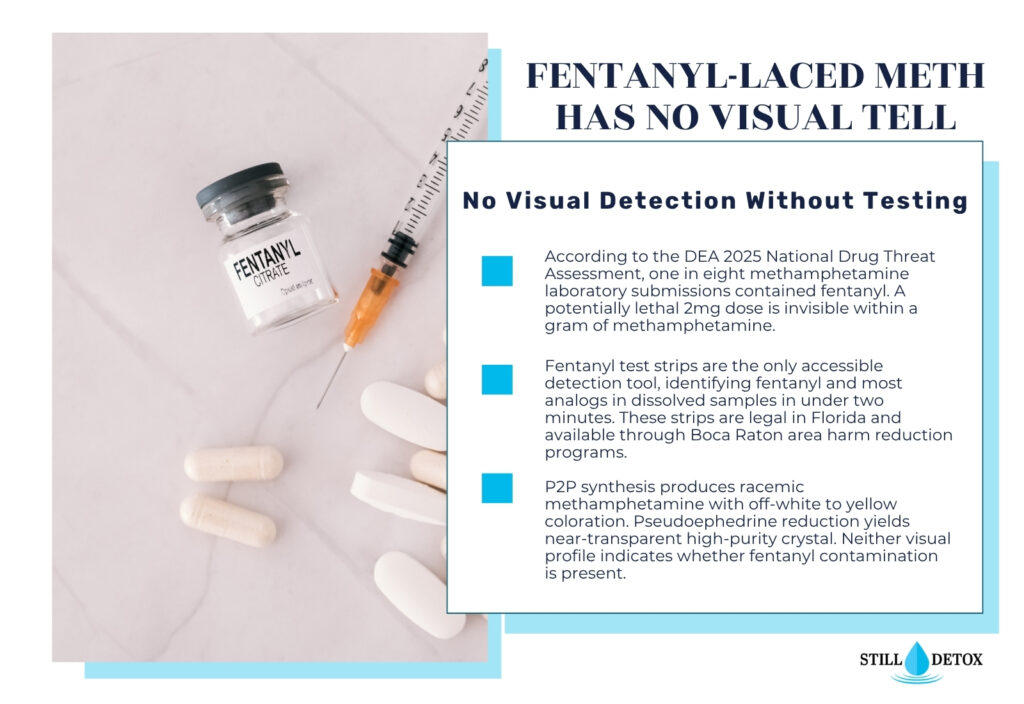
Adulterated methamphetamine is visually indistinguishable from pure product without chemical testing. This is the most critical identification limitation: no visual characteristic confirms whether a methamphetamine sample contains lethal adulterants. According to the DEA’s 2025 National Drug Threat Assessment, one in eight methamphetamine submissions to forensic laboratories also contained fentanyl. Fentanyl test strips are the only accessible field-level detection tool.
What Does Fentanyl-Laced Meth Look Like?
Fentanyl-laced methamphetamine appears identical to unadulterated crystal or powder product. A lethal fentanyl dose is approximately 2 milligrams, a quantity microscopically invisible within a gram of methamphetamine. Fentalog contamination (acetylfentanyl, carfentanil, furanylfentanyl) is equally undetectable visually.
Some users encountering fentanyl-laced methamphetamine attribute the combined stimulant-opioid effect to unusually strong product rather than recognizing opioid contamination. This masking significantly raises overdose risk because individuals do not apply harm reduction responses appropriate for opioid exposure. Fentanyl test strips are available over the counter in Florida and through Boca Raton area harm reduction programs.
Common Meth Cutting Agents and Their Visual Impact
Methamphetamine cutting agents are selected specifically to mimic the white-crystalline appearance of pure product. The table below covers the most common adulterants encountered in U.S. market methamphetamine and their visual distinguishability characteristics.
| Cutting Agent | Appearance | Visual Similarity to Meth | Detection Method |
|---|---|---|---|
| MSM (methylsulfonylmethane) | White crystalline powder | High | Chemical reagent test |
| Creatine | White to off-white powder | Moderate | Dissolve test (clumps in water) |
| Caffeine | Fine white powder | High | Marquis reagent color change |
| Table salt (NaCl) | White crystalline granules | High | Taste (non-bitter) |
| Inositol | Fine white powder | High | Chemical reagent test |
| Acetaminophen | White compressed powder | High | Simon’s reagent |
| Fentanyl | Micro-dose white powder | Not visually detectable | Fentanyl test strip only |
What Does Meth Residue Look Like?
Methamphetamine leaves persistent residue on paraphernalia and surfaces long after the drug itself has been consumed. This residue functions as both a physical identification marker and a secondary dermal exposure hazard. Residue identification is relevant for law enforcement assessment, child protective services investigations, and real estate remediation under Florida’s methamphetamine remediation standards.
Meth Residue on Pipes and Paraphernalia
A used meth pipe develops white to pale-yellow interior cloudiness from condensed methamphetamine vapor deposited on the glass bulb walls. This interior film is reconstituted methamphetamine that users sometimes re-vaporize when fresh supply is unavailable. The density of white interior film increases proportionally with pipe use frequency.
Aluminum foil used for methamphetamine vaporization shows dark brown or black directional streaks from tracking the drug along the foil surface while applying heat from below. These unidirectional streaks are consistent with following a running vapor stream and differ from the random burn patterns left by foil used for other purposes. Residue on syringes, cooker spoons, or straws indicates injection or insufflation administration respectively.
Individuals who use methamphetamine via rectal administration leave no pipe or foil residue, making behavioral and physiological signs the primary identification pathway rather than paraphernalia-based detection.
Meth Residue on Surfaces and in Living Spaces
Active methamphetamine production and heavy use environments accumulate methamphetamine hydrochloride residue on walls, floors, HVAC systems, and soft furnishings. This residue appears as a faint white to yellowish film on hard surfaces, often initially invisible to the naked eye but detectable under UV lighting or with chemical swab testing.
Florida requires methamphetamine testing and certified remediation following confirmed production under the Meth Lab Cleanup Act. Children in former production or heavy use environments face documented dermal absorption and respiratory exposure risk from surface-deposited methamphetamine. Professional chemical testing rather than visual inspection is the standard required by Florida Department of Health remediation protocols.
Physical Signs of Methamphetamine Use Disorder
Methamphetamine use disorder produces progressive, recognizable physical deterioration that clinicians, family members, and first responders can identify across severity tiers. The DSM-5 diagnosis of stimulant use disorder requires two or more criteria within a 12-month period spanning impaired control, social impairment, risky use, and pharmacological dimensions. Physical signs correlate with both duration and cumulative dose of methamphetamine exposure.
Common Physical Signs of Meth Use
Common external indicators of methamphetamine use disorder include:
- Rapid unexplained weight loss from methamphetamine’s direct suppression of hypothalamic appetite-regulating neuropeptides
- Mydriasis producing large, poorly reactive pupils even in well-lit environments during active intoxication phases
- Xerostomia causing accelerated dental decay, pronounced gum recession, and increasing caries formation
- Psychomotor agitation including repetitive purposeless behaviors such as compulsive cleaning, electronic disassembly, or skin picking
- Skin flushing, diaphoresis, and elevated core body temperature during active methamphetamine intoxication periods
Severe Physical Effects and Emergency Warning Signs
Seek emergency care immediately if any of the following effects of meth occur during or following methamphetamine use:
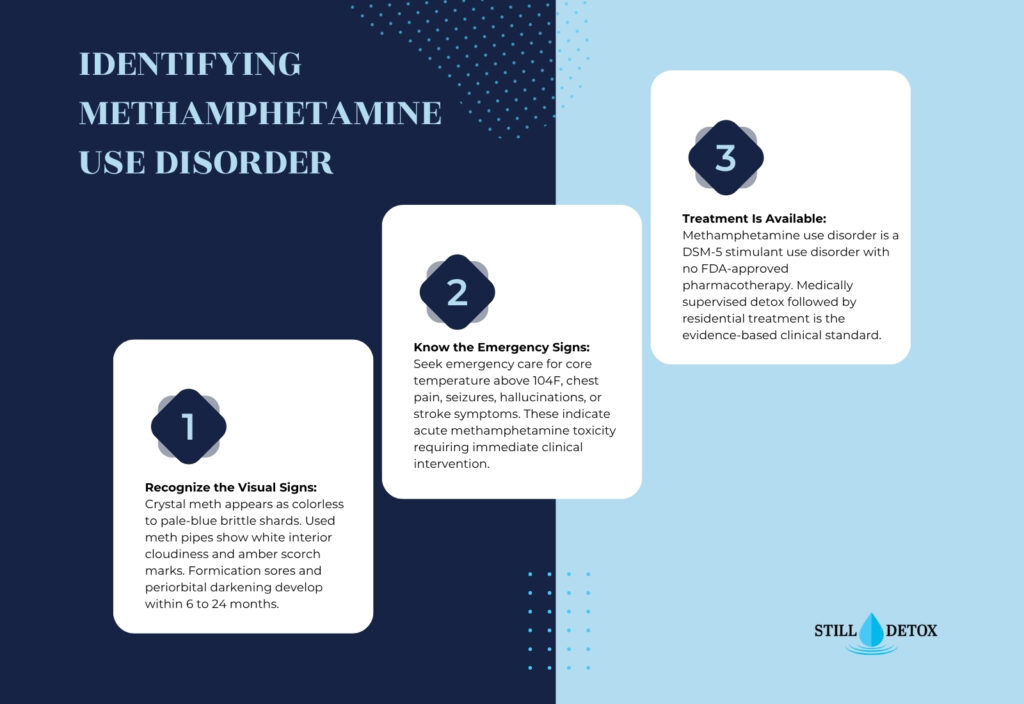
- Core body temperature exceeding 104°F (40°C) with confusion, agitation, or impaired consciousness indicating hyperthermia
- Chest pain, severe palpitations, or irregular heartbeat requiring emergency cardiac evaluation
- Seizure activity of any duration in a person with no prior seizure history
- Auditory or visual hallucinations combined with paranoid delusions indicating methamphetamine-induced psychosis
- Sudden facial drooping, arm weakness, or speech difficulty indicating methamphetamine-associated cerebrovascular event
Long-Term Physical Changes from Chronic Meth Use
Chronic methamphetamine use produces durable physical changes visible within 6 to 24 months of regular use. Progressive facial tissue deterioration from malnutrition, chronic sleep deprivation, and methamphetamine-induced vascular constriction is widely documented in longitudinal imaging studies. These changes persist well beyond acute withdrawal and early sobriety.
Long-term physical manifestations of methamphetamine use disorder include:
- Severe dental destruction from xerostomia, bruxism, acidic vapor inhalation, and neglected oral hygiene over months to years
- Pronounced periorbital darkening and dark circles under the eyes from cumulative sleep deprivation and systemic malnutrition
- Open excoriation sores and scarring on the face, arms, and scalp from methamphetamine-induced formication
- Facial hollowing from rapid subcutaneous adipose tissue loss combined with chronic malnutrition
- Pulmonary arterial changes from methamphetamine-associated pulmonary hypertension in long-term smokers
Individuals who simultaneously use cocaine face compounded cardiovascular deterioration from dual phenethylamine stimulant adrenergic receptor activation, accelerating arrhythmia risk and vascular damage progression beyond either substance alone.
Methamphetamine Use Disorder Treatment at Still Detox
Methamphetamine use disorder is a chronic DSM-5 stimulant use disorder with no FDA-approved pharmacotherapy. Evidence-based treatment combines medically supervised detoxification with structured behavioral intervention in a residential setting to address both acute withdrawal and the protracted dopaminergic dysregulation that persists 12 to 24 months after cessation.
Adults in South Florida seeking comprehensive dual-diagnosis methamphetamine treatment can access medically supervised detoxification and residential programming at Still Detox’s residential treatment program in the Boca Raton area. Same-day clinical assessments are available for individuals ready to begin treatment.
Frequently Asked Questions
Is meth a hard or soft drug?
Methamphetamine is a hard drug based on its Schedule II classification, high physical and psychological dependence potential, and severity of neurological damage. The distinction is not a formal pharmacological category but consistently identifies substances with high addiction liability. Methamphetamine produces dopamine dysregulation severe enough to impair reward processing for 12 to 24 months after cessation, placing it among the most dependence-producing substances clinically documented.
What are the top 3 most addictive drugs?
Research consistently identifies heroin, methamphetamine, and cocaine as among the most addictive substances. According to NIDA, methamphetamine drives addiction through dopamine surges 3 to 5 times above natural reward thresholds, establishing compulsive reinforcement patterns within the first use episodes. Each drug hijacks the mesolimbic dopamine pathway through distinct pharmacological mechanisms, though all three produce severe withdrawal and compulsive craving driving continued use.
What drugs smell the worst?
Among illicit drugs, active methamphetamine production environments carry the strongest chemical smell, combining ammonia, acetone, ether, and sulfurous synthesis byproducts in a pervasive mix. Individual methamphetamine base form carries the most intense single-drug odor. Heroin, crack cocaine smoke, and solvent-based substances also produce distinctive strong odors. Methamphetamine labs are routinely identified by odor detection before visual or physical evidence is confirmed.
Is cocaine the same as meth?
No. Cocaine is a tropane alkaloid extracted from coca leaves that primarily blocks dopamine, norepinephrine, and serotonin reuptake. Methamphetamine is a synthetic phenethylamine that both blocks reuptake and actively triggers monoamine release. Cocaine has a duration of 20 to 90 minutes; methamphetamine lasts 8 to 12 hours. Both are Schedule II stimulants but differ in origin, mechanism, duration, and long-term neurological damage profiles.
What does blue meth look like?
Real methamphetamine is never a consistent vivid blue. Blue coloration indicates synthesis impurities or deliberate dye addition, not high purity. The blue crystal methamphetamine in Breaking Bad is fictional. Pure methamphetamine hydrochloride is colorless to slightly pale at most when natural trace mineral contamination occurs during pseudoephedrine reduction synthesis. Vivid blue product should be considered heavily adulterated and presents heightened unknown-adulterant risk.
Can you tell if meth has fentanyl in it by looking at it?
No visual examination can confirm whether methamphetamine contains fentanyl. According to the DEA’s 2025 National Drug Threat Assessment, one in eight methamphetamine laboratory submissions contained fentanyl. Fentanyl test strips are the only accessible detection tool, identifying fentanyl and most analogs in a dissolved sample. These strips are legal in Florida and available through harm reduction services in the Boca Raton and Palm Beach County area.
References
- Drug Enforcement Administration. (2025). 2025 National Drug Threat Assessment. https://www.dea.gov/documents/2025/2025-05/2025-05-13/national-drug-threat-assessment
- National Institute on Drug Abuse. (2022). Methamphetamine research report. https://nida.nih.gov/publications/research-reports/methamphetamine/overview
- Substance Abuse and Mental Health Services Administration. (2022). Key substance use and mental health indicators in the United States: Results from the 2021 National Survey on Drug Use and Health. https://www.samhsa.gov/data/sites/default/files/reports/rpt39443/2021NSDUHFFRRev010323.pdf
- Drug Enforcement Administration. (2024). Drug fact sheet: Methamphetamine. https://www.dea.gov/sites/default/files/2022-06/Methamphetamine_2022_1.pdf
- National Institute on Drug Abuse. (2021). Methamphetamine DrugFacts. https://nida.nih.gov/publications/drugfacts/methamphetamine
- American Psychiatric Association. (2022). Diagnostic and statistical manual of mental disorders (5th ed., text rev.). American Psychiatric Publishing.
- Moszczynska, A. (2021). Current and emerging treatments for methamphetamine use disorder. Current Neuropharmacology, 19(12), 2077–2091.
- Florida Legislature. (2023). Florida Statute 893.13: Drug abuse prevention and control. The Florida Senate.


