




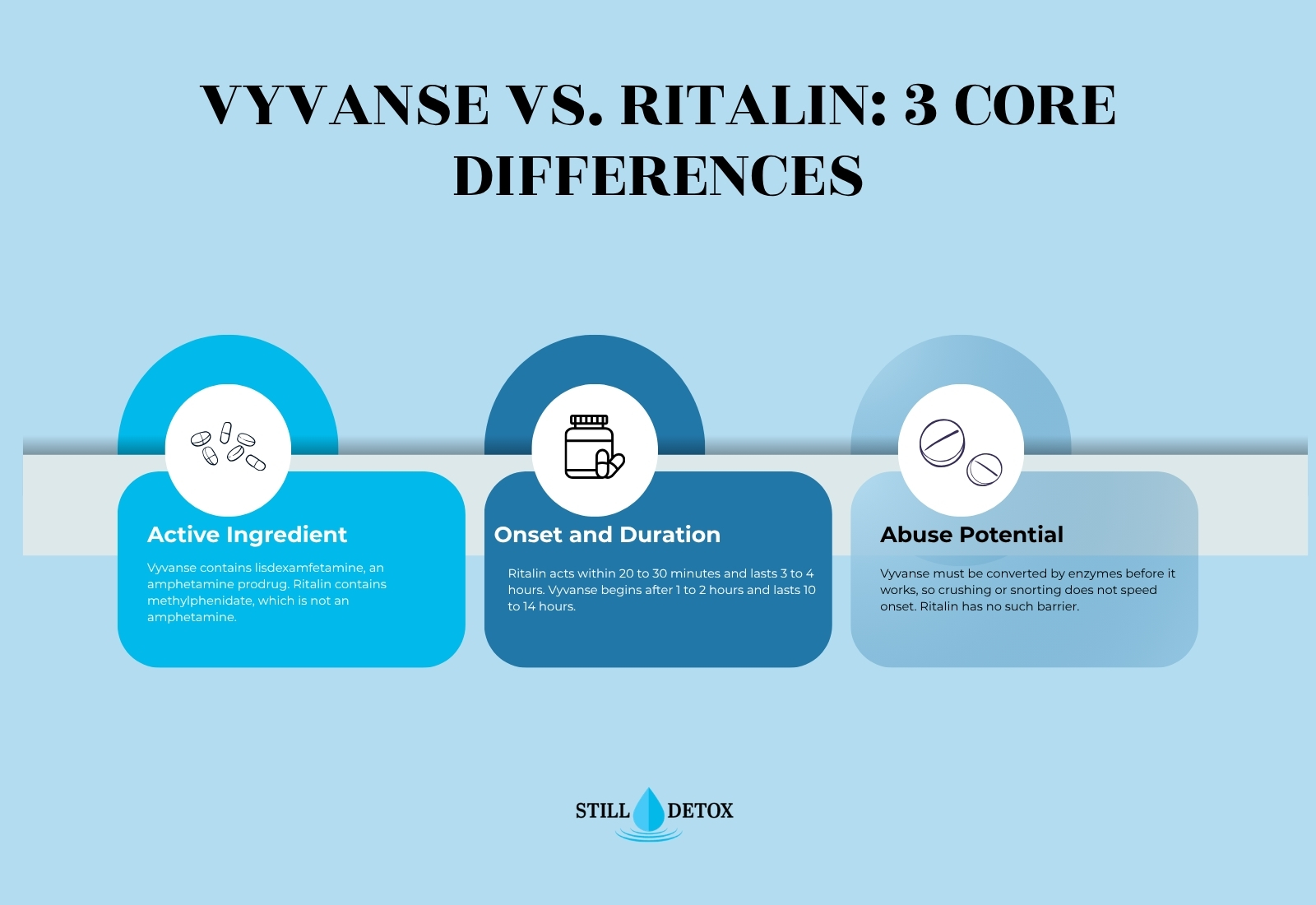
Vyvanse vs Ritalin comes down to one structural difference: Vyvanse is an amphetamine prodrug the body must convert before it works, while Ritalin is methylphenidate that acts immediately. That conversion step changes how fast each drug takes effect, how long it lasts, and how easily it can be misused.
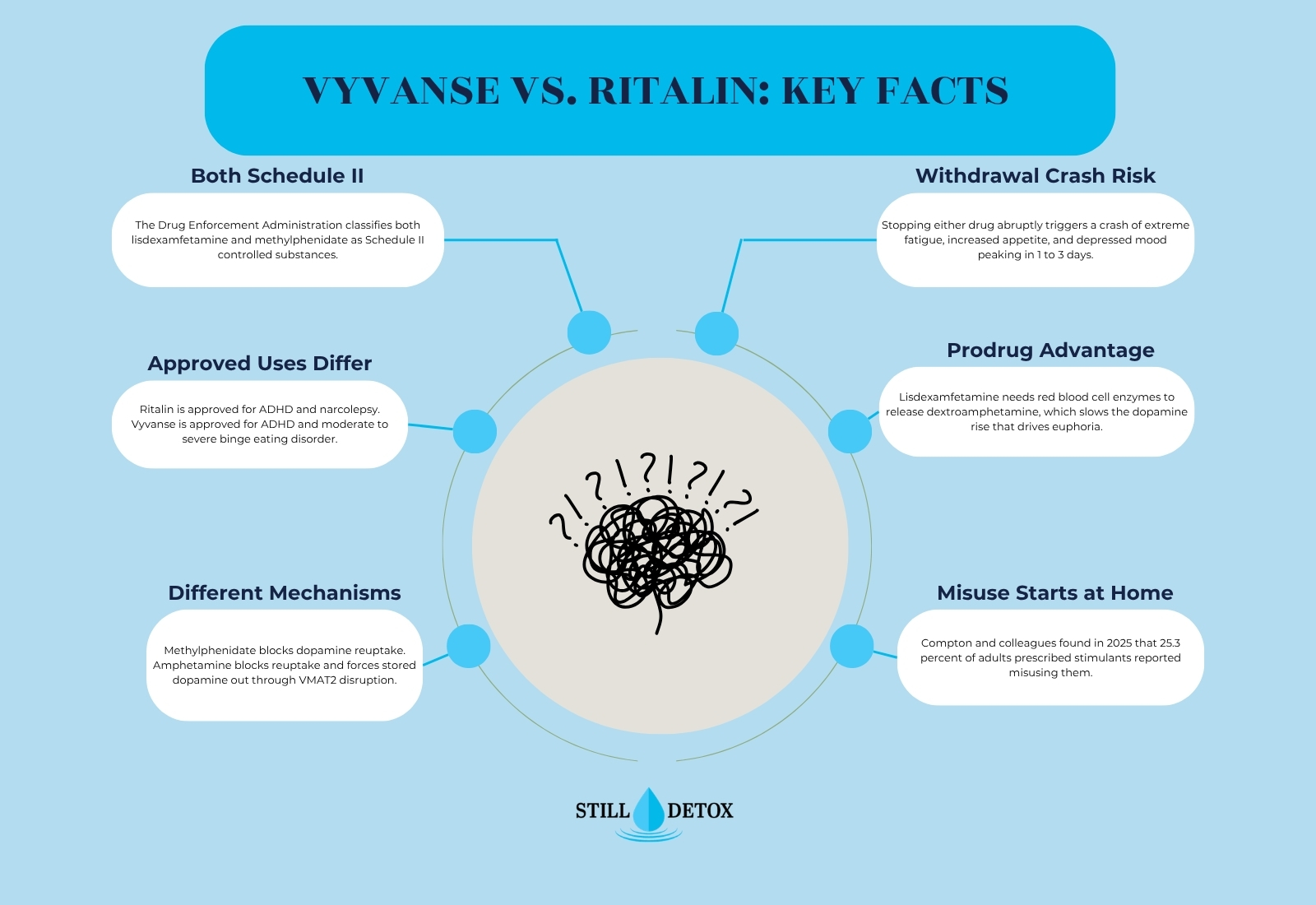
Both medications hold a Schedule II classification, the strictest category the Drug Enforcement Administration assigns to drugs with accepted medical use. Both treat attention-deficit/hyperactivity disorder, and both carry real dependence risk.
The differences that matter most are not about which drug performs better. They are about which one is easier to misuse, and what happens when a prescription stops being taken as written.
Key Takeaways
- Vyvanse is lisdexamfetamine, an inactive prodrug that peptidase activity inside red blood cells must hydrolyze into dextroamphetamine before any stimulant effect begins, while Ritalin is methylphenidate hydrochloride and requires no conversion.
- The Substance Abuse and Mental Health Services Administration reported in the 2023 National Survey on Drug Use and Health that 3.9 million people aged 12 and older, or 1.4 percent of that population, misused prescription stimulants in the past year.
- Compton and colleagues found in a 2025 JAMA study that 25.3 percent of adults prescribed stimulants reported misusing them, and 9.0 percent met criteria for prescription stimulant use disorder.
- The Drug Enforcement Administration schedules lisdexamfetamine and methylphenidate as Schedule II controlled substances, the same category that contains cocaine and fentanyl.
- Required enzymatic conversion slows the rise of dopamine in the brain’s reward pathway, which is why crushing or snorting Vyvanse does not accelerate its effect.
What Are Vyvanse and Ritalin?
Vyvanse and Ritalin are prescription central nervous system stimulants that raise dopamine and norepinephrine signaling in the brain, but they belong to different drug classes and reach the bloodstream through different routes.
What Vyvanse Is and What It Treats
Vyvanse is the brand name for lisdexamfetamine dimesylate, an amphetamine prodrug in which dextroamphetamine is covalently bonded to the amino acid l-lysine.
- The molecule arrives inactive: Lisdexamfetamine produces no stimulant effect until enzymes cleave the l-lysine and release dextroamphetamine.
- Absorption uses a peptide transporter: Peptide transporter 1 carries the intact molecule across the intestinal wall, after which hydrolysis occurs in the cytosol of red blood cells.
- Two indications carry Food and Drug Administration approval: Regulators approved Vyvanse for attention-deficit/hyperactivity disorder and for moderate to severe binge eating disorder in adults.
- Generic versions exist: Generic lisdexamfetamine entered the United States market after patent expiration, sold in capsule and chewable tablet forms.
What Ritalin Is and What It Treats
Ritalin is the brand name for immediate-release methylphenidate hydrochloride, a stimulant that is not an amphetamine and becomes pharmacologically active the moment it is absorbed.
- No conversion step exists: Methylphenidate blocks dopamine and norepinephrine transporters directly, without requiring metabolic activation.
- Immediate release drives short duration: Prescribers order two or three daily doses because the immediate-release formulation clears within several hours.
- Two indications carry approval: Regulators approved Ritalin for attention-deficit/hyperactivity disorder and for narcolepsy.
- Extended-release relatives exist separately: Extended-release methylphenidate formulations like Concerta deliver the same molecule across a longer window through a different delivery system.
Vyvanse vs Ritalin: Key Differences at a Glance
Vyvanse and Ritalin diverge across drug class, activation requirement, onset, duration, and the degree to which their formulation resists misuse.
Side-by-Side Comparison of Vyvanse and Ritalin
The following comparison isolates the features that distinguish lisdexamfetamine from immediate-release methylphenidate.
| Feature | Vyvanse (lisdexamfetamine) | Ritalin (methylphenidate) |
|---|---|---|
| Drug class | Amphetamine prodrug | Methylphenidate, a non-amphetamine stimulant |
| Active compound | Dextroamphetamine, released after enzymatic hydrolysis | Methylphenidate, active on absorption |
| Release profile | Long-acting, single morning dose | Immediate release, two to three doses daily |
| Onset of effect | 1 to 2 hours | 20 to 30 minutes |
| Duration of effect | 10 to 14 hours | 3 to 4 hours |
| DEA classification | Schedule II | Schedule II |
| Approved indications | ADHD, moderate to severe binge eating disorder | ADHD, narcolepsy |
| Effect of crushing or snorting | Blocked by the required conversion step | Not blocked, rapid onset achievable |
How Vyvanse and Ritalin Work in the Brain
Vyvanse and Ritalin both raise dopamine and norepinephrine concentrations in the prefrontal cortex, but methylphenidate blocks reuptake while amphetamine additionally forces neurotransmitter release.
How Methylphenidate Acts on Dopamine Transporters
Methylphenidate raises synaptic dopamine by occupying the dopamine transporter and preventing reabsorption of dopamine already released.
- Transporter blockade is the primary mechanism: Methylphenidate binds the dopamine transporter and the norepinephrine transporter, leaving both neurotransmitters in the synapse longer.
- Volkow established the potency comparison: Nora Volkow, Director of the National Institute on Drug Abuse, used positron emission tomography to demonstrate that oral methylphenidate blocks the dopamine transporter with potency comparable to cocaine, published in the American Journal of Psychiatry in 1998.
- The prefrontal cortex mediates the therapeutic effect: Increased norepinephrine and dopamine signaling in the prefrontal cortex improves sustained attention and impulse control.
- Rate of rise determines the subjective effect: Volkow and Swanson demonstrated in 2003 that how quickly dopamine rises, rather than how high it climbs, generates the reinforcing effect that drives misuse. This mechanism also explains why stimulants calm ADHD symptoms rather than causing agitation at therapeutic doses.
How Amphetamine Prodrugs Act Differently
Dextroamphetamine released from lisdexamfetamine blocks reuptake and additionally drives dopamine out of storage vesicles, producing a broader mechanism than methylphenidate.
- Vesicular release adds a second pathway: Amphetamine enters the neuron and disrupts vesicular monoamine transporter 2, pushing stored dopamine into the cytoplasm.
- Reverse transport follows: The dopamine transporter then runs backward, releasing dopamine into the synapse independently of neuronal firing.
- Trace amine-associated receptor 1 modulates the response: Amphetamine activates trace amine-associated receptor 1, which alters dopamine transporter function and amplifies the effect.
- Conversion imposes a rate limit: Because red blood cell hydrolysis releases dextroamphetamine gradually, the dopamine rise in the nucleus accumbens stays slower than with an equivalent immediate-release amphetamine such as mixed amphetamine salts.
Why Prescription Stimulants Cause Dependence
Prescription stimulant dependence develops when repeated dopamine surges in the nucleus accumbens downregulate receptor sensitivity, driving escalating doses to reproduce the original effect.
Neurobiological Drivers of Stimulant Dependence
The neurobiology of stimulant dependence centers on the brain’s reward pathway adapting to repeated artificial dopamine elevation.
- Receptor downregulation produces tolerance: Sustained dopamine elevation reduces dopamine D2 receptor availability, which flattens the response to the same dose.
- Escalating doses follow tolerance: Reduced receptor sensitivity drives people to take more than prescribed to restore the earlier level of focus or energy.
- Route of administration accelerates the process: Insufflation and injection compress the time to peak concentration, which sharpens the reinforcing signal.
- Baseline dopamine falls during abstinence: Withdrawal produces a dopamine deficit state that generates fatigue, low mood, and craving.
Behavioral and Situational Drivers
Behavioral patterns convert a legitimate prescription into misuse, most often through performance demands rather than recreational intent.
- Academic and workplace pressure drives dose escalation: Students and professionals take extra doses to extend working hours, which establishes a pattern of using the medication outside its prescribed purpose.
- Untreated symptoms invite self-adjustment: Inadequate symptom control prompts people to change their own dose rather than return to the prescriber.
- Weight control becomes a secondary motive: Appetite suppression leads some people to continue or increase stimulants for reasons unrelated to attention.
- Availability normalizes sharing: Widespread prescribing makes stimulants accessible through friends and classmates, which is how most nonmedical use begins.
Comorbid Conditions That Raise Dependence Risk
Several co-occurring conditions raise prescription stimulant dependence risk through identifiable mechanisms.
- Untreated depression drives stimulant self-medication: Stimulants temporarily lift mood and energy, which reinforces use in people whose depressive symptoms remain untreated.
- Anxiety disorders complicate dosing: Stimulants worsen anxiety in some patients, who then add sedatives or alcohol, establishing a polysubstance pattern.
- Existing substance use disorder predicts stimulant misuse: A history of alcohol or cannabis use disorder raises the likelihood of misusing a prescribed stimulant, which is why dependence on prescription stimulants often appears alongside other substance use.
- Eating disorders interact with appetite suppression: Stimulant-induced appetite loss reinforces restrictive eating patterns and complicates both conditions.
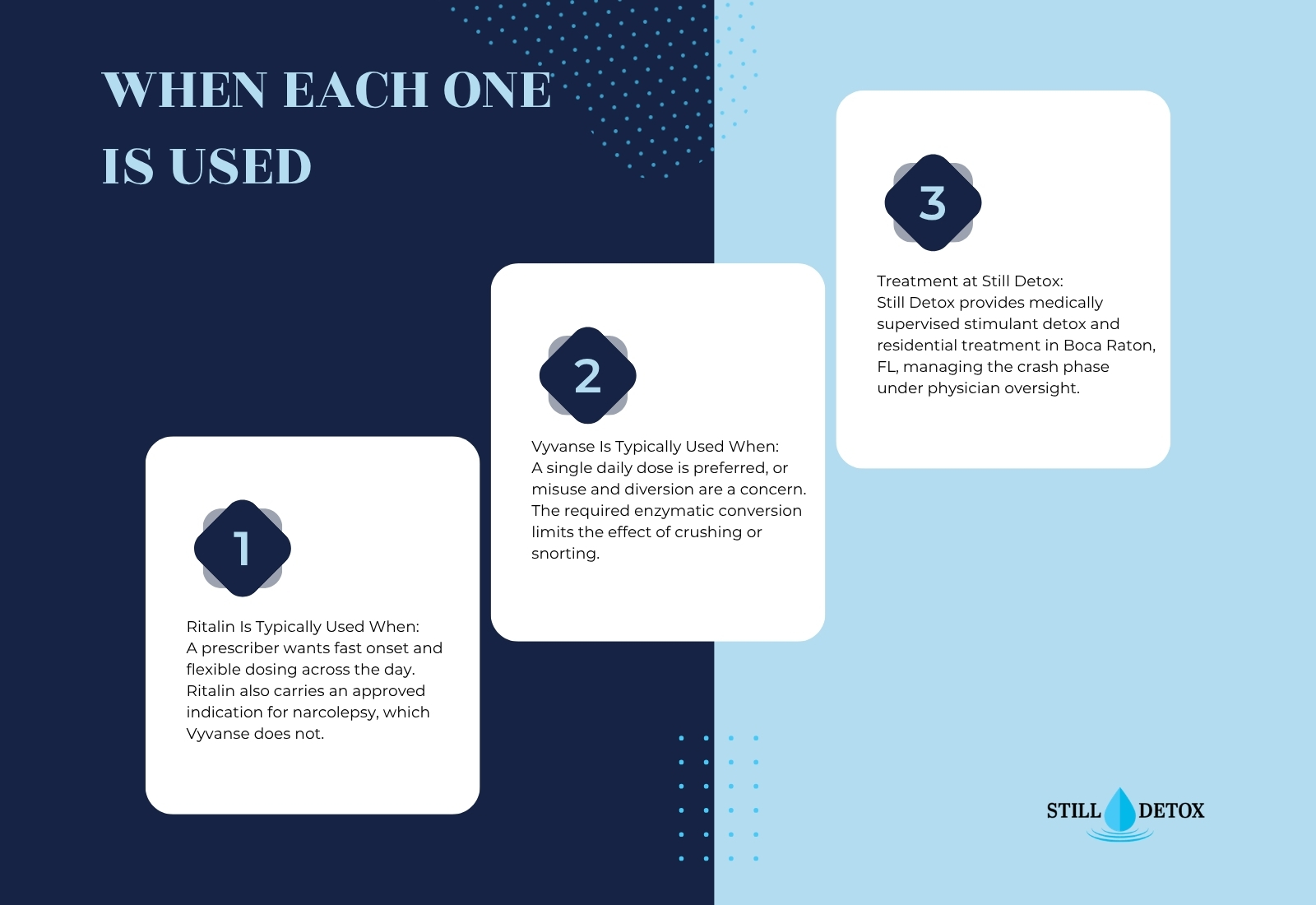
Vyvanse vs Ritalin: Onset, Peak, and Duration
Vyvanse and Ritalin follow markedly different pharmacokinetic curves, and those curves explain both their dosing schedules and their differing misuse potential.
Vyvanse Timeline After a Single Morning Dose
Lisdexamfetamine produces a delayed and gradual rise because absorption must precede enzymatic conversion.
- Minutes 0 to 60: Peptide transporter 1 absorbs the intact prodrug, and no stimulant effect is present.
- Hours 1 to 2: Red blood cell peptidase activity releases dextroamphetamine, and the initial effect emerges.
- Hours 3 to 4: Plasma dextroamphetamine reaches peak concentration.
- Hours 4 to 12: Effect holds at a relatively steady level without the sharp peaks of immediate-release stimulants.
- Hours 10 to 14: Effect tapers, and how long lisdexamfetamine remains detectable extends beyond the period of noticeable effect.
Ritalin Timeline After a Single Immediate-Release Dose
Immediate-release methylphenidate produces a rapid rise and an equally rapid decline, which is why prescribers divide the daily dose.
- Minutes 20 to 30: Methylphenidate begins occupying dopamine and norepinephrine transporters, and the effect starts.
- Hours 1 to 2: Plasma concentration peaks, producing the strongest effect of the dosing interval.
- Hours 3 to 4: Concentration falls and symptom control weakens, prompting the next scheduled dose.
- Hours 4 to 6: Rebound symptoms including irritability, fatigue, and returning inattention appear in some patients as levels drop.
Vyvanse and Ritalin Side Effects by Severity
Vyvanse and Ritalin share a side effect profile driven by sympathetic nervous system activation, ranging from appetite suppression to cardiovascular and psychiatric emergencies.
Common Side Effects of Vyvanse and Ritalin
Common side effects of both stimulants appear within the first weeks of treatment and reflect elevated norepinephrine activity.
- Appetite suppression is near-universal: Both medications reduce hunger, and Vyvanse produces longer appetite suppression because its effect spans 10 to 14 hours.
- Insomnia follows late dosing: Both stimulants delay sleep onset, particularly when a dose is taken in the afternoon or evening.
- Dry mouth and headache are frequent: Reduced salivary flow and tension headache accompany sympathetic activation.
- Heart rate and blood pressure rise modestly: Both medications elevate resting heart rate and blood pressure, which requires monitoring in patients with cardiovascular history.
- Irritability emerges as levels fall: The wearing-off period produces mood irritability, more noticeably with immediate-release Ritalin than with Vyvanse.
- Weight loss follows sustained appetite reduction: Continued appetite suppression produces weight loss, monitored closely in children and adolescents.
Severe Side Effects and Effects When Misused
Severe stimulant side effects concentrate in the cardiovascular and psychiatric systems and appear disproportionately when doses exceed what a prescriber ordered.
- Chest pain, shortness of breath, or fainting: These findings demand immediate emergency evaluation, because stimulants raise the risk of arrhythmia and, rarely, sudden cardiac events.
- Psychosis with hallucinations or paranoia: High doses precipitate stimulant-induced psychosis, which can occur even in people with no psychiatric history.
- Seizure activity: Stimulants lower the seizure threshold, and seizures at any dose require emergency assessment.
- Peripheral vasculopathy including Raynaud phenomenon: Both drugs constrict peripheral blood vessels, producing numbness, coolness, and color change in fingers and toes.
- Priapism: The Food and Drug Administration warns that methylphenidate products can cause prolonged, painful erections requiring urgent medical care.
- Severe agitation with high body temperature: This combination signals stimulant toxicity and requires emergency treatment.
- Suicidal thinking during withdrawal: Abrupt cessation after heavy use produces depressed mood severe enough to generate suicidal thoughts.
Long-Term Risks of Prescription Stimulant Misuse
Long-term prescription stimulant misuse produces cumulative cardiovascular, psychiatric, and functional damage that persists beyond the period of active use.
- Sustained hypertension damages the cardiovascular system: Chronic blood pressure elevation raises long-term risk of stroke and cardiomyopathy.
- Repeated psychosis episodes raise recurrence risk: Each stimulant-induced psychotic episode increases the likelihood of subsequent episodes at lower doses.
- Nasal and sinus damage follows insufflation: Crushing and snorting methylphenidate tablets erodes nasal tissue and introduces tablet fillers not intended for mucosal contact.
- Malnutrition compounds over months: Prolonged appetite suppression produces measurable weight loss and micronutrient deficiency, a pattern also documented in heavy amphetamine use.
- Occupational and academic function declines: The performance improvement that motivated misuse reverses as tolerance, sleep loss, and withdrawal cycles accumulate.
Abuse Risk: Which Carries Higher Misuse Potential
Immediate-release Ritalin carries higher misuse potential than Vyvanse, because methylphenidate requires no metabolic activation and therefore reaches peak brain concentration far faster.
Why the Vyvanse Prodrug Design Lowers Abuse Liability
The lisdexamfetamine prodrug structure reduces abuse liability by imposing a biological rate limit that no route of administration can bypass.
- Conversion must occur regardless of route: Crushing, snorting, or dissolving and injecting lisdexamfetamine does not skip the red blood cell hydrolysis step required to release dextroamphetamine.
- The dopamine rise stays gradual: Slower release produces a slower rise in nucleus accumbens dopamine, which reduces the euphoric reinforcement Volkow and Swanson identified as the driver of misuse.
- Clinical trials show lower subjective drug liking: Human abuse liability studies reported lower drug-liking scores for oral lisdexamfetamine than for equivalent immediate-release dextroamphetamine.
- Lower liability is not zero liability: Vyvanse remains a Schedule II controlled substance, and taking doses above what a prescriber ordered still produces dependence.
Why Immediate-Release Ritalin Carries Higher Misuse Potential
Immediate-release methylphenidate carries elevated misuse potential because its rapid onset and short duration create both a sharp reinforcing signal and frequent dosing opportunities.
- Onset within 20 to 30 minutes produces a steep rise: Fast transporter occupancy generates the rapid dopamine increase that drives reinforcement.
- Non-oral routes accelerate the effect further: Crushing tablets and insufflating the powder shortens time to peak concentration and intensifies the subjective effect.
- Short duration multiplies dosing decisions: Three daily doses create three daily opportunities to take more than prescribed.
- Multiple daily doses complicate diversion tracking: Divided dosing makes missing tablets harder for prescribers and families to detect.
How Diversion Happens With Both Medications
Diversion of both stimulants occurs primarily through social networks rather than illicit markets, which shapes who develops stimulant use disorder.
- Sharing among peers is the dominant route: Most people who misuse prescription stimulants obtain them from a friend, family member, or classmate holding a valid prescription.
- Misuse concentrates among prescription holders: Compton and colleagues found in 2025 that a quarter of adults prescribed stimulants reported misusing them, indicating that misuse frequently begins inside legitimate treatment.
- Counterfeit tablets add overdose risk: Pills purchased outside a pharmacy and sold as Adderall or Ritalin increasingly contain methamphetamine or fentanyl.
- Early warning signs precede disorder: Recognizing signs of prescription drug misuse allows intervention before dependence establishes itself.
How Stimulant Use Disorder Is Diagnosed
Clinicians diagnose stimulant use disorder using DSM-5-TR criteria, evaluating a pattern of stimulant use that produces clinically significant impairment across a 12-month period.
DSM-5-TR Criteria for Stimulant Use Disorder
The DSM-5-TR defines stimulant use disorder through 11 criteria, with severity graded by how many criteria a person meets within 12 months.
- Severity is graded by criteria count: Two to three criteria indicate mild stimulant use disorder, four to five indicate moderate, and six or more indicate severe.
- Loss of control appears across several criteria: Taking larger amounts than intended, unsuccessful attempts to cut down, and persistent craving reflect impaired control.
- Tolerance and withdrawal are excluded when medication is taken as prescribed: The DSM-5-TR does not count tolerance or withdrawal toward diagnosis in people taking stimulants under appropriate medical supervision.
- Functional consequences carry diagnostic weight: Failure to meet obligations at work or school, continued use despite interpersonal problems, and abandoning activities all count toward the diagnosis.
Screening With the Drug Abuse Screening Test
The Drug Abuse Screening Test provides a brief self-report screen that quantifies the severity of drug-related problems before formal assessment.
- The 10-item version is standard: The Drug Abuse Screening Test, 10-item version (DAST-10), asks about the past 12 months and yields a score from 0 to 10.
- Score bands map to severity: A score of 0 indicates no reported problems, 1 to 2 indicates low level, 3 to 5 moderate, 6 to 8 substantial, and 9 to 10 severe drug-related problems.
- The Adult ADHD Self-Report Scale addresses the other side of the question: The Adult ADHD Self-Report Scale, version 1.1 (ASRS-v1.1), screens for adult ADHD, where four or more marked items in Part A indicate symptoms consistent with the condition and warrant evaluation.
- Screening never replaces assessment: Both instruments identify who needs a clinical evaluation rather than establishing a diagnosis.
Signs a Prescription Has Become a Problem
Specific behavioral patterns distinguish appropriate stimulant use from misuse that warrants clinical attention.
- Running out of medication before the refill date: Early depletion indicates doses are being taken more frequently or at higher amounts than prescribed.
- Taking a dose to function rather than to focus: Needing the medication to get out of bed or to feel normal signals dependence rather than symptom management.
- Seeking prescriptions from multiple prescribers: Obtaining overlapping prescriptions is a defining pattern of stimulant use disorder.
- Changing the route of administration: Crushing, snorting, or injecting a medication intended for oral use marks a clear transition into misuse.
- Combining stimulants with alcohol or sedatives: Layering substances to manage stimulant side effects establishes a polysubstance pattern that raises overdose risk.
“Almost nobody arrives here describing themselves as addicted to a stimulant. They describe a prescription that stopped working, so they took a little more, and then the refill ran out four days early, and then it was six. The medication never changed. What changed is that the dose became a decision they were making instead of one a physician was making.”
Dr. Gladys Martinez, Medical Director, Still Detox
Treatment for Prescription Stimulant Addiction
Treatment for prescription stimulant addiction relies primarily on behavioral therapy, because no medication holds Food and Drug Administration approval for stimulant use disorder.
First-Line Behavioral Therapies
Behavioral therapies carry the strongest evidence base for stimulant use disorder and form the foundation of treatment.
- Contingency management holds the strongest evidence: This approach delivers structured incentives for verified abstinence and outperforms other single interventions for stimulant use disorder.
- Cognitive behavioral therapy restructures use patterns: Cognitive behavioral therapy identifies the performance demands and emotional states that precede stimulant use and builds alternative responses.
- The Matrix Model integrates multiple components: This structured 16-week outpatient protocol combines cognitive behavioral elements, family education, and drug testing specifically for stimulant users.
- Community reinforcement approach restructures reward: This modality builds non-drug sources of reinforcement in work, family, and social domains.
Medications Used During Stimulant Withdrawal
No medication carries approval for stimulant use disorder, so prescribers target specific withdrawal symptoms rather than the disorder itself.
- No approved pharmacotherapy exists: The Food and Drug Administration has approved no medication for stimulant use disorder, unlike opioid or alcohol use disorder.
- Antidepressants address the crash-phase mood drop: Prescribers use bupropion or mirtazapine off-label when depressed mood persists past the acute withdrawal window.
- Trazodone and mirtazapine support sleep: Sleep restoration during withdrawal reduces relapse risk in the first weeks.
- Existing ADHD requires a treatment plan: Patients with genuine ADHD need a plan for managing symptoms without the misused medication, developed with a prescriber.
Second-Line and Adjunct Approaches
Second-line approaches extend treatment when behavioral therapy alone produces insufficient response.
- Group therapy reduces isolation: Structured group work counters the social withdrawal that accompanies stimulant use disorder.
- Family therapy restores accountability structures: Family involvement addresses the household patterns that enabled diversion or concealment.
- Sleep and exercise interventions rebuild baseline function: Structured sleep hygiene and physical activity accelerate recovery of energy and mood.
- Mutual-help participation extends support: Twelve-step and alternative peer groups provide continuing support after structured treatment ends.
Emerging and Investigational Treatments
Several treatments for stimulant use disorder remain investigational, and none holds an approved indication in the United States.
- Combined bupropion and injectable naltrexone is in advanced trials: The ADAPT-2 trial tested this combination for methamphetamine use disorder, and it holds no approved indication for stimulant use disorder.
- Modafinil is used off-label with mixed results: This wakefulness-promoting agent has been trialed for stimulant use disorder without consistent benefit.
- Transcranial magnetic stimulation is investigational for craving: This noninvasive brain stimulation approach carries approval for depression but remains investigational for stimulant craving.
- N-acetylcysteine is under study for craving reduction: This glutamate-modulating supplement is being investigated for craving in stimulant use disorder, with no approved indication.
Treatment at Still Detox
Still Detox provides medically supervised detoxification and long-term residential treatment in Boca Raton, Florida, for adults whose use of prescribed or diverted stimulants has progressed to stimulant use disorder.
Medically Supervised Stimulant Detox
Medically supervised detox at Still Detox manages the stimulant crash phase, when fatigue, hyperphagia, and depressed mood peak in the first days after cessation.
- The crash phase requires monitoring rather than tapering: Stimulant withdrawal does not produce the seizure risk of alcohol or benzodiazepine withdrawal, but depressed mood and suicidal thinking make supervision important.
- Medical oversight is physician-directed: Medical Director Dr. Gladys Martinez oversees medical protocols, with nursing care directed by Britney Marshall, RN.
- Accreditation reflects independent review: Still Detox holds Joint Commission accreditation and licensure through the Florida Department of Children and Families.
- Polysubstance patterns are assessed on admission: Many patients presenting with stimulant misuse are also using alcohol or sedatives, which changes the detox protocol.
Long-Term Residential Treatment
Long-term residential care at Still Detox delivers the behavioral therapy that constitutes the primary evidence-based treatment for stimulant use disorder.
- Cognitive and dialectical behavior therapies anchor the program: Still Detox delivers cognitive behavioral therapy and dialectical behavior therapy as core clinical modalities.
- Residential length allows the crash phase to resolve: Extended residential care spans the weeks during which mood and sleep normalize after stimulant cessation.
- Twelve-step programming supplements clinical work: Structured twelve-step participation runs alongside individual and group therapy.
- An LGBTQ-affirming track is offered: Still Detox maintains a dedicated LGBTQ program within its Boca Raton facility.
Dual Diagnosis Care for ADHD and Co-Occurring Conditions
Co-occurring mental health conditions receive concurrent treatment at Still Detox, which matters because untreated ADHD, depression, or anxiety predicts return to stimulant misuse.
- Genuine ADHD requires a forward plan: Patients with confirmed ADHD need a management strategy developed with a prescriber, because leaving the condition untreated raises relapse risk.
- Depression and anxiety are assessed after the crash resolves: Acute withdrawal mimics depression, so psychiatric assessment carries more accuracy once the crash phase has passed.
- Misuse of prescribed medications is addressed directly: Still Detox treats misuse of prescribed medications alongside other substance use disorders.
“The hardest conversation in stimulant treatment is not about stopping. It is about what happens in month three, when somebody with real attention problems is sober, functioning, and being told they cannot go back to the medication that used to work. Recovery does not hold unless that question has an actual answer, and the answer has to come from a prescriber, not from willpower.”
Britney Barnes, Clinical Director, Still Detox
Frequently Asked Questions
Is Ritalin stronger than Vyvanse?
Neither medication is uniformly stronger. Ritalin produces a faster and sharper rise in dopamine because methylphenidate needs no conversion, so its effect feels more abrupt. Vyvanse delivers a steadier effect across 10 to 14 hours because red blood cell enzymes release dextroamphetamine gradually. Comparing milligram amounts between the two is meaningless, since they act through different mechanisms.
Why do people switch from Ritalin to Vyvanse?
Prescribers often move patients to Vyvanse when immediate-release methylphenidate wears off mid-afternoon and produces rebound irritability. A single Vyvanse dose covers a full day without repeat dosing. Clinicians also select Vyvanse when misuse or diversion is a concern, because the prodrug design limits the effect of crushing or snorting. That decision belongs to a prescribing physician.
Is Ritalin addictive?
Yes. Methylphenidate blocks the dopamine transporter with potency comparable to cocaine, and the Drug Enforcement Administration classifies it as a Schedule II controlled substance. Taken orally as prescribed, the slow rise in dopamine keeps addiction risk low. Crushing, snorting, or taking doses above what a physician prescribed accelerates that rise and generates dependence.
How long does Ritalin last compared to Vyvanse?
Immediate-release Ritalin takes effect within 20 to 30 minutes and lasts roughly 3 to 4 hours, which is why prescribers order two or three daily doses. Vyvanse begins working after 1 to 2 hours and continues for 10 to 14 hours on a single morning dose. The required conversion step explains both the delayed onset and the extended duration.
Can you become dependent on Vyvanse if you take it as prescribed?
Physical dependence develops in some people taking Vyvanse exactly as prescribed, producing fatigue and low mood if the medication stops abruptly. Dependence differs from addiction. Addiction involves compulsive use and loss of control, which the DSM-5-TR classifies as stimulant use disorder. Anyone stopping long-term stimulant therapy should do so under physician supervision.
What happens if you stop taking Vyvanse or Ritalin suddenly?
Abrupt discontinuation triggers a withdrawal crash marked by extreme fatigue, increased appetite, vivid dreams, and depressed mood. Symptoms typically peak within 1 to 3 days and ease across one to two weeks. Suicidal thinking emerges in some people during this window, which makes medical supervision important for anyone stopping after heavy or prolonged use.
Which stimulant causes more weight loss?
Both suppress appetite, but amphetamine-based Vyvanse generally produces stronger and longer-lasting appetite reduction because its effect spans 10 to 14 hours. Shorter-acting Ritalin allows appetite to return between doses. The Food and Drug Administration approved Vyvanse for moderate to severe binge eating disorder, though weight loss is not an approved use for either medication.
Can adults take Ritalin and Vyvanse together?
Prescribers occasionally combine a long-acting stimulant with a short-acting one to extend afternoon coverage, but that decision requires a physician and cardiovascular monitoring. Combining amphetamine and methylphenidate compounds blood pressure elevation, heart rate increase, and insomnia risk. Taking both without a prescription substantially raises the chance of stimulant-induced psychosis and cardiovascular emergency.
References
- Volkow, N. D., Wang, G.-J., Fowler, J. S., Gatley, S. J., Logan, J., Ding, Y.-S., Hitzemann, R., & Pappas, N. (1998). Dopamine transporter occupancies in the human brain induced by therapeutic doses of oral methylphenidate. American Journal of Psychiatry, 155(10), 1325-1331.
- Volkow, N. D., & Swanson, J. M. (2003). Variables that affect the clinical use and abuse of methylphenidate in the treatment of ADHD. American Journal of Psychiatry, 160(11), 1909-1918.
- Pennick, M. (2014). Lisdexamfetamine prodrug activation by peptidase-mediated hydrolysis in the cytosol of red blood cells. Neuropsychiatric Disease and Treatment, 10, 317-327.
- Substance Abuse and Mental Health Services Administration. (2024). Key substance use and mental health indicators in the United States: Results from the 2023 National Survey on Drug Use and Health. https://www.samhsa.gov/data/
- Compton, W. M., Han, B., Blanco, C., Johnson, K., & Jones, C. M. (2025). Prescription stimulant use, misuse, and use disorder among US adults aged 18 to 64 years. JAMA.
- Staley, B. S., Robinson, L. R., Claussen, A. H., Katz, S. M., Danielson, M. L., Summers, A. D., Farr, S. L., Blumberg, S. J., & Tinker, S. C. (2024). Attention-deficit/hyperactivity disorder diagnosis, treatment, and telehealth use in adults, National Center for Health Statistics Rapid Surveys System, United States, October to November 2023. MMWR. Morbidity and Mortality Weekly Report, 73(40), 890-895. https://www.cdc.gov/mmwr/volumes/73/wr/mm7340a1.htm
- U.S. Food and Drug Administration. (2023). Vyvanse (lisdexamfetamine dimesylate) prescribing information. https://www.accessdata.fda.gov
- American Psychiatric Association. (2022). Diagnostic and statistical manual of mental disorders (5th ed., text rev.).


