




Belbuca and Suboxone both contain buprenorphine, but they are approved for different conditions and are not interchangeable. Belbuca is a buccal film approved by the FDA for chronic pain, while Suboxone is a sublingual film approved for opioid use disorder (OUD). The two medications differ in ingredients, dosing units, and intended use, even though they share the same core opioid.
Confusing the two can lead to under-treatment of pain, under-treatment of addiction, or an unsafe medication switch. So what actually separates these two buprenorphine products, and does either one carry addiction risk of its own?
Key Takeaways
- Belbuca (buprenorphine buccal film) is FDA-approved for chronic pain; Suboxone (buprenorphine/naloxone sublingual film) is FDA-approved for opioid use disorder. Neither is approved for the other’s use.
- Suboxone contains naloxone as an abuse-deterrent; Belbuca does not, because it is not designed to treat opioid dependence.
- In 2024, an estimated 4.8 million Americans aged 12 or older had opioid use disorder, and only 17.0% (818,000 people) received medications for it, according to SAMHSA’s National Survey on Drug Use and Health.
- Buprenorphine’s partial-agonist “ceiling effect” gives both drugs a safer overdose profile than full opioid agonists like methadone or oxycodone.
- Both medications are Schedule III controlled substances, reflecting lower abuse potential than Schedule II opioids, though misuse and diversion risk still exist.
What Are Belbuca and Suboxone?
Belbuca and Suboxone are both brand-name medications built on buprenorphine, but each is formulated and FDA-approved for a distinct clinical purpose.
Belbuca: Buprenorphine for Chronic Pain
- Belbuca delivers buprenorphine alone through a dissolving buccal film placed against the inner cheek, where the drug absorbs across the buccal mucosa using BioErodible MucoAdhesive (BEMA) technology.
- The FDA approved Belbuca in October 2015 specifically for chronic pain severe enough to require daily, around-the-clock opioid treatment when other options are inadequate, not for opioid use disorder.
- Belbuca comes in seven dose strengths from 75 to 900 micrograms, allowing physicians to titrate pain relief precisely without reaching doses intended for addiction treatment.
Suboxone: Buprenorphine and Naloxone for Opioid Use Disorder
- Suboxone combines buprenorphine with naloxone in a sublingual film placed under the tongue, and it is FDA-approved specifically to treat opioid use disorder (OUD), the clinical diagnosis defined in the DSM-5-TR.
- Suboxone doses range from about 2 to 24 milligrams of buprenorphine daily, dosed in milligrams rather than the micrograms used for Belbuca, reflecting its role in blocking cravings from stronger opioids.
- Clients considering medication options for opioid dependence can review the medication-assisted treatment FAQ for eligibility and induction requirements.
How Buprenorphine Works in the Brain
Both Belbuca and Suboxone rely on buprenorphine’s unique partial-agonist chemistry, which produces effects at opioid receptors but stops well short of a full opioid response.
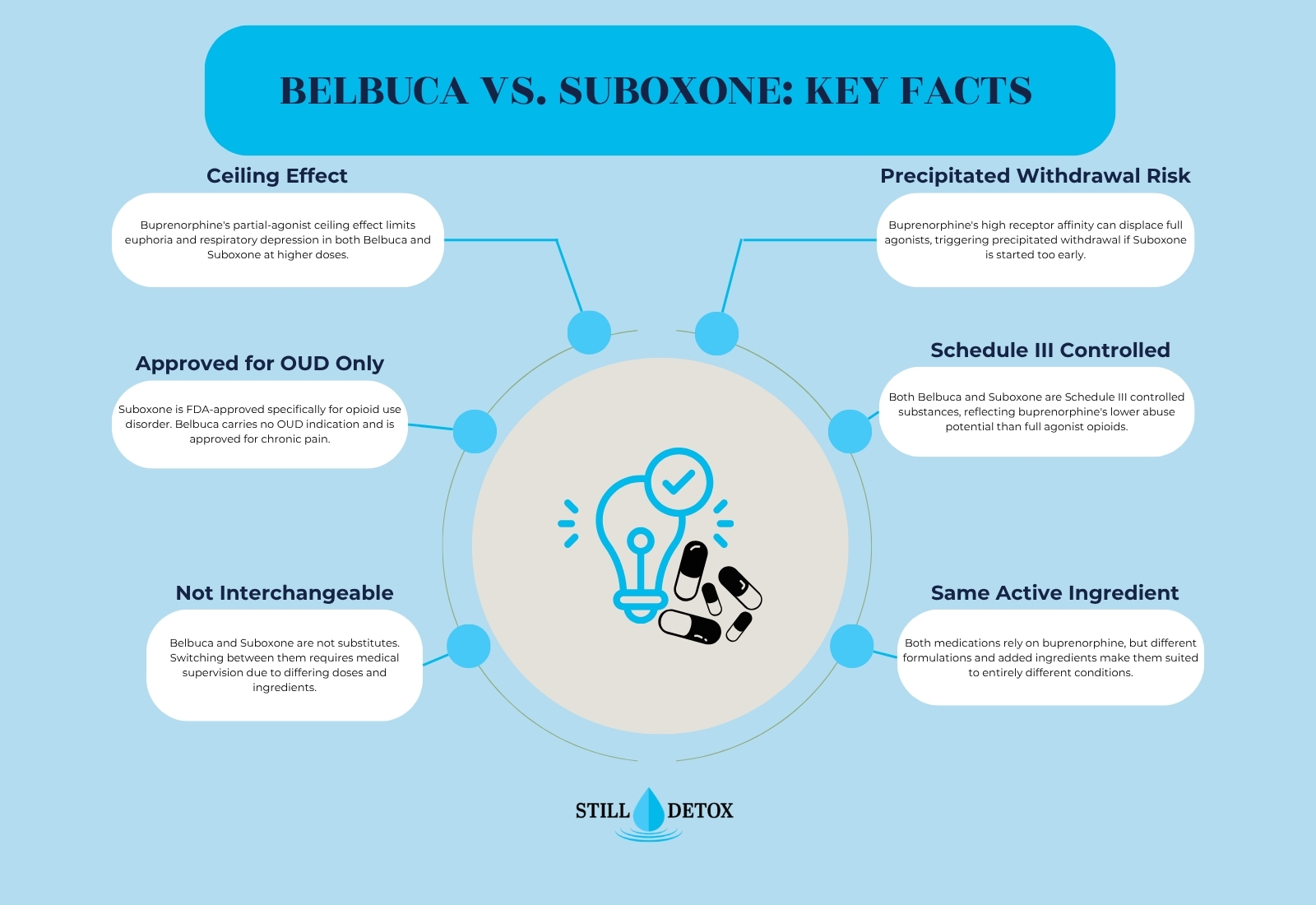
Partial Agonism and the Ceiling Effect
- Buprenorphine binds tightly to mu-opioid receptors as a partial agonist, producing pain relief and blocking cravings without the full euphoric or respiratory-depressing effect of a full agonist like oxycodone or methadone.
- Buprenorphine’s agonist effects plateau at a dose ceiling, typically around 12 to 16 milligrams, so increasing the dose beyond that point produces no additional euphoria or respiratory depression, which lowers overdose risk compared with full agonists.
- Buprenorphine also acts as a kappa-opioid receptor antagonist, a secondary mechanism thought to contribute to its comparatively mild dysphoria and lower abuse liability relative to other opioids.
Why Naloxone Is Added to Suboxone but Not Belbuca
- Naloxone is a potent mu-opioid receptor antagonist added to Suboxone specifically to deter injection misuse, since it produces almost no effect when taken as directed sublingually but precipitates immediate withdrawal if the film is dissolved and injected.
- Belbuca omits naloxone because it is designed for pain patients rather than individuals actively dependent on opioids, where injection-deterrence is not the primary clinical concern.
Precipitated Withdrawal Risk
- Buprenorphine’s high receptor affinity can displace full agonists like heroin or oxycodone from mu-opioid receptors, and because buprenorphine only partially activates those receptors, this displacement can trigger sudden precipitated withdrawal.
- Clinicians use the Clinical Opiate Withdrawal Scale (COWS) to confirm a patient has entered withdrawal, generally waiting for a score above 12, before starting Suboxone induction to avoid precipitating a more severe reaction. Readers can review the full Clinical Opiate Withdrawal Scale breakdown for scoring details.
Formulation and Dosing Timeline: Belbuca vs. Suboxone
Belbuca and Suboxone use different film placements, absorption routes, and dosing schedules that reflect their distinct clinical purposes.
Belbuca Buccal Film: Dosing and Onset
- Belbuca is applied to the inner cheek every 12 hours, with the buccal mucosa providing steady, sustained absorption suited to continuous pain control rather than rapid symptom relief.
- Belbuca’s seven-strength dosing range tops out at roughly 900 micrograms twice daily, equivalent to a maximum of about 160 milligrams of oral morphine sulfate per day.
Suboxone Sublingual Film: Dosing and Onset
- Suboxone film or tablets dissolve under the tongue or against the cheek over 2 to 5 minutes, a faster and more direct absorption route than Belbuca’s buccal placement.
- Suboxone dosing typically starts at 2 to 4 milligrams and increases as treatment progresses, adjusted based on withdrawal control and craving suppression rather than a fixed pain-management target.
- Individuals wondering about the tapering process afterward can review how long Suboxone withdrawal typically lasts once treatment concludes.
Misuse Potential and Safety Profile
Belbuca and Suboxone are both Schedule III controlled substances with lower abuse potential than Schedule II opioids, but neither is entirely free of misuse or safety risk.
Common Side Effects
- Nausea, constipation, and dizziness: Both medications commonly cause these effects, reflecting their shared opioid-receptor activity even at partial-agonist doses.
- Headache and drowsiness: These effects are typically mild and often diminish as the body adjusts to a stable dose.
Serious Risks and Warning Signs
- Precipitated withdrawal: Starting Suboxone too soon after a full agonist opioid can trigger sudden, severe withdrawal symptoms requiring medical attention.
- Respiratory depression when combined with sedatives: Mixing either medication with benzodiazepines or alcohol substantially raises the risk of dangerous breathing suppression, despite buprenorphine’s ceiling effect.
- Liver toxicity signs such as yellowing skin or dark urine warrant immediate medical evaluation in anyone taking buprenorphine-based products long-term.
Diversion and Abuse Potential
- Buprenorphine’s ceiling effect reduces but does not eliminate abuse potential, and diversion of both Belbuca and Suboxone has been documented, though less frequently than with full-agonist opioids.
- Clients with concerns about safe use alongside other medications should review Suboxone overdose risks and symptoms before starting treatment.
Belbuca vs. Suboxone: Which Treats What?
Belbuca and Suboxone share buprenorphine as their active ingredient but are approved for entirely different clinical uses, which is the single most important distinction between them.
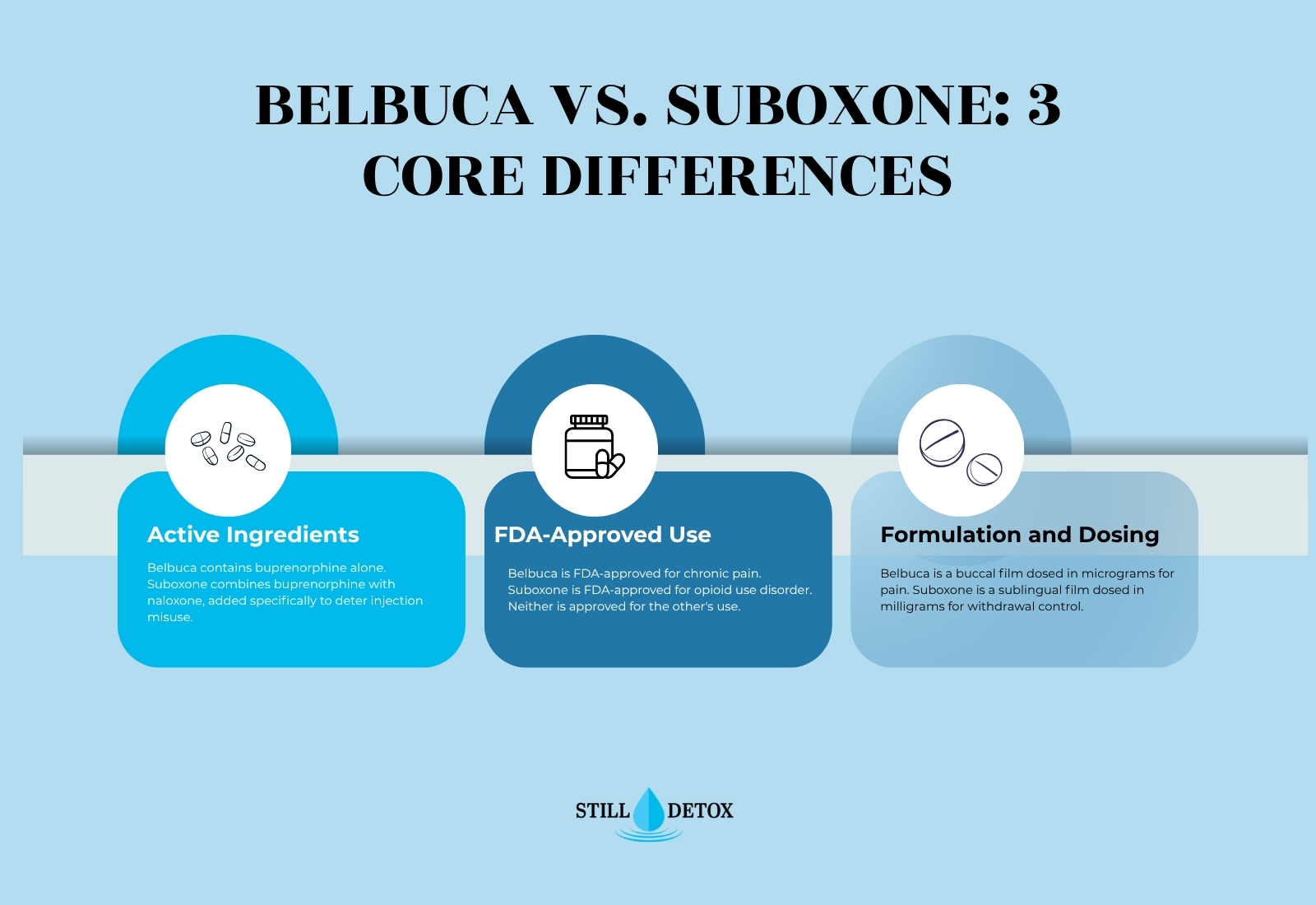
| Feature | Belbuca | Suboxone |
|---|---|---|
| Active ingredients | Buprenorphine only | Buprenorphine + naloxone |
| FDA-approved use | Chronic pain | Opioid use disorder (OUD) |
| Formulation | Buccal film (inner cheek) | Sublingual film or tablet (under tongue) |
| Dosing range | 75-900 mcg every 12 hours | 2-24 mg daily |
| Abuse-deterrent mechanism | None | Naloxone (activates only if injected) |
| DEA scheduling | Schedule III | Schedule III |
Treatment for Opioid Use Disorder
Suboxone is one option within a four-tier approach to opioid use disorder treatment that combines behavioral therapy, medication, and long-term monitoring.
First-Line Behavioral Therapies
- Cognitive behavioral therapy (CBT) addresses the thought patterns that drive cravings and supports relapse prevention alongside medication.
- Contingency management reinforces abstinence with structured incentives, a behavioral approach with strong evidence specifically for opioid use disorder.
First-Line Medications for OUD
- Suboxone (buprenorphine/naloxone) is a first-line FDA-approved medication for OUD, reducing cravings and withdrawal severity while its naloxone component deters injection misuse.
- Methadone fully activates opioid receptors under daily clinical supervision, offering a longer-acting alternative for individuals with more severe dependence.
- Naltrexone (Vivitrol) blocks opioid receptors entirely and supports relapse prevention once a person has fully cleared opioids from their system.
- Belbuca is not FDA-approved for OUD, though its buprenorphine content means some prescribers use it off-label in select pain-management-with-dependence cases; this use requires close clinical supervision and is not a substitute for Suboxone.
Second-Line and Adjunct Treatments
- Sublocade, a monthly buprenorphine injection, offers an alternative to daily dosing for individuals who have stabilized on sublingual buprenorphine.
- Clonidine and lofexidine (Lucemyra) ease residual withdrawal symptoms during buprenorphine dose adjustments or induction.
Emerging and Investigational Treatments
- Brixadi, a long-acting injectable buprenorphine formulation, expands dosing intervals beyond monthly options currently on the market.
- Expanded prescriber access following the 2023 elimination of the buprenorphine X-waiver is being studied for its effect on treatment gaps, since most U.S. counties with high opioid mortality still lack sufficient buprenorphine-certified providers.
Buprenorphine Treatment at Still Detox
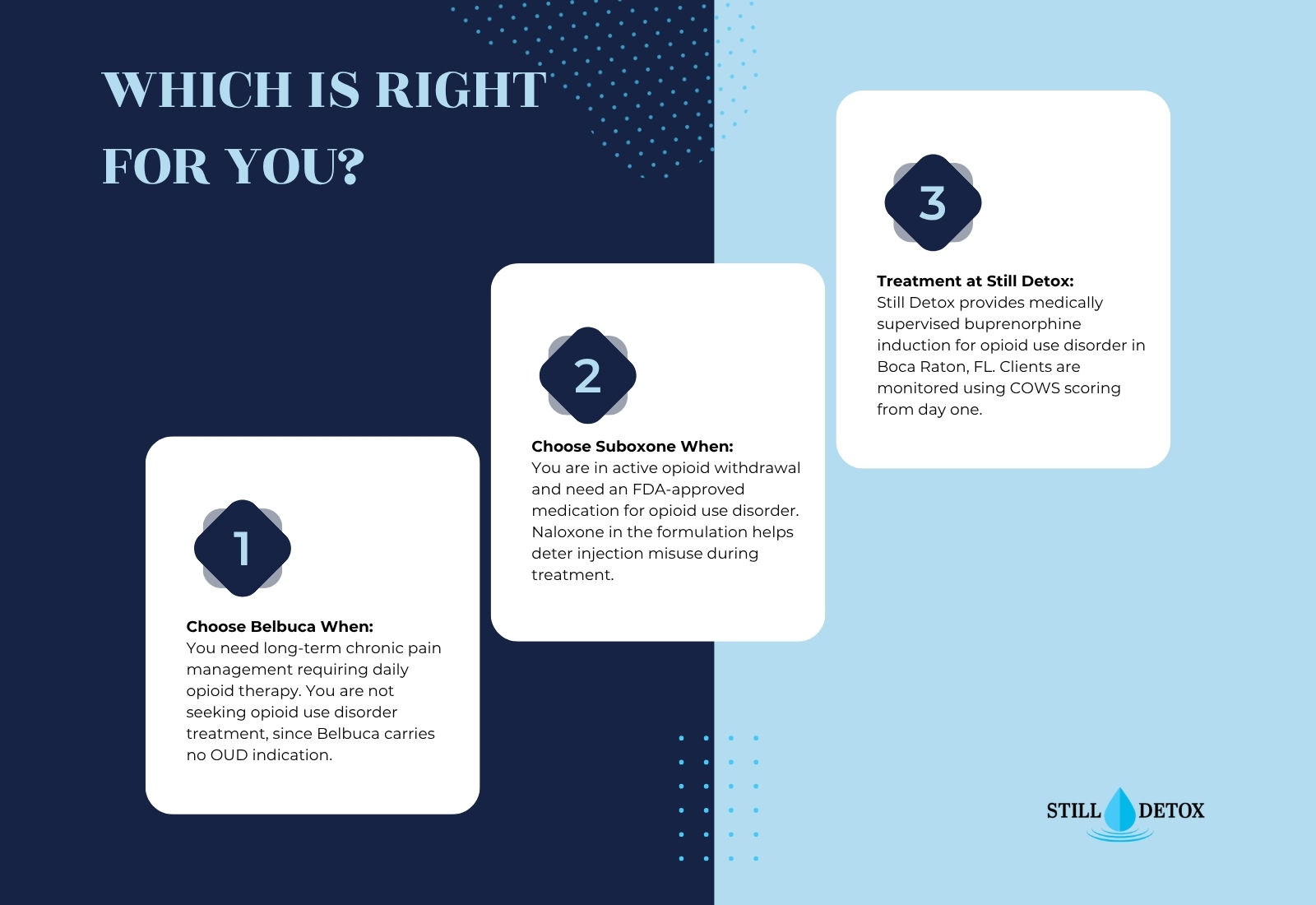
Still Detox provides medically supervised buprenorphine induction and management in Boca Raton, Florida, for clients starting Suboxone as part of opioid use disorder treatment.
Medically Supervised Buprenorphine Induction
- Clients are monitored through COWS scoring before induction begins, reducing the risk of precipitated withdrawal that can occur when buprenorphine is started too early.
- Clients can review the full detoxification program and inpatient rehab treatment options available before and after induction.
Addiction specialist Shelly Thompson, who holds a Master’s in Clinical Mental Health Counseling and has worked in the field since 2020, notes: “People are often relieved to learn Suboxone and a pain medication like Belbuca aren’t the same thing. That distinction changes how we build their plan. Families often assume any buprenorphine product will work the same way, but thats not the case. We address that directly during our treatment program.
Frequently Asked Questions
Is Belbuca the same as Suboxone?
No. Both contain buprenorphine, but Belbuca is approved for chronic pain and Suboxone is approved for opioid use disorder. They differ in ingredients, dosing units, and formulation.
Can Belbuca be used for opioid withdrawal?
Belbuca is not FDA-approved for opioid withdrawal or OUD. Some prescribers use it off-label in specific pain-with-dependence cases, but this requires close medical supervision.
Does Belbuca get you high?
Buprenorphine’s partial-agonist ceiling effect limits euphoria compared to full opioids, so most patients report mild or no noticeable high at therapeutic pain-management doses.
How long does Suboxone treatment typically last?
Some people use Suboxone for a short detox period, while others remain on it for extended maintenance. Duration depends on individual treatment goals and clinical progress.
Is Belbuca addictive?
Belbuca carries some abuse potential as a Schedule III opioid, though its ceiling effect and dosing profile make dependence less likely than with full-agonist pain medications.
Can you switch between Belbuca and Suboxone?
Only under medical supervision. The two are not interchangeable, since Belbuca lacks naloxone and is dosed for pain rather than opioid use disorder.
What happens if you take Belbuca and Suboxone together?
Combining the two provides no additional benefit due to buprenorphine’s shared ceiling effect and increases the risk of side effects like sedation. Never combine them without medical guidance.
Which is safer in overdose, Belbuca or Suboxone?
Both carry a similar overdose profile because both rely on buprenorphine’s ceiling effect. Risk increases substantially when either is combined with benzodiazepines or alcohol.
References
- American Psychiatric Association. (2022). Diagnostic and Statistical Manual of Mental Disorders (5th ed., text rev.). APA Publishing.
- Substance Abuse and Mental Health Services Administration. (2025). Key substance use and mental health indicators in the United States: Results from the 2024 National Survey on Drug Use and Health. SAMHSA.
- Substance Abuse and Mental Health Services Administration. (2025). NSDUH data spotlight: Medications for opioid use disorder. SAMHSA.
- Kumar, R., Viswanath, O., & Saadabadi, A. (2024). Buprenorphine. In StatPearls. StatPearls Publishing.
- U.S. Food and Drug Administration. (2015). FDA approves Belbuca (buprenorphine) buccal film for chronic pain management [Press release]. Endo Pharmaceuticals.
- Das, S., Muhetaer, K., Gandotra, N., & Tomoyasu, N. (2024). Filling the treatment gap: Geographic expansion of buprenorphine providers across the U.S. Journal of Substance Use and Addiction Treatment.
- Wesson, D. R., & Ling, W. (2003). The Clinical Opiate Withdrawal Scale (COWS). Journal of Psychoactive Drugs, 35(2), 253-259.
- Substance Abuse and Mental Health Services Administration. (2023). Treatment Episode Data Set (TEDS) 2022: Admissions to and discharges from publicly funded substance use treatment. SAMHSA.


