

No, Naltrexone and Suboxone are not the same drug. Naltrexone is a pure opioid antagonist that blocks all opioid activity at receptor sites, while Suboxone is a combination of buprenorphine, a partial opioid agonist, and naloxone. These are entirely different pharmacological classes with different mechanisms, different clinical indications, and a fundamentally different relationship to opioid receptors.
Both are FDA-approved medications for addiction treatment, both involve opioid receptors, and both appear frequently in conversations about medication-assisted treatment. But prescribing one when a patient needs the other carries serious clinical consequences.
Key Takeaways
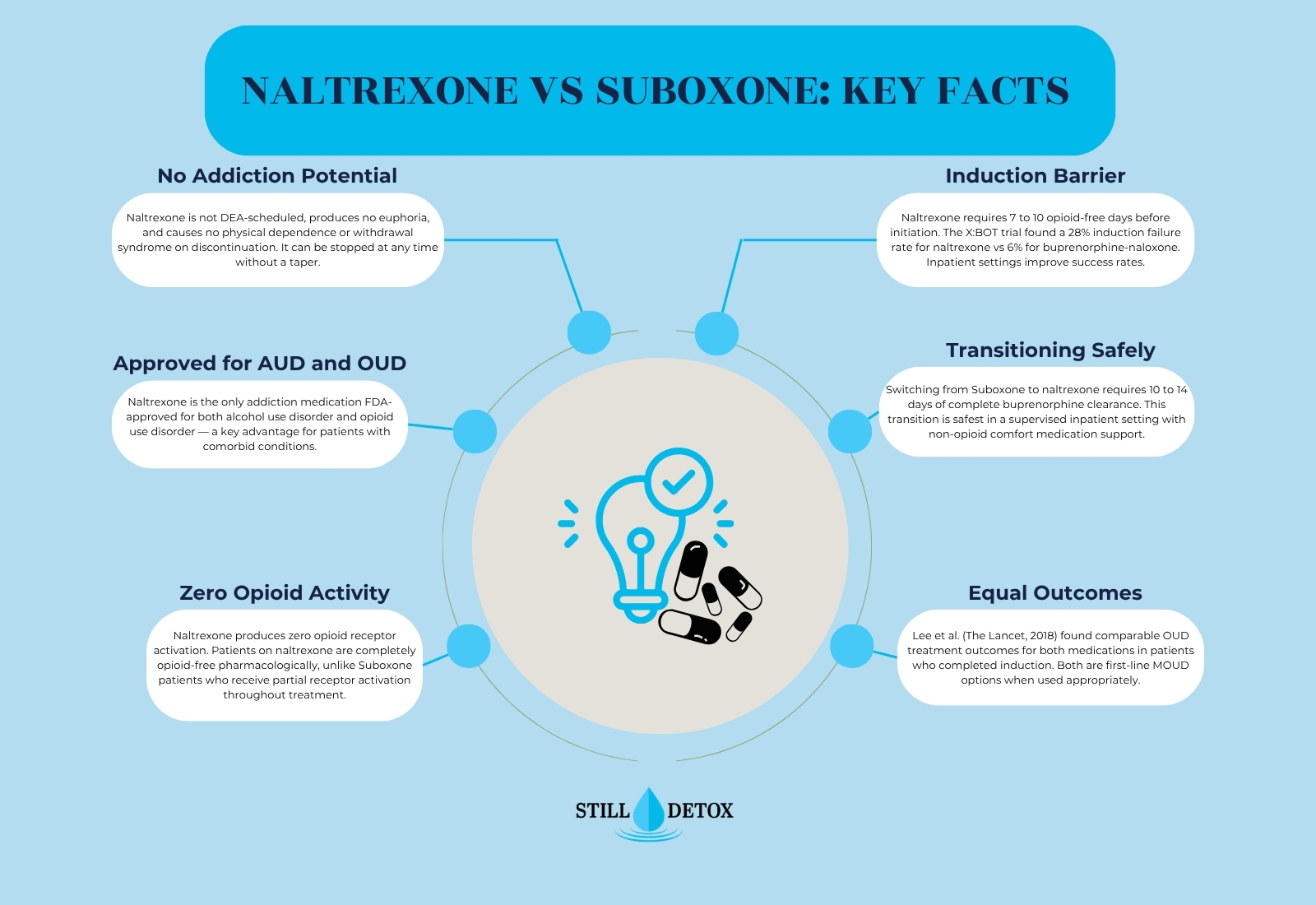
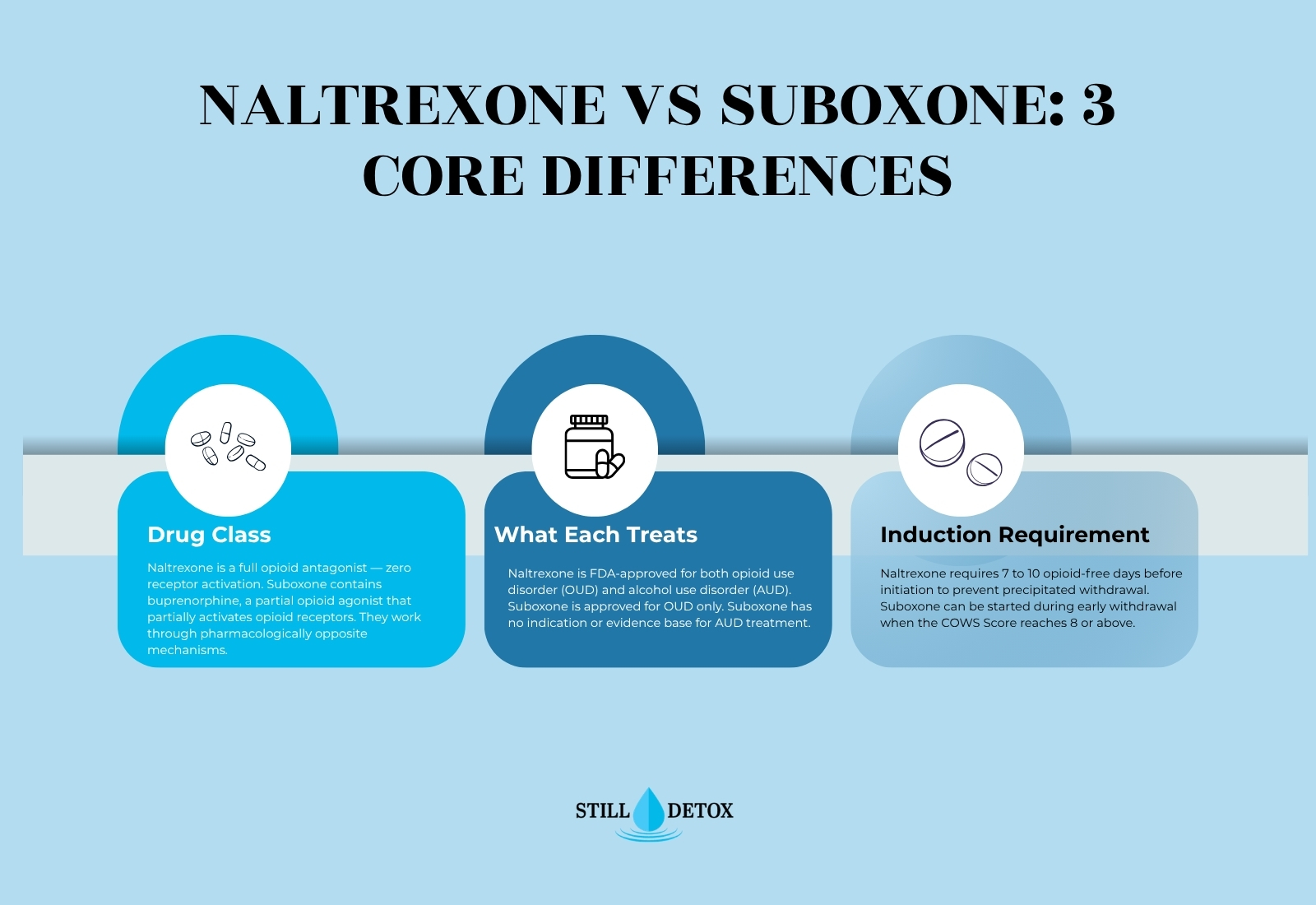
- Naltrexone is a full opioid antagonist approved for both alcohol use disorder (AUD) and opioid use disorder (OUD). Suboxone contains buprenorphine, a partial opioid agonist approved for OUD only, it is not approved for AUD.
- According to SAMHSA’s 2023 NSDUH, approximately 6 million Americans aged 12 and older met DSM-5 criteria for opioid use disorder in the past year. Buprenorphine/naloxone and naltrexone are the two primary outpatient pharmacological treatments available.
- Naltrexone requires a minimum 7 to 10 days of opioid abstinence before initiation to avoid precipitated withdrawal. Suboxone can be started during early opioid withdrawal without this waiting period.
- Naltrexone carries zero addiction potential and zero DEA scheduling. Buprenorphine (the active ingredient in Suboxone) is DEA Schedule III and produces physical dependence with ongoing use.
- The X:BOT trial (Lee et al., 2018, The Lancet) found that extended-release naltrexone and buprenorphine-naloxone produced comparable OUD outcomes when patients successfully completed induction, but naltrexone induction failure was significantly higher (28% vs. 6%) due to the opioid-free waiting requirement.
What Does Naltrexone Treat?
Naltrexone is FDA-approved for two distinct diagnoses: opioid use disorder (OUD) and alcohol use disorder (AUD). For OUD, it blocks the euphoric and reinforcing effects of opioids, eliminating the reward that drives continued use. For AUD, it blocks the opioid-mediated reward that alcohol produces through beta-endorphin release, reducing the craving for additional drinks.
Naltrexone is available as a 50mg oral tablet (ReVia and generic) taken once daily, or as a 380mg extended-release injectable suspension (Vivitrol) administered monthly. How long naltrexone stays in your system differs significantly between formulations: oral naltrexone clears within approximately 4 days, while Vivitrol maintains therapeutic concentrations for the full 30-day dosing cycle. Naltrexone is not a DEA-scheduled controlled substance.
What Does Suboxone Treat?
Suboxone is FDA-approved exclusively for opioid use disorder. It is not indicated for alcohol use disorder and has no evidence base for AUD treatment. Buprenorphine’s partial agonist activity at the mu-opioid receptor stabilizes OUD patients by maintaining sufficient receptor occupancy to eliminate withdrawal symptoms and reduce cravings without producing the escalating euphoria and dose-escalation cycle of active opioid use.
This approach is called medication for opioid use disorder (MOUD), and Suboxone is one of three FDA-approved MOUD agents alongside methadone and buprenorphine in its various formulations. The risk of Suboxone overdose increases significantly when combined with benzodiazepines or alcohol, Suboxone overdose risk is primarily driven by CNS depressant co-ingestion rather than buprenorphine alone.
Is Naltrexone the Same as Suboxone?
No. Naltrexone and Suboxone are pharmacologically opposite drug classes that produce fundamentally different effects on opioid receptors. Naltrexone is a full opioid antagonist, it completely blocks all opioid receptor activity. Suboxone contains a partial opioid agonist, it partially activates opioid receptors while also blocking additional full agonist activity above its own partial activation ceiling.
Taking naltrexone while buprenorphine is in your system blocks buprenorphine completely. Taking buprenorphine while naltrexone is active precipitates acute withdrawal.
Opioid Antagonist vs Partial Agonist: The Core Pharmacological Difference
The full antagonist vs partial agonist distinction is the most clinically important difference between these two medications. A full antagonist like naltrexone produces zero receptor activation regardless of dose. A partial agonist like buprenorphine produces some receptor activation that plateaus at a ceiling, increasing the dose produces diminishing additional opioid effect above that ceiling, which gives buprenorphine its safety advantage over full agonists.
Buprenorphine’s ceiling effect means that at moderate doses, increasing the dose does not proportionally increase respiratory depression, giving it a wider therapeutic index than full agonists. However, this ceiling also means buprenorphine still carries opioid effects, patients taking Suboxone are not abstinent from opioid activity in the physiological sense. They are stabilized on a controlled opioid agonist. Naltrexone-treated patients, by contrast, have zero opioid receptor activation and cannot experience opioid euphoria or effects from any source.
Comparing Naltrexone and Suboxone in the Brain
Both medications act primarily on the mu-opioid receptor, but their actions are inverse. Naltrexone displaces endogenous and exogenous opioids from the receptor and produces no activation signal. Suboxone occupies the receptor with very high affinity, higher than most full agonists, and produces partial activation.
Because buprenorphine occupies mu-opioid receptors with such tight binding, it also blocks additional full opioid agonists from producing their full effect, which is why a person on Suboxone who uses heroin will not feel the full heroin effect. This blocking property superficially resembles naltrexone’s mechanism but differs fundamentally: buprenorphine blocks by outcompeting opioids for the receptor while still activating it; naltrexone blocks while producing zero activation.
Naltrexone vs Suboxone: Full Comparison
| Feature | Naltrexone (ReVia / Vivitrol) | Suboxone (Buprenorphine / Naloxone) |
|---|---|---|
| Drug class | Full opioid antagonist | Partial opioid agonist + opioid antagonist |
| DEA schedule | Not scheduled | Schedule III |
| FDA-approved for | OUD and AUD | OUD only |
| Produces opioid effect | No | Yes (partial activation) |
| Physical dependence | None | Yes — discontinuation produces withdrawal |
| Addiction potential | None | Low but present with misuse |
| Induction requirement | 7 to 10 days opioid-free (oral); 10 to 14 days from methadone/buprenorphine | Begin during early withdrawal (COWS Score ≥8) |
| Forms available | Oral daily 50mg or monthly injection (Vivitrol 380mg) | Sublingual film or tablet daily; injectable (Sublocade) |
| Alcohol use disorder | FDA-approved, first-line option | Not indicated, no evidence base |
| Blocks opioid relapse | Yes — complete receptor blockade | Partially — outcompetes opioids but doesn’t fully block |
| Ceiling effect | No ceiling on receptor blockade | Yes — limits full agonist-level activity and overdose risk |
When Is Naltrexone Preferred Over Suboxone?
Naltrexone is preferred over Suboxone in specific clinical scenarios where its antagonist-only profile, non-controlled status, or AUD indication provides clear advantages. Understanding when each medication is clinically superior requires understanding what each addresses and what constraints each carries.
Naltrexone for Alcohol Use Disorder
Suboxone has no indication in AUD. Naltrexone for alcohol use disorder is the medication of choice when a patient’s primary diagnosis is alcohol use disorder without comorbid opioid use disorder. In the AUD-only patient, buprenorphine provides no therapeutic benefit and introduces Schedule III controlled substance prescribing liability without clinical rationale.
Naltrexone’s dual FDA approval for both AUD and OUD makes it particularly useful for patients with comorbid alcohol and opioid use disorders, a profile that is increasingly common in clinical practice.
Naltrexone for Opioid Use Disorder: The Induction Requirement
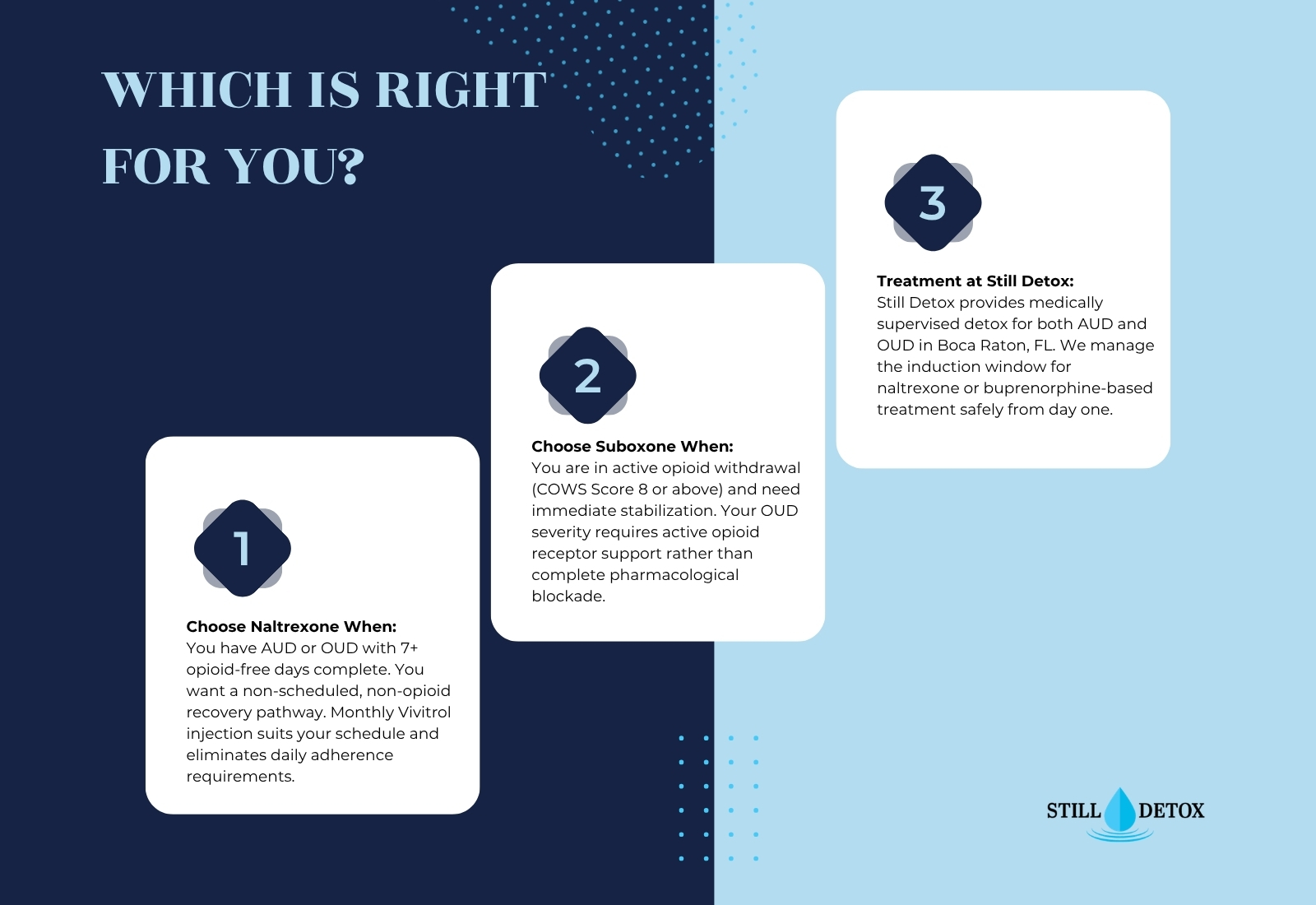
Naltrexone is frequently preferred for OUD patients who have already completed opioid detoxification and want a non-opioid recovery pathway, particularly those with strong motivation, professional licensing concerns, or personal objections to ongoing opioid receptor activation. The monthly Vivitrol injection is especially valued by criminal justice populations, probationers, and patients returning from residential treatment who want long-acting relapse protection without daily adherence requirements.
The critical barrier to naltrexone for OUD is the induction requirement: patients must complete a minimum 7 to 10 days of abstinence from short-acting opioids, or 10 to 14 days from buprenorphine, before the first naltrexone dose. Attempting to administer naltrexone before opioids clear produces naltrexone-precipitated opioid withdrawal, an abrupt, severe withdrawal syndrome. Managing this requirement in an inpatient treatment setting significantly improves naltrexone induction success rates compared to outpatient attempts.
When Is Suboxone Preferred Over Naltrexone?
Suboxone is preferred over naltrexone in the majority of OUD clinical presentations because it can be started earlier in the withdrawal cycle, has a lower induction failure rate, and provides direct pharmacological relief of opioid withdrawal symptoms that naltrexone does not. For patients still in acute opioid withdrawal — experiencing muscle pain, nausea, anxiety, and restlessness, waiting 7 to 10 days for naltrexone induction without medication is a significant barrier that leads to high dropout rates.
Buprenorphine’s Ceiling Effect and Overdose Safety Profile
Buprenorphine’s ceiling effect on respiratory depression gives it a substantially safer overdose profile than full opioid agonists like heroin, methadone, or fentanyl. Buprenorphine alone is difficult to fatally overdose on in otherwise healthy adults. This safety margin makes Suboxone the preferred option for patients with high relapse risk in early recovery, limited clinical monitoring access, and those whose withdrawal history suggests high physiological opioid dependence requiring active opioid receptor stabilization rather than complete blockade.
Starting Suboxone: Why the COWS Score Matters
The Clinical Opiate Withdrawal Scale (COWS) measures opioid withdrawal severity across 11 objective and subjective items, pulse rate, sweating, restlessness, pupil size, joint aches, runny nose, gastrointestinal symptoms, tremor, yawning, anxiety, and gooseflesh, producing a total score from 0 to 48.
A COWS score of 8 or higher typically indicates sufficient withdrawal severity for safe buprenorphine induction without risk of buprenorphine-precipitated withdrawal. Starting buprenorphine too early, before sufficient withdrawal is present, can itself precipitate withdrawal similar to naltrexone-precipitated withdrawal.
Buprenorphine discontinuation produces its own withdrawal syndrome distinct from heroin or oxycodone withdrawal: onset is typically 36 to 72 hours after the last dose due to buprenorphine’s long half-life, with symptoms including anxiety, insomnia, muscle aches, sweating, and gastrointestinal symptoms that can persist for 2 to 4 weeks at lower intensity.
Can You Take Naltrexone and Suboxone Together?
No. Combining naltrexone and Suboxone is contraindicated and clinically dangerous. Naltrexone is a competitive antagonist that displaces buprenorphine from mu-opioid receptors with higher binding affinity, precipitating acute opioid withdrawal in any patient who has buprenorphine on board. This reaction produces severe, abrupt-onset withdrawal, intense muscle cramps, agitation, cardiovascular instability, and vomiting, indistinguishable from naltrexone-precipitated withdrawal from heroin or oxycodone.
Conversely, initiating buprenorphine in a patient who has been recently administered naltrexone provides no benefit: buprenorphine cannot activate receptors that naltrexone is occupying. The standard protocol for patients transitioning from Suboxone to naltrexone requires complete buprenorphine discontinuation and a 10 to 14 day waiting period before the first naltrexone dose. This transition is safest in a supervised medical setting given the discomfort of the bridging period.
Treatment for OUD and AUD at Still Detox
Still Detox’s residential treatment program in Boca Raton provides medically supervised detox for both opioid use disorder and alcohol use disorder, managing the induction window required for either naltrexone or buprenorphine-based treatment to begin safely.
Patients arriving on Suboxone who want to transition to naltrexone require careful medical management through the buprenorphine clearance window, which the inpatient setting supports with clinical monitoring and non-opioid comfort medications throughout the bridging period.
Patients with opioid use disorder complicated by comorbid alcohol use disorder receive integrated assessment at admission, the profile that makes naltrexone’s dual indication most clinically relevant.
Frequently Asked Questions
Is naltrexone the same as Suboxone?
No. Naltrexone is a full opioid antagonist that produces zero opioid receptor activation and is FDA-approved for both alcohol use disorder and opioid use disorder. Suboxone contains buprenorphine, a partial opioid agonist that partially activates opioid receptors, approved for opioid use disorder only. They work through opposite mechanisms. Taking naltrexone while buprenorphine is in your system will precipitate acute opioid withdrawal within minutes.
Can you switch from Suboxone to naltrexone?
Yes, but the transition requires careful medical management. You must fully discontinue Suboxone and wait 10 to 14 days for buprenorphine to clear from opioid receptors before taking the first naltrexone dose. Starting naltrexone before buprenorphine clears precipitates severe withdrawal. This transition is safest in a supervised inpatient medical setting where the bridging discomfort can be managed with non-opioid comfort medications and clinical monitoring throughout the clearance period.
Does naltrexone work as well as Suboxone for opioid use disorder?
The X:BOT trial (Lee et al., 2018, The Lancet) found that among patients who successfully completed induction, extended-release naltrexone and buprenorphine-naloxone produced comparable OUD treatment outcomes. The critical difference was induction: 28% of naltrexone-assigned patients failed induction versus 6% of buprenorphine patients, primarily due to the opioid-free waiting requirement. Naltrexone equals buprenorphine for motivated patients who complete the induction period; it underperforms in populations with high induction dropout.
Is naltrexone addictive like Suboxone?
No. Naltrexone produces no opioid receptor activation, no euphoria, and no physical dependence. It can be stopped at any time without a withdrawal syndrome. Suboxone contains buprenorphine, a Schedule III controlled substance that produces physical dependence with ongoing use, discontinuation requires tapering or management of a buprenorphine withdrawal syndrome. Naltrexone has no abuse potential and is not scheduled by the DEA, making it far easier to prescribe and manage than Suboxone.
What is safer, Naltrexone or Suboxone?
Both have favorable safety profiles when used correctly. Naltrexone’s primary risk is precipitated withdrawal in anyone with opioids present at initiation, this is severe but predictable and preventable. Suboxone’s primary risk is respiratory depression when combined with benzodiazepines or alcohol, despite buprenorphine’s ceiling effect. Naltrexone has zero overdose risk from the medication itself and no addiction potential. For patients managing both AUD and OUD, naltrexone eliminates both risks simultaneously.
Does naltrexone block Suboxone?
Yes. Naltrexone binds mu-opioid receptors with higher affinity than buprenorphine and displaces buprenorphine from its receptor binding site, blocking all of buprenorphine’s opioid effects. A patient who takes naltrexone while still having buprenorphine in their system will experience precipitated opioid withdrawal as naltrexone rapidly displaces the buprenorphine from receptors. This is why a 10 to 14 day buprenorphine clearance window is required before any naltrexone initiation following Suboxone treatment.
References
- Lee, J. D., Nunes, E. V., Novo, P., Bachrach, K., Bailey, G. L., Bhatt, S., & Rotrosen, J. (2018). Comparative effectiveness of extended-release naltrexone versus buprenorphine-naloxone for opioid relapse prevention (X:BOT). The Lancet, 391(10118), 309–318.
- Substance Abuse and Mental Health Services Administration. (2024). Key substance use and mental health indicators in the United States: Results from the 2023 National Survey on Drug Use and Health. https://www.samhsa.gov/data/report/2023-nsduh-annual-national-report
- Xu, K. Y., Mintz, C. M., Presnall, N., Bierut, L. J., & Grucza, R. A. (2022). Comparative effectiveness associated with buprenorphine and naltrexone in opioid use disorder and co-occurring polysubstance use. JAMA Network Open, 5(5), e2211363.
- U.S. Food and Drug Administration. (2023). Information about medications for opioid use disorder. https://www.fda.gov/drugs/information-drug-class/information-about-medications-opioid-use-disorder-moud
- American Psychiatric Association. (2022). Diagnostic and statistical manual of mental disorders (5th ed., text rev.). American Psychiatric Publishing.
- Substance Abuse and Mental Health Services Administration. (2021). Medications for opioid use disorder (Treatment Improvement Protocol Series 63). https://store.samhsa.gov/product/TIP-63-Medications-for-Opioid-Use-Disorder/PEP21-02-01-002
- Wesson, D. R., & Ling, W. (2003). The Clinical Opiate Withdrawal Scale (COWS). Journal of Psychoactive Drugs, 35(2), 253–259.
- Vivitrol (naltrexone for extended-release injectable suspension) [Prescribing information]. (2023). Alkermes. https://www.vivitrol.com