


The feening meaning is the same regardless of how you spell it: an intense, compulsive craving for a substance driven by physical or psychological dependence.
Whether you have seen it written as feening, feining, fiending, or feigning, all of these spellings point to the same desperate, all-consuming urge tied to addiction. This is not a casual want. Feening describes a neurologically driven state that rewires how the brain processes reward, urgency, and decision-making after repeated substance use.
If you or someone you love is caught in this cycle, understanding what feening means is the first step toward finding the right help.
Key Takeaways
- “Feening” (also spelled feining, fiending, and fiening) describes an intense, compulsive craving tied to physical or psychological dependence on a substance.
- According to the National Institute on Drug Abuse, drug craving is a core diagnostic symptom of substance use disorder, driven by structural changes in the brain’s dopamine and reward circuits.
- Research published in the Journal of Clinical Psychology shows that unmanaged physical cravings drive relapse rates as high as 85% within the first year of recovery.
- The feening meaning and feining meaning are clinically identical: both describe the compulsive, neurologically driven craving state that defines active substance use disorder.
- Feening is a symptom of a diagnosable medical condition, not a character flaw, and it responds to evidence-based addiction treatment.
Feening Meaning: What Does Feening Mean?
The feening meaning refers to an intense, all-consuming craving for a substance that emerges when the brain has grown physically or psychologically dependent on it.
How the Feening Meaning Is Defined in Addiction Medicine
The feening meaning and feining meaning are used interchangeably in slang and clinical discussion, both describing the same underlying neurological state:
- Feening meaning in DSM-5 context: Feening corresponds directly to “craving” as listed in the DSM-5-TR diagnostic criteria for substance use disorder, defined as an overwhelming, recurrent urge to use that interferes with daily functioning and rational decision-making.
- Feining meaning as a spelling variant: The feining meaning is clinically identical to the feening meaning. Both describe the compulsive, neurologically driven urge to obtain and consume a substance once physical or psychological dependence has formed.
- Feening definition in everyday usage: As a feening definition, the term captures both the urgency and desperation that separate compulsive drug craving from ordinary preference or voluntary choice.
- Behavioral expression: Feening rewires the brain’s priority system, elevating substance-seeking above basic needs, including food, safety, and social connection, through incentive salience dysregulation.
What the Feening Meaning Reveals About Substance Use Disorder
The feening meaning signals more than a strong desire. It reflects a diagnosable, treatable medical condition:
- Neurological origin: Feening is not a matter of willpower. Chronic substance exposure suppresses the brain’s natural dopamine production and creates structural dependence on the substance to restore baseline neurochemical function.
- Diagnostic relevance: According to the DSM-5-TR, craving is one of eleven diagnostic criteria for substance use disorder. Two or more criteria met within a twelve-month period constitute a diagnosable disorder.
- Severity spectrum: Feening ranges from mild, a persistent intrusive thought, to severe, where the craving completely overrides executive function and compels dangerous drug-seeking behavior.
Feening vs. Feining vs. Fiending: Spelling and Meaning Explained
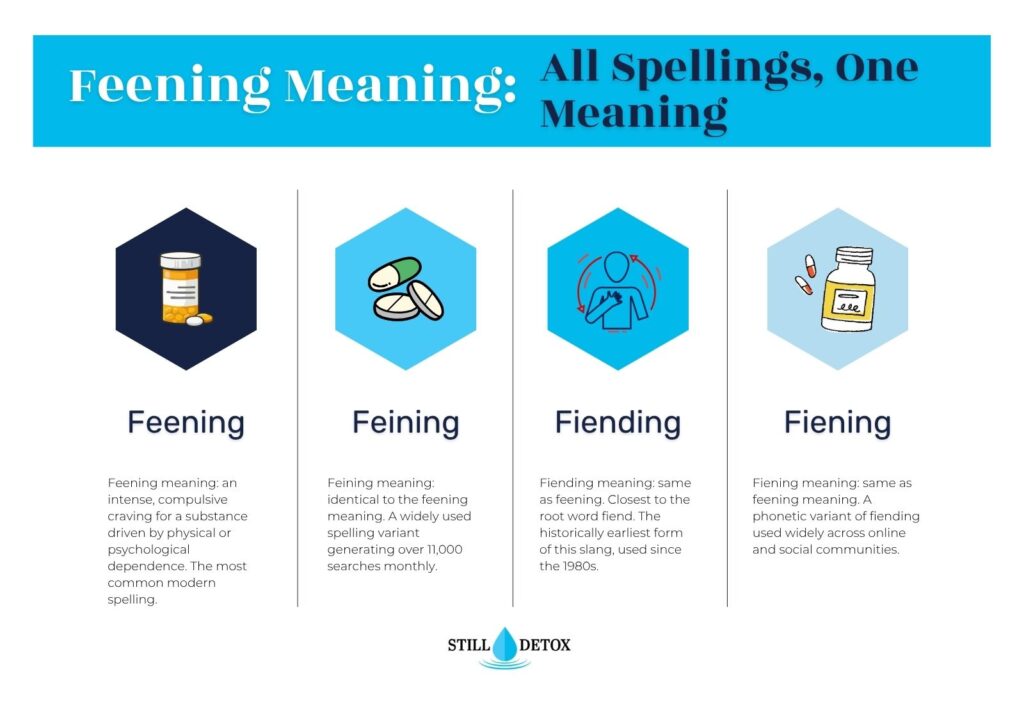
The feening meaning, feining meaning, and fiending meaning are clinically identical despite different spellings. All describe intense, compulsive drug craving driven by substance use disorder.
Spelling Variants and What Each Means
All of the following spellings refer to the same clinical state of compulsive substance craving:
| Spelling | Correct Slang? | Notes |
|---|---|---|
| Feening | Yes | Most common modern spelling in online and social media usage |
| Feining | Yes | Common variant; feining meaning = feening meaning |
| Fiending | Yes | Closest to the root word “fiend”; historically, the earliest form |
| Fiening | Yes | Alternate phonetic spelling of fiending; fiening meaning = feening meaning |
| Fenning | Informal | Phonetic misspelling; fenning meaning = feening meaning |
| Feenin | Informal | Shortened oral form; feenin meaning = feening meaning |
| Feigning | No | Entirely different word meaning “to pretend”; no connection to addiction |
| Fein / Feen | Yes | Noun and verb roots used in street slang across all spellings |
Why “Feigning” Is Not the Same as Feening
The confusion between feigning and feening generates thousands of misdirected searches every month:
- Definition of feigning: To feign means to simulate or pretend something. Feigning has no connection to addiction, substance craving, or substance use disorder.
- “Feigning meaning drugs” searches: When people search “feigning meaning drugs” or “feigning slang,” they are almost always looking for the feening meaning or feining meaning, not the literal definition of feigning.
- Clinical distinction: Feening and feining both reflect real, measurable neurological states driven by substance use disorder. Feigning describes deliberate performance. The two words describe opposite phenomena.
Regardless of Spelling, the Meaning Is the Same
Across all spelling variants, the feening meaning, feining meaning, and fiending meaning are identical:
- Shared clinical meaning: Feening, feining, fiending, and fiening all describe an intense, neurologically driven craving for a substance caused by substance use disorder. The feening meaning and feining meaning refer to the same compulsive behavioral state regardless of which spelling a person uses.
- Language evolution: The diversity of spellings reflects how quickly this term spread through oral culture and social media, where phonetic variations establish themselves independently across communities before any standard spelling emerges.
Where Did “Feening” Come From?
The word feening traces directly to “fiend,” a term historically used to describe someone of an evil or demonic nature who could not control their behavior.
The Historical Roots of Feening
The etymology of feening connects directly to the earliest language of addiction in America:
- 1873 origin: The Oxford English Dictionary records “dope fiend” as early as 1873, used to describe people addicted to opium and other narcotics during the late 19th century.
- 1980s street adoption: By the 1980s, “fiending” had become established street slang to describe the compulsive, desperate behavior of people experiencing acute drug withdrawal and craving. The fiending meaning in this context was universally understood in communities affected by heroin and cocaine use disorder.
- 1990s popularization: The phonetically softened variant “feening” gained widespread traction through hip-hop culture and urban communities throughout the 1990s, entering mainstream language primarily through music and oral tradition.
How Feening Spread Into Modern Usage
Feening has since expanded well beyond its addiction-specific origins:
- Spelling fragmentation through social media: Rapid sharing across digital platforms generated the variants feining, fiening, fenning, and feenin, all phonetic derivatives of the same term, with no standard spelling enforced.
- Expanded popular meaning: In contemporary slang, feening describes intense craving for food, a person, or entertainment. Its clinical roots, however, remain firmly tied to substance dependence.
- Retained clinical weight: Despite casual usage, the feening meaning retains its neurological significance in addiction medicine, where it describes a real and measurable state of craving-driven behavior tied to substance use disorder.
What Does Fein Mean for Drugs?
“Fein” (also spelled feen) is the noun and verb root behind feening, used to describe both a person in active addiction and the act of intensely craving a substance.
How “Fein” Functions in Drug Slang
Fein operates as both a noun and a verb in street language:
- As a noun: A “drug fein” or “drug feen” refers to a person who is addicted and compulsively pursues a substance despite negative consequences. The term derives directly from “fiend” and carries the feening meaning in person-form.
- As a verb: To “fein for drugs” or “feen for drugs” means to experience the intense, compulsive craving that drives substance-seeking behavior in people with substance use disorder.
- Fein meaning drugs: The fein meaning in a drug context is synonymous with the feening meaning, describing the same neurologically driven craving state whether the word functions as a noun or a verb.
The Stigma Problem With “Drug Fein” Terminology
The fein and fiend labels carry significant historical stigma that actively harms people with substance use disorder:
- Historical roots in moral judgment: “Drug fiend” and “drug fein” both derive from language that historically attributed addiction to moral weakness or demonic influence rather than neurological dysfunction.
- Impact on treatment engagement: Stigmatizing labels reduce the likelihood that people with substance use disorder seek professional treatment. The feening meaning reflects a real medical condition, not a character flaw.
- Clinical framing: Addiction medicine replaced “drug fiend” language with diagnostic terms like substance use disorder precisely to separate behavioral symptoms from moral judgment and improve treatment engagement outcomes.
Symptoms of Feening for Drugs
Feening produces both physical and psychological symptoms that intensify the longer substance use disorder goes untreated.
Physical Symptoms of Feening
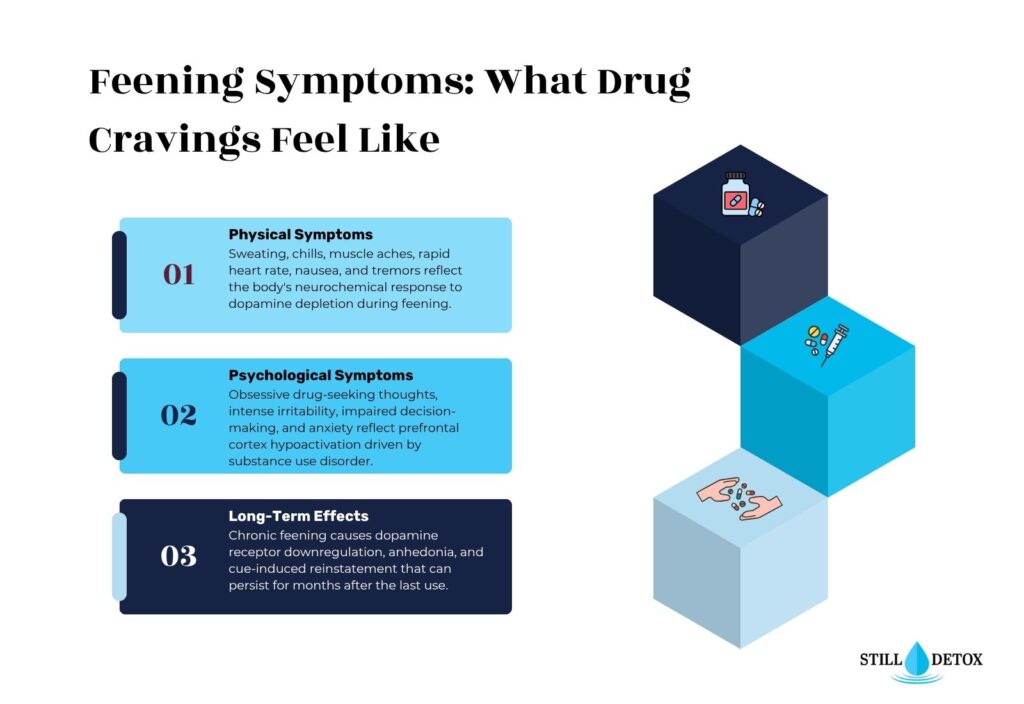
The physical symptoms of feening overlap significantly with formal withdrawal syndrome and reflect the body’s neurochemical response to dopamine depletion:
- Autonomic arousal: Sweating, chills, goosebumps, rapid heart rate, and elevated blood pressure reflect sympathetic nervous system activation in response to suppressed baseline dopamine and norepinephrine function.
- Gastrointestinal distress: Nausea, vomiting, stomach cramping, and diarrhea occur as the enteric nervous system destabilizes during the withdrawal and craving phase.
- Musculoskeletal symptoms: Muscle aches, restlessness, and uncontrollable tremors reflect noradrenergic hyperactivity in the locus coeruleus as the brain compensates for suppressed baseline inhibitory activity.
- Sleep disruption: Insomnia and the inability to rest are driven by elevated cortisol and norepinephrine levels that accompany acute withdrawal-phase feening, particularly in opioid and alcohol use disorder.
Psychological Symptoms of Feening
The psychological component of feening is often described as more overpowering than the physical discomfort it produces:
- Obsessive ideation: Intrusive, repetitive thoughts about obtaining and using the substance dominate the mental landscape, displacing every competing priority through a process called incentive salience dysregulation.
- Affective dysregulation: Intense irritability, agitation, anxiety, panic, and a persistent sense of dread reflect limbic system hyperactivation driven by suppressed GABA-A receptor function or prolonged dopaminergic dysregulation.
- Cognitive impairment: Impaired decision-making and loss of impulse control result directly from prefrontal cortex hypoactivation, which chronic substance use produces through repeated dopamine surges followed by neurochemical depletion.
- Behavioral escalation: Rationalization and justification of dangerous drug-seeking behavior emerge as the extended amygdala drives substance use not only to produce pleasure but to eliminate the aversive neurological state of feening.
Long-Term Effects of Chronic Feening
When feening persists untreated over months or years, it produces lasting neurological changes that sustain the addiction cycle:
- Receptor downregulation: Chronic dopamine surges cause the brain to reduce dopamine receptor density in the nucleus accumbens, increasing the quantity of the substance required to produce the same craving-relief effect over time.
- Anhedonia: Prolonged dopaminergic dysregulation depletes the brain’s natural capacity for reward, producing persistent emotional flatness that sustains feening by making sobriety feel neurologically unrewarding.
- Cue-induced reinstatement: Even after extended abstinence, exposure to cues associated with past drug use triggers intense feening through conditioned place preference pathways that remain encoded in the brain’s procedural memory system.
What Causes Feening for Drugs?
Feening originates in neurological changes that chronic substance use produces across the brain’s reward, motivation, and stress-response systems.
Brain Chemistry and the Dopamine Reward System
The neurological mechanism of feening involves multiple interconnected brain systems operating in sequence:
- Nucleus accumbens sensitization: Addictive substances flood the nucleus accumbens with dopamine, producing intense reward. Repeated exposure sensitizes this pathway, increasing cue-reactivity and driving compulsive drug-seeking behavior even as the reward value of the substance declines.
- Prefrontal cortex hypoactivation: Chronic substance use progressively hypoactivates the prefrontal cortex, the brain region governing impulse control and decision-making. This is why someone who is feening makes choices that their sober judgment would immediately reject.
- Extended amygdala hyperactivation: The extended amygdala becomes hyperactivated during craving states, generating an aversive emotional signal that drives substance use not only to feel pleasure but to escape the unbearable neurological discomfort of feening itself.
- Incentive salience dysregulation: According to incentive salience theory, feening reflects a pathological increase in the motivational value (“wanting”) assigned to the drug, independent of how much pleasure (“liking”) it currently produces — explaining why people continue feening even when the drug no longer brings enjoyment.
Common Triggers for Drug Cravings
Feening does not require active substance use to activate. Specific environmental and emotional triggers can reignite intense craving in people who have achieved abstinence:
- Environmental cues: People, places, and objects associated with past drug use activate cue-induced reinstatement pathways, producing intense feening through learned associative memory even in the complete absence of the substance.
- Emotional states: Stress, loneliness, anxiety, and boredom activate corticotropin-releasing factor (CRF) pathways that overlap with the brain’s addiction circuitry, directly intensifying feening without any external drug-related stimulus.
- Physical states: Pain, illness, sleep deprivation, and hunger reduce prefrontal cortex inhibitory capacity, lowering the threshold at which feening escalates into drug-seeking behavior.
- Temporal patterns: Specific times of day previously linked to habitual substance use become conditioned stimuli that reliably trigger feening through Pavlovian conditioning, even years after the last use.
Which Drugs Cause the Most Intense Feening?
Any addictive substance can produce feening, but certain drug classes generate particularly severe and rapid-onset craving based on their mechanisms of action in the dopamine and opioid receptor systems.
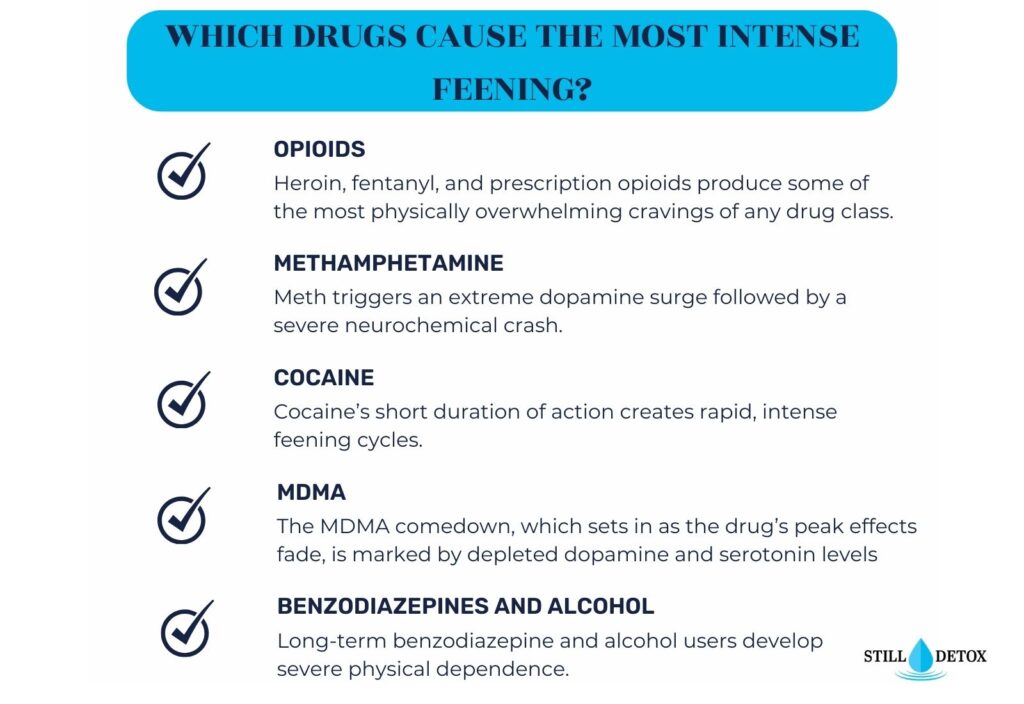
Opioids
Opioid feening is among the most physically overwhelming of any drug class:
- Mechanism: Heroin, fentanyl, and prescription opioids bind to mu-opioid receptors in the nucleus accumbens, producing extreme dopamine release followed by severe receptor downregulation that makes feening onset rapid, intense, and physically debilitating.
- Timeline: Opioid feening typically begins within hours of the last dose as mu-opioid receptor withdrawal generates a noradrenergic storm through the locus coeruleus, producing the physical symptoms that drive urgent drug-seeking.
- Fentanyl specificity: Fentanyl’s high lipophilicity and potent mu-opioid receptor binding affinity produce particularly severe feening. People navigating heroin addiction and fentanyl dependence consistently describe feening as the most significant barrier to sustained recovery.

Methamphetamine
Meth generates extreme feening through dopaminergic depletion that can persist for months:
- Mechanism: Methamphetamine triggers a massive dopamine release followed by severe striatal dopamine depletion, producing a neurochemical crash that drives intense feening. The tweaking phase following heavy meth use involves relentless craving, paranoia, and agitation as depleted dopamine reserves fail to produce any baseline sense of reward.
- Duration: Methamphetamine feening can persist for weeks or months after cessation, as dopamine transporter recovery following stimulant use disorder proceeds slowly and inconsistently.
Cocaine
Cocaine’s pharmacokinetics create rapid, cycling feening that drives binge behavior:
- Mechanism: Cocaine’s short duration of action produces rapid-onset dopamine release followed by an equally rapid neurochemical crash. This cycle drives the binge patterns characteristic of cocaine use disorder, where successive doses are taken to sustain the effect and suppress the feening that emerges within minutes of the peak high.
MDMA and Benzodiazepines
These substance classes generate feening through distinct but equally powerful neurochemical mechanisms:
- MDMA: The MDMA comedown depletes both dopamine and serotonin stores, generating strong psychological craving for re-dosing driven by post-use anhedonia and affective dysphoria.
- Benzodiazepines and alcohol: Long-term benzodiazepine and alcohol use produce GABA-A receptor downregulation and chloride ionophore complex disruption, creating physical dependence in which feening during withdrawal carries the risk of life-threatening tonic-clonic seizures. People with benzodiazepine dependence require medically supervised tapering to manage withdrawal-phase feening safely.
Feening for Someone vs. Feening for Drugs
The word “feening” appears in two distinct contexts, one clinical and one casual, and the distinction matters when assessing whether someone needs professional support.
What “Feening for Someone” Means
The casual use of feening describes intense emotional longing without clinical significance:
- Romantic context: “Feening for someone” or “feening for you” describes an intense emotional preoccupation with another person. These phrases are widely used in music and social media to express compelling desire or emotional attachment.
- Non-clinical usage: These casual uses share the urgency of the original addiction-specific slang but carry no diagnostic significance. The word captures an emotional state, not a neurological one driven by receptor dysregulation.
Why Feening for Drugs Is Categorically Different
Clinical feening is neurologically distinct from any form of casual craving:
- Neurological versus emotional: Drug feening reflects measurable changes in dopamine receptor density, prefrontal cortex activity, and amygdala function. Feening for a person reflects emotional attachment without the structural brain changes produced by chronic substance exposure.
- Compulsive versus voluntary: Drug feening overrides voluntary control through incentive salience dysregulation and prefrontal hypoactivation. Emotional feening remains subject to rational decision-making and self-regulation in most circumstances.
- Clinical context: In addiction medicine, the feening meaning is specific. It refers to the neurologically driven, compulsive craving tied to substance use disorder, not metaphor or hyperbole.
Is Feening the Same as Withdrawal?
Feening and withdrawal are closely related but clinically distinct phenomena that almost always co-occur during substance cessation in moderate to severe substance use disorder.
The Difference Between Feening and Withdrawal
Understanding the distinction clarifies why different treatment interventions are required:
- Withdrawal definition: Withdrawal describes the full set of physical and psychological symptoms including autonomic instability, gastrointestinal distress, and neurological symptoms that emerge when someone with physical dependence stops or significantly reduces substance use.
- Feening as a component of withdrawal: Feening refers specifically to the craving component within withdrawal or abstinence. It is one dimension of the broader withdrawal syndrome rather than a synonym for it.
- Feening without formal withdrawal: Someone can experience intense feening during active use, between doses, or during early abstinence before formal withdrawal criteria are clinically met.
When Feening and Withdrawal Co-Occur
In moderate to severe substance use disorder, feening and acute withdrawal symptoms occur simultaneously and reinforce each other:
- Overlapping timeline: During opioid withdrawal, feening peaks alongside peak physical symptoms, typically 24 to 72 hours after the last dose, because the same noradrenergic hyperactivity in the locus coeruleus drives both craving and somatic distress.
- Post-acute context: Physical withdrawal typically resolves within days to weeks, but psychological feening driven by dopaminergic dysregulation persists for months in post-acute withdrawal syndrome (PAWS), making ongoing behavioral treatment essential.
- Treatment implication: Because feening outlasts physical withdrawal by a significant margin, detoxification alone does not constitute adequate treatment. Behavioral therapy directly targets the craving patterns that sustain feening after the body has physically stabilized.
When Does Feening Signal a Serious Addiction?
Feening crosses the threshold of serious substance use disorder when it begins to override rational decision-making and dominate behavior despite clear awareness of harm.
Warning Signs That Feening Has Become a Medical Emergency
The following signs indicate that feening reflects a clinically significant substance use disorder requiring professional intervention:
- Continued use despite harm: Continuing to use despite clear knowledge that the substance is causing harm to physical health, relationships, finances, or legal standing is a DSM-5-TR diagnostic criterion for substance use disorder.
- Loss of control: Genuinely wanting to stop using but being unable to follow through despite repeated sincere attempts reflects prefrontal cortex impairment produced by chronic substance use, not a deficit of motivation or character.
- Financial and behavioral consequences: Spending money designated for necessities on obtaining substances, or engaging in dangerous or illegal behavior to secure drugs, indicates that feening has fully displaced rational priority-setting.
- Acute feening during abstinence: Experiencing intense physical and psychological symptoms during any period of attempted sobriety confirms neurological dependence and indicates that medically supervised detoxification is clinically indicated rather than self-managed abstinence.
How to Manage Drug Cravings
Managing feening is an active, ongoing process that requires both behavioral strategies and, in many cases, clinical pharmacological support.
Evidence-Based Strategies for Reducing Feening Intensity
The following approaches have clinical evidence supporting their effectiveness in reducing both the frequency and intensity of craving episodes:
- The 15-minute rule: Most feening peaks and begins to subside within 15 to 20 minutes. Physical movement, calling a support contact, or changing environments during this window interrupts the craving cycle before behavioral escalation occurs.
- Mindfulness and urge surfing: Mindfulness-based techniques train the brain to observe feening without responding to it compulsively. Urge surfing, observing the craving as it rises and falls without acting on it, directly targets the incentive salience response by breaking the automatic connection between craving and behavior.
- Trigger identification and restructuring: Identifying the specific people, places, emotional states, and situations that activate feening allows for strategic environmental restructuring that reduces cue-induced reinstatement events and lowers relapse risk.
- Medication-Assisted Treatment (MAT): Buprenorphine partially activates mu-opioid receptors to suppress opioid feening. Naltrexone blocks the reward response entirely, preventing reinforcement if relapse occurs. Acamprosate reduces alcohol feening by stabilizing glutamate and GABA activity dysregulated by alcohol use disorder.
- Peer and clinical support: Regular engagement with a sponsor, therapist, or recovery group reduces the social isolation and emotional dysregulation that consistently amplify feening intensity during early recovery.
Treatment at Still Detox
Still Detox in Boca Raton provides medically supervised detox and evidence-based addiction treatment designed to address feening at its neurological and psychological source.
Medical Detoxification
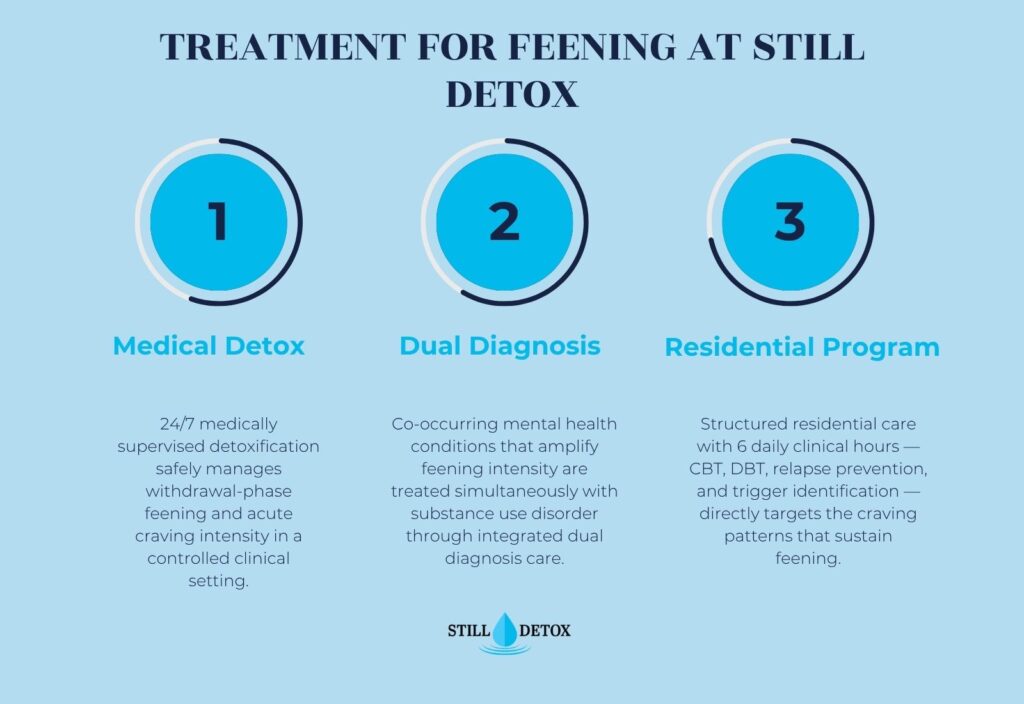
Medically supervised detoxification at Still Detox manages both the physical and psychological dimensions of feening in a controlled clinical environment. Withdrawal-phase feening is addressed through physician-supervised protocols that reduce craving intensity and minimize the risk of dangerous withdrawal complications including seizure.
Dual Diagnosis Treatment
Many people who are feening for drugs carry co-occurring mental health conditions including anxiety disorders, major depressive disorder, and PTSD that amplify craving intensity and undermine recovery. Dual diagnosis treatment at Still Detox addresses substance use disorder and co-occurring mental health conditions simultaneously, targeting the affective dysregulation that sustains feening when left untreated.
Residential Treatment Program
Still Detox’s residential program provides structured, immersive care with six hours of daily clinical programming. Clients receive individual therapy, group therapy incorporating CBT and DBT modalities, and relapse prevention work that directly targets the feening triggers identified during intake clinical assessment. Same-day assessments are available for anyone ready to begin.
Frequently Asked Questions
What is the feening meaning?
The feening meaning is an intense, compulsive craving for a drug or substance driven by physical or psychological dependence. It describes the neurologically driven state of urgent, all-consuming substance-seeking behavior that emerges when the brain has developed dependence. The feening meaning is the same regardless of which spelling variant is used.
What is the feining meaning?
The feining meaning is identical to the feening meaning: an intense, compulsive craving for a substance caused by physical or psychological dependence. “Feining” is a widely used spelling variant of “feening” that generates significant independent search volume. Both refer to the same neurologically driven craving state that defines active substance use disorder.
What does fiending mean?
The fiending meaning is the same as the feening meaning and feining meaning: a compulsive, intense craving for a drug driven by substance use disorder. “Fiending” is the spelling closest to the root word “fiend” and the historically earliest form of the term. Fiending meaning, feening meaning, and feining meaning all describe the same clinical state.
Is it feigning or feening?
These are two entirely different words. Feigning means to pretend or simulate something and has no connection to addiction. Feening, or feining, is slang for intense drug cravings tied to substance dependence. Despite sounding similar, they have completely unrelated meanings. The correct slang for drug cravings is feening or feining, not feigning.
What does fein mean for drugs?
“Fein” is street slang for someone who is addicted and compulsively craves a substance. It derives from “fiend” and functions as both a noun (a drug fein) and a verb (to fein for something). The fein meaning in a drug context is synonymous with the feening meaning: the same compulsive, neurologically driven craving state.
Where did feening come from?
Feening evolved from “fiend,” used in American slang as early as 1873 to describe people addicted to narcotics. By the 1980s, “fiending” described compulsive drug-craving behavior in street language. The phonetic variant “feening” was then popularized through hip-hop culture during the 1990s, generating the spelling variants feining, fiening, and feenin that remain in use today.
Can feening happen for things other than drugs?
Yes. In contemporary slang, feening describes intense craving for food, a person, or entertainment. However, in addiction medicine, feening refers specifically to the neurologically driven, compulsive craving tied to substance use disorder. The casual use of the word does not reflect the severity of drug feening as a clinical symptom of physical and psychological dependence.
How long does feening last during withdrawal?
Duration varies by substance and individual physiology. Opioid feening typically begins within hours of the last dose and peaks at 24 to 72 hours. Methamphetamine feening can persist for weeks to months. Psychological feening driven by dopaminergic dysregulation consistently outlasts physical withdrawal, which is why behavioral therapy and ongoing clinical support are essential to long-term recovery.
References
- National Institute on Drug Abuse. (2020). Drugs, brains, and behavior: The science of addiction. U.S. Department of Health and Human Services. https://nida.nih.gov/publications/drugs-brains-behavior-science-addiction
- Substance Abuse and Mental Health Services Administration. (2023). Key substance use and mental health indicators in the United States: Results from the 2022 National Survey on Drug Use and Health. https://www.samhsa.gov/data/
- American Psychiatric Association. (2022). Diagnostic and statistical manual of mental disorders (5th ed., text rev.). American Psychiatric Publishing.
- Oxford English Dictionary. (2023). Fiend. Oxford University Press.
- Koob, G. F., and Volkow, N. D. (2016). Neurobiology of addiction: A neurocircuitry analysis. The Lancet Psychiatry, 3(8), 760–773.
- Robinson, T. E., and Berridge, K. C. (2008). The incentive sensitization theory of addiction: Some current issues. Philosophical Transactions of the Royal Society B: Biological Sciences, 363(1507), 3137–3146.
- Hunt, W. A., Barnett, L. W., and Branch, L. G. (1971). Relapse rates in addiction programs. Journal of Clinical Psychology, 27(4), 455–456. https://pubmed.ncbi.nlm.nih.gov/5115648/