

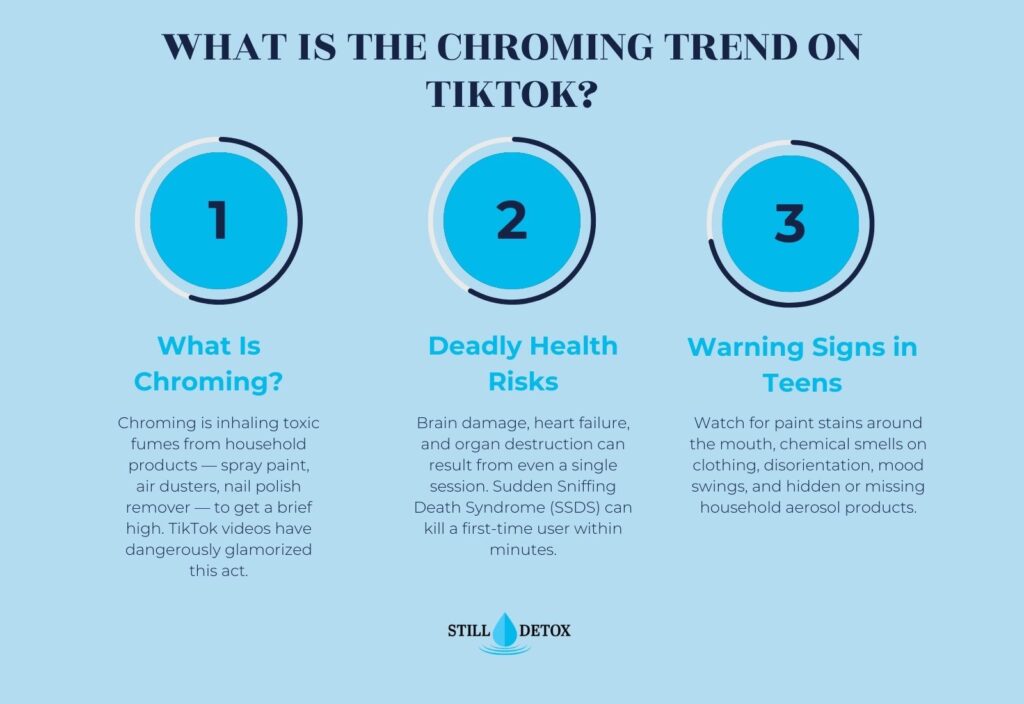
Chroming is the act of inhaling toxic chemical fumes from everyday household products to achieve a brief, intense high. The chroming trend has spread rapidly on TikTok and other social media platforms, exposing teens and preteens to one of the most dangerous forms of inhalant abuse. Because the products involved are legal, cheap, and found in almost every home, chroming poses a uniquely severe and underrecognized threat to young people. Even a single session of chroming can trigger fatal cardiac arrest, making early awareness and education critical for parents, caregivers, and clinicians.
Key Takeaways
- Chroming is a form of inhalant abuse involving deliberate inhalation of toxic fumes from products like spray deodorant, nail polish remover, aerosol paint, and air dusters.
- A 2024 study presented at the American Academy of Pediatrics National Conference analyzed 109 TikTok chroming videos that collectively exceeded 25.7 million views, with minors accounting for 39% of creators.
- The National Survey on Drug Use and Health (2021) identifies children aged 12 to 17 as the most at-risk population for inhalant abuse.
- Sudden Sniffing Death Syndrome (SSDS) can cause fatal cardiac arrest after just one use, even in an otherwise healthy teenager.
- Professional treatment, including medical detox and dual diagnosis therapy, is available and essential for teens struggling with repeated inhalant abuse.
What Is Chroming? Definition and Origin
Chroming is a slang term that originated in Australia, where it initially described the inhalation of chrome-based metallic paint fumes to get high. Over time, the term expanded to cover any deliberate inhalation of chemical vapors from household or industrial products for recreational effect. Today, chroming is used interchangeably with “huffing” and “inhalant abuse” across the United States, United Kingdom, Ireland, and Australia.
The word entered mainstream awareness when it began appearing on social media under hashtags like #chroming and #WhipTok. Despite TikTok banning search terms associated with the trend, users continue to find workarounds, keeping the behavior visible and accessible to minors worldwide.
How Does Chroming Work?
When someone inhales chemical vapors, those toxins are absorbed almost instantly through the lungs and enter the bloodstream within seconds. The chemicals reach the brain rapidly, producing a short-lived euphoric or dissociative state that typically lasts less than five minutes. This rapid onset is a large part of the appeal, especially for adolescents seeking an immediate, substance-free-looking high. The National Institute on Drug Abuse notes that inhalants depress the central nervous system in a way similar to alcohol or sedatives.
There are three primary methods used in the chroming process:
- Sniffing: Inhaling vapors directly from an open container, bottle, or can.
- Bagging: Spraying or pouring a substance into a plastic or paper bag and then inhaling concentrated fumes from inside the bag.
- Huffing: Soaking a rag, cloth, or towel with a liquid solvent and pressing it to the nose and mouth to inhale the vapors.
Common Products Used for Chroming
Any product containing volatile organic compounds or pressurized gases can be misused for chroming. The most frequently reported items include:
- Aerosol spray deodorant and hairspray
- Air dusters (canned compressed air)
- Permanent markers
- Nail polish and nail polish remover
- Spray paint and metallic paints
- Gasoline and lighter fluid
- Paint thinner and glue
The wide availability of these products is what makes chroming particularly dangerous. Many parents are unaware that over-the-counter products sold in any convenience store can be misused as inhalants, making household monitoring more complex than with traditional street drugs.
Why Teens Are Drawn to the Chroming Challenge
Several factors make chroming specifically appealing to younger age groups. The substances are legal, inexpensive, and available without any ID or prescription. Many teens mistakenly perceive chroming as safer than illicit drugs because the products are common household items. Social media amplifies this misconception by framing chroming in meme culture, making it appear lighthearted or even funny.
The 2024 AAP study found that 70% of analyzed chroming videos used memes to normalize the behavior, reducing the perceived severity of the risk in the eyes of young viewers. Researchers also noted that some children and teens may use inhalants as a form of self-medication for underlying anxiety, depression, or trauma. Those psychosocial drivers are a critical consideration when evaluating the full scope of the problem.
Short-Term Effects of Chroming
The immediate effects of chroming typically begin within seconds and rarely last longer than a few minutes. While they may feel temporary and manageable to the user, every episode carries a risk of sudden death. Short-term effects reported by users and documented in clinical literature include:
- Euphoria and a sense of floating or dissociation
- Dizziness and loss of coordination
- Slurred speech and confusion
- Nausea and vomiting
- Hallucinations and distorted perception
- Headache and ringing in the ears
- Numbness or tingling in the extremities
What chroming feels like is often described as a brief, disorienting rush similar to being severely drunk, followed by a rapid comedown. That fast cycle of high and crash is part of what drives repeated use within a single session.
Long-Term Effects of Chroming
Repeated inhalant abuse causes cumulative, often irreversible damage to multiple organ systems. The brain is particularly vulnerable because many of the solvents involved are neurotoxic. Long-term effects documented in peer-reviewed literature include:
- Permanent cognitive impairment, including memory loss and reduced attention span
- Dementia-like neurological decline in chronic users
- Liver and kidney damage from toxic metabolites
- Heart arrhythmias and cardiovascular disease
- Hearing and vision loss
- Muscle weakness and loss of coordination (inhalant-induced neuropathy)
- Psychological dependence and withdrawal symptoms, including cravings, irritability, and mood disturbances
The American Academy of Pediatrics emphasizes that even adolescents who use inhalants only a handful of times can sustain measurable neurological damage, particularly given that the developing brain is more vulnerable to chemical toxins than the adult brain.
Sudden Sniffing Death Syndrome: The One-Time Risk
Sudden Sniffing Death Syndrome (SSDS) is the most immediately life-threatening consequence of chroming, and it can occur during a person’s very first exposure. SSDS happens when inhaled chemicals sensitize the heart to adrenaline, triggering a fatal arrhythmia or cardiac arrest. Physical exertion or a sudden startle, such as being interrupted mid-session, dramatically increases this risk by causing a natural adrenaline surge.
SSDS does not require a history of use, a pre-existing heart condition, or any warning signs. It can kill a perfectly healthy teenager in minutes with no opportunity for intervention. This is why the National Institute on Drug Abuse at the National Institutes of Health classifies inhalant abuse as one of the most dangerous and underappreciated substance use behaviors among adolescents.
Chroming vs. Huffing: Is There a Difference?
Chroming and huffing are used interchangeably in most clinical and media contexts, but there is a subtle distinction in origin and framing. Huffing is the older, more established American term for inhalant abuse and refers specifically to the method of soaking a cloth and inhaling from it. Chroming is the newer slang term, popularized in Australia and the United Kingdom and more recently in the United States through TikTok. In practice, both terms now describe the same behavior: the deliberate inhalation of toxic chemical fumes for a recreational high.
This is different from activities like what hotboxing involves, which typically refers to inhaling cannabis smoke in an enclosed space. Chroming and huffing involve volatile chemical solvents and aerosols that are acutely toxic in ways that cannabis is not, making the risk profile fundamentally different.
The TikTok Chroming Trend: How Social Media Spreads It
The resurgence of inhalant abuse in recent years is directly tied to social media exposure. The chroming challenge spread under hashtags like #WhipTok and #chroming, accumulating hundreds of millions of views before TikTok began actively restricting the search terms. Researchers at the 2024 AAP National Conference confirmed that content promoting or trivializing chroming remains accessible on the platform despite moderation efforts.
What makes the social media angle especially alarming is the demographic of content creators. In the analyzed sample, minors produced 39% of chroming-related videos, meaning children are both the primary audience and a significant portion of the content producers. The platform’s algorithm amplifies engaging content regardless of safety risk, making it structurally difficult to contain the spread of dangerous challenge trends without aggressive, platform-level intervention.
Unlike slang-driven drug trends tied to substances like what sherm drug is, chroming does not require access to an illicit market, which is exactly what makes its social media spread so consequential.
Real Deaths Linked to the Chroming Challenge
Several high-profile deaths have brought international attention to the dangers of chroming:
- Esra Haynes, 13, Australia (March 2023): Esra went into cardiac arrest and sustained irreversible brain damage after chroming with aerosol deodorant at a friend’s sleepover. She was placed on life support and died eight days later. Her parents became prominent advocates for chroming awareness.
- Sarah Mescall, 14, Ireland (September 2023): Sarah died following what Irish authorities investigated as a chroming-related incident. Irish police opened a formal investigation, and her case prompted national warnings from health authorities.
- Tommie-Lee Gracie Billington, 11, United Kingdom (March 2024): At just 11 years old, Tommie-Lee died from inhalant abuse in Lancaster, England, making her one of the youngest documented fatalities linked to the chroming trend.
- Cesar, 12, United States (Summer 2024): A 12-year-old introduced to chroming by an older peer was found seizing on the floor by his mother. He was placed in a medically induced coma for 48 hours after cardiac arrest and survived, but sustained lasting short-term memory damage.
These cases are not isolated outliers. They represent a pattern of preventable deaths in children who had little to no understanding of the lethal risk they were taking.
Warning Signs Your Teen May Be Chroming
Chroming is often done covertly, and its effects are short-lived, making detection harder than with many other substances. Parents and caregivers should watch for these behavioral and physical indicators:
- Chemical or solvent smell on breath, hair, or clothing
- Paint stains, residue, or discoloration on face, hands, or clothes
- Empty aerosol cans, used rags, or missing household products
- Sudden disorientation, slurred speech, or loss of coordination with no clear explanation
- Red or watery eyes, persistent runny nose, or sores around the mouth and nose
- Mood changes, irritability, or social withdrawal
- Secretive behavior around household supply closets or garages
If you notice any of these signs, address the situation immediately and without judgment. Open, non-punitive conversation creates the space teens need to be honest about what they have been doing.
What to Do If Your Child Is Chroming
If you suspect or confirm that your child is engaging in chroming, take action immediately. In a medical emergency, call 911. Do not attempt to startle or physically stimulate the person mid-inhalation, as this can trigger SSDS. Keep the individual calm and still until emergency help arrives.
For ongoing or repeated use, professional treatment is essential. Inhalant abuse rarely resolves on its own, particularly when it is driven by underlying mental health conditions like anxiety, depression, or trauma. Inpatient medical detoxification offers a supervised environment for physical stabilization, while behavioral therapies address the psychological and social drivers of the behavior.
Many teens who develop inhalant use disorders also meet criteria for co-occurring psychiatric conditions. Dual diagnosis treatment addresses both the substance use and the underlying mental health condition simultaneously, which research consistently shows produces better long-term outcomes than treating either in isolation.
Frequently Asked Questions
What does chromed mean in slang?
In slang, “chromed” means being under the influence of inhaled chemical fumes, specifically from chrome-based metallic paint or aerosol products. The term originated in Australia and refers to the intoxicated, disoriented state produced by inhalant abuse. Today it is used broadly across English-speaking countries to describe being high from any inhaled volatile substance, not just chrome paint specifically.
What is the process of chroming?
Chroming involves inhaling toxic chemical vapors using one of three methods: sniffing fumes directly from a container, bagging by spraying a substance into a bag and inhaling, or huffing by soaking a cloth and pressing it to the face. The chemicals are absorbed through the lungs almost instantly. The resulting high is brief, usually lasting only a few minutes, but the health risks are severe and can be fatal.
What are the side effects of inhaling chemicals?
Inhaling chemical fumes causes both immediate and long-term effects. Immediately, users experience dizziness, euphoria, nausea, hallucinations, slurred speech, and loss of coordination. With repeated use, chemical inhalation causes permanent brain damage, cognitive impairment, liver and kidney failure, and heart arrhythmias. The most immediate danger is Sudden Sniffing Death Syndrome, a fatal cardiac event that can occur during a person’s first-ever session without any warning signs.
How does chroming create a high?
Chroming creates a high by flooding the bloodstream with volatile organic compounds that rapidly cross the blood-brain barrier. These chemicals suppress central nervous system activity, producing effects similar to alcohol intoxication or sedative use, including euphoria, disinhibition, and altered sensory perception. Because the compounds are absorbed through the lungs rather than digested, the onset is nearly immediate. The effect dissipates quickly, which often leads users to repeat the behavior multiple times in a single session.
References
- National Institute on Drug Abuse. (2024). Inhalants research overview. National Institutes of Health. https://nida.nih.gov/research-topics/inhalants
- Substance Abuse and Mental Health Services Administration. (2022). 2021 National Survey on Drug Use and Health: Key substance use and mental health indicators in the United States. U.S. Department of Health and Human Services. https://www.samhsa.gov/data/report/2021-nsduh-annual-national-report
- Krishna, R. N., et al. (2024). Chroming crisis: An analysis of chroming related content on TikTok. Presented at the American Academy of Pediatrics National Conference and Exhibition, October 2024.
- Radparvar, S. (2023). The clinical assessment and treatment of inhalant abuse. The Permanente Journal, 27(2), 99-109.
- Cruz, S. L., Rivera-Garcia, M. T., & Woodward, J. J. (2023). Review of inhalants: From chemistry to neurobiology and hope for treatment. Journal of Neurochemistry, 166(4), 606-626.
- Finch, C. K., & Lobo, B. L. (2005). Acute inhalant-induced neurotoxicity with delayed recovery. Annals of Pharmacotherapy, 39(1), 169-172.