




A k-hole is a state of profound dissociation and total sensory detachment produced by a high recreational dose of ketamine, the DEA Schedule III dissociative anesthetic.
NMDA receptor blockade at subanesthetic doses strips away bodily awareness, sensory processing, and self-identity, leaving the user immobile, unresponsive, and fully disconnected from their physical environment for up to 90 minutes.
Unlike other altered states, a k-hole is not a distortion of reality, it is the near-complete suspension of perceived reality. The term originated in recreational drug communities in the 1990s. At the doses required for a k-hole, the user cannot speak, cannot respond to others, and cannot protect themselves from physical harm. Understanding what a k-hole is, how it occurs neurologically, and why it carries serious medical risk can be lifesaving.
Key Takeaways:
- A k-hole is ketamine-induced dissociative anesthesia at recreational doses, producing complete loss of somatic and perceptual awareness lasting 30 to 90 minutes.
- Ketamine is a DEA Schedule III controlled substance; recreational misuse constitutes a criminal offense, and street ketamine carries unknown purity and dosing risks.
- According to NIDA, approximately 2.6 million Americans reported hallucinogen use including ketamine in 2021, reflecting a significant rise from prior-year figures.
- K-hole states eliminate the user’s protective airway reflexes, creating documented fatal risks from aspiration, drowning, and falls that occur while the user is helpless.
- Hallucinogen persisting perception disorder (HPPD) and ketamine-induced psychosis can develop from repeated high-dose k-hole exposure, producing psychiatric symptoms that outlast drug clearance by weeks or months.
What Is a K-Hole?
A k-hole is the colloquial term for ketamine-induced dissociative anesthesia, a pharmacological state in which NMDA receptor blockade produces complete perceptual and somatic disconnection from the environment at recreational doses.
K-Hole Meaning in Slang
The term “k-hole” originated in recreational drug communities to describe the experience of taking enough ketamine to produce near-complete loss of body awareness and reality testing. In slang, “falling into a k-hole” or “getting k-holed” describes the moment a ketamine user loses voluntary control over perception and movement. The term “kholed” refers to actively being in this state.
The word “hole” reflects the subjective experience of falling into an inescapable internal void from which the user cannot exit. Normal sensory reality does not merely distort during a k-hole it disappears, replaced by abstract internal experiences bearing no relation to the physical environment.
What Does Falling into a K-Hole Feel Like?
K-hole experiences are consistently described across clinical and harm-reduction literature as dissociation so complete that normal consciousness is suspended rather than altered. The subjective k-hole experience involves:
Core k-hole phenomenology includes:
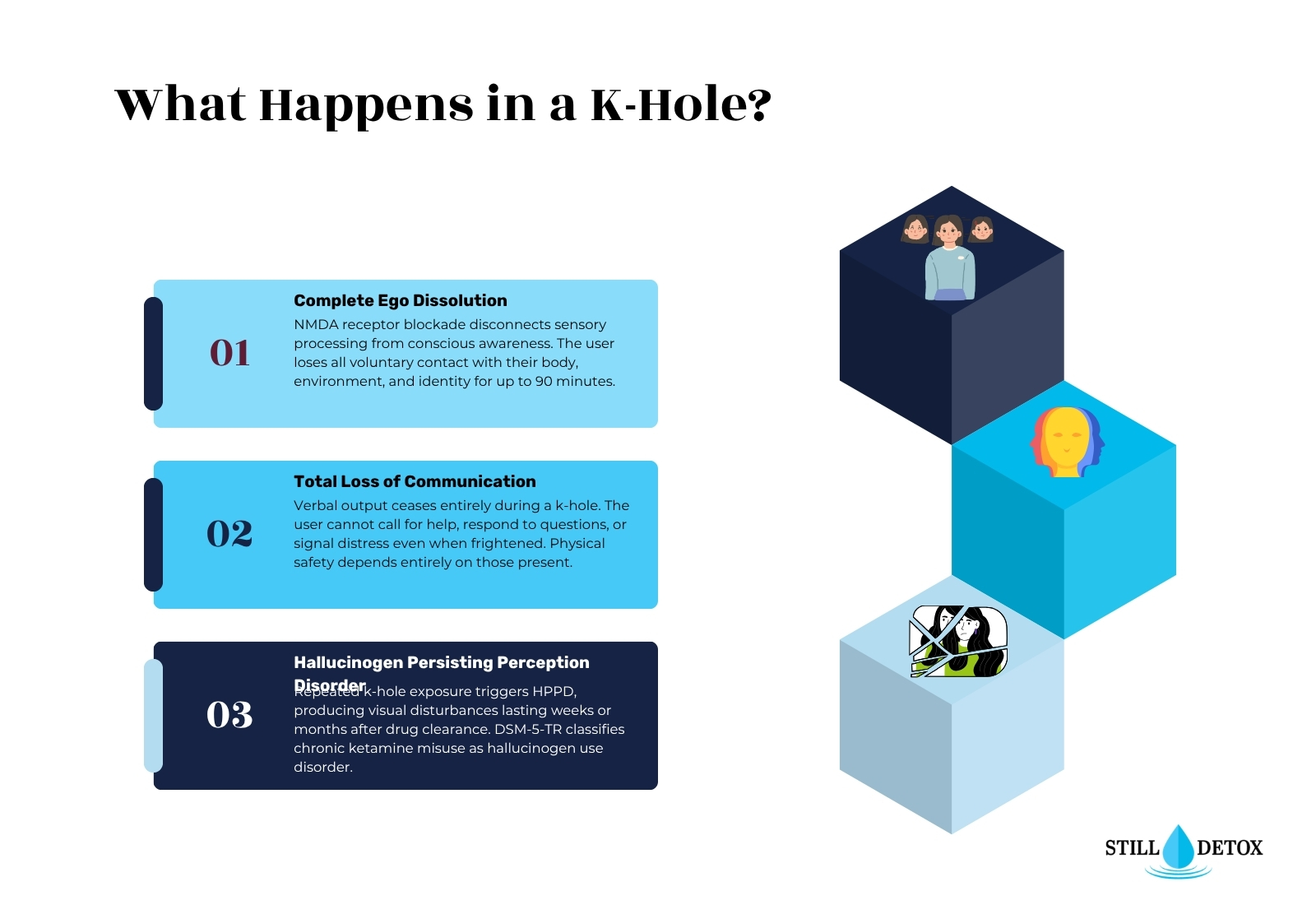
- Ego dissolution: Total loss of self-identity and the boundary between self and environment; the user cannot identify their body, its position, or its relation to the world
- Inability to communicate: Verbal output ceases entirely; users cannot call for help, respond to questions, or signal distress even when frightened
- Near-death or out-of-body perception: Many users report perceiving themselves as dead, dying, or outside their physical body during the peak phase
- Time distortion: Subjective time decouples entirely from clock time; a 45-minute k-hole can feel like minutes or an eternity
- Dark or tunnel-like visuals: Unlike serotonergic psychedelics, k-hole visuals are not richly figural; they tend toward void-like, geometric, or compressed tunnel imagery
Is K-Hole a Medical Term?
No. K-hole is not a DSM-5-TR diagnosis or formally recognized medical term. It describes the recreational misuse phenomenon of ketamine-induced dissociative anesthesia crossing into a pathological dissociative range. The DSM-5-TR classifies clinically significant outcomes of ketamine misuse under phencyclidine-type substance use disorder or other hallucinogen use disorder depending on presentation, frequency, and impairment.
How Ketamine Causes a K-Hole in the Brain
Ketamine causes a k-hole by non-competitively blocking NMDA receptors in the central nervous system at subanesthetic doses, disrupting the thalamocortical relay system responsible for translating sensory signals into conscious experience.
NMDA receptors are ligand-gated ion channels that mediate glutamate neurotransmission throughout the cortex, limbic system, and sensory relay stations of the brainstem. Ketamine binds to the open channel of the NMDA receptor, blocking chloride and calcium ion flux and silencing glutamate-driven signaling along the thalamocortical pathway. When this relay system stops functioning, sensory information from the body and environment can no longer reach the cortex for conscious integration, producing the perceptual void characteristic of a k-hole.
Secondary to NMDA antagonism, ketamine binds to sigma-1 receptors, which contribute to the hallucinogenic dimension of the k-hole experience. Dopaminergic activation in the mesolimbic reward pathway generates the dissociative euphoria that reinforces repeated use despite negative consequences, forming the neurobiological basis of ketamine use disorder.
K-Hole Effects: Timeline and How Long Ketamine Lasts
K-hole onset occurs within 1 to 5 minutes of insufflation (snorting) and within 30 seconds of intravenous injection, with maximum dissociation reached at approximately 15 to 30 minutes.
Onset to Peak: The K-Hole Timeline
The temporal progression of a k-hole follows a consistent pharmacokinetic pattern by route of administration:
K-hole timeline by route:
- Insufflation (snorting): Onset 1 to 5 minutes; k-hole peak at 15 to 30 minutes; total duration 45 to 90 minutes; most common recreational route
- Intravenous injection: Onset within 30 seconds; peak within 5 minutes; total duration 15 to 45 minutes; highest intensity and medical risk
- Oral ingestion: Onset 20 to 30 minutes; flatter effect curve lasting up to 3 hours; k-hole less likely but achievable at high doses
Emergence from a k-hole frequently produces more acute distress than the k-hole itself. Re-entry of sensory information into a disrupted nervous system generates agitation, confusion, and extreme spatial disorientation. a clinical phenomenon called the emergence phenomenon, documented in medical ketamine administration and present in recreational use at higher rates and severity.
How Long Does K Last?
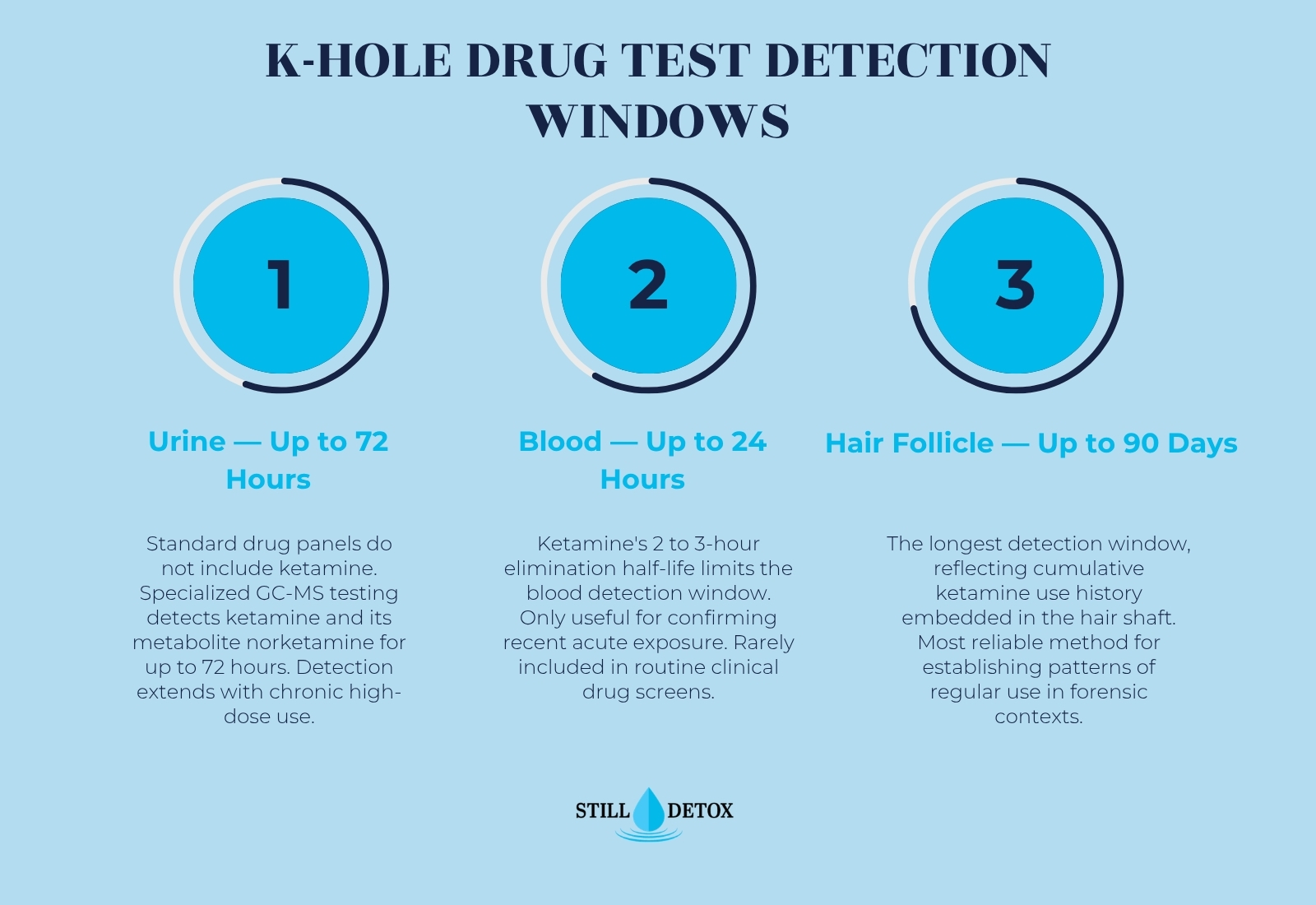
Ketamine’s elimination half-life is approximately 2 to 3 hours. The active metabolite norketamine clears the bloodstream within 6 to 12 hours of a single dose. Cognitive impairment and disorientation typically persist for 2 to 4 hours after motor function returns. Hair follicle drug tests detect ketamine metabolites for up to 90 days, reflecting cumulative exposure rather than acute use.
How Does Ketamine Make You Feel Before the K-Hole?
At sub-k-hole doses, ketamine produces mild dissociation, perceptual distortions, reduced anxiety, mild euphoria, and profound analgesia, effects that explain recreational appeal and the tendency toward dose escalation. As the dose increases toward k-hole territory, these effects amplify non-linearly. The transition from pleasant dissociation to full k-hole occurs over a narrow dose range, particularly with insufflated ketamine, making precise recreational dose control practically impossible without clinical instrumentation.
Can You Die from a K-Hole?
Direct fatality from ketamine alone at k-hole doses is rare because ketamine’s therapeutic index — the ratio of the lethal dose to the effective dose, is wide, which is why it is used as a clinical anesthetic. The k-hole state eliminates protective reflexes and the ability to self-rescue, generating multiple documented pathways to indirect death.
Physical Dangers
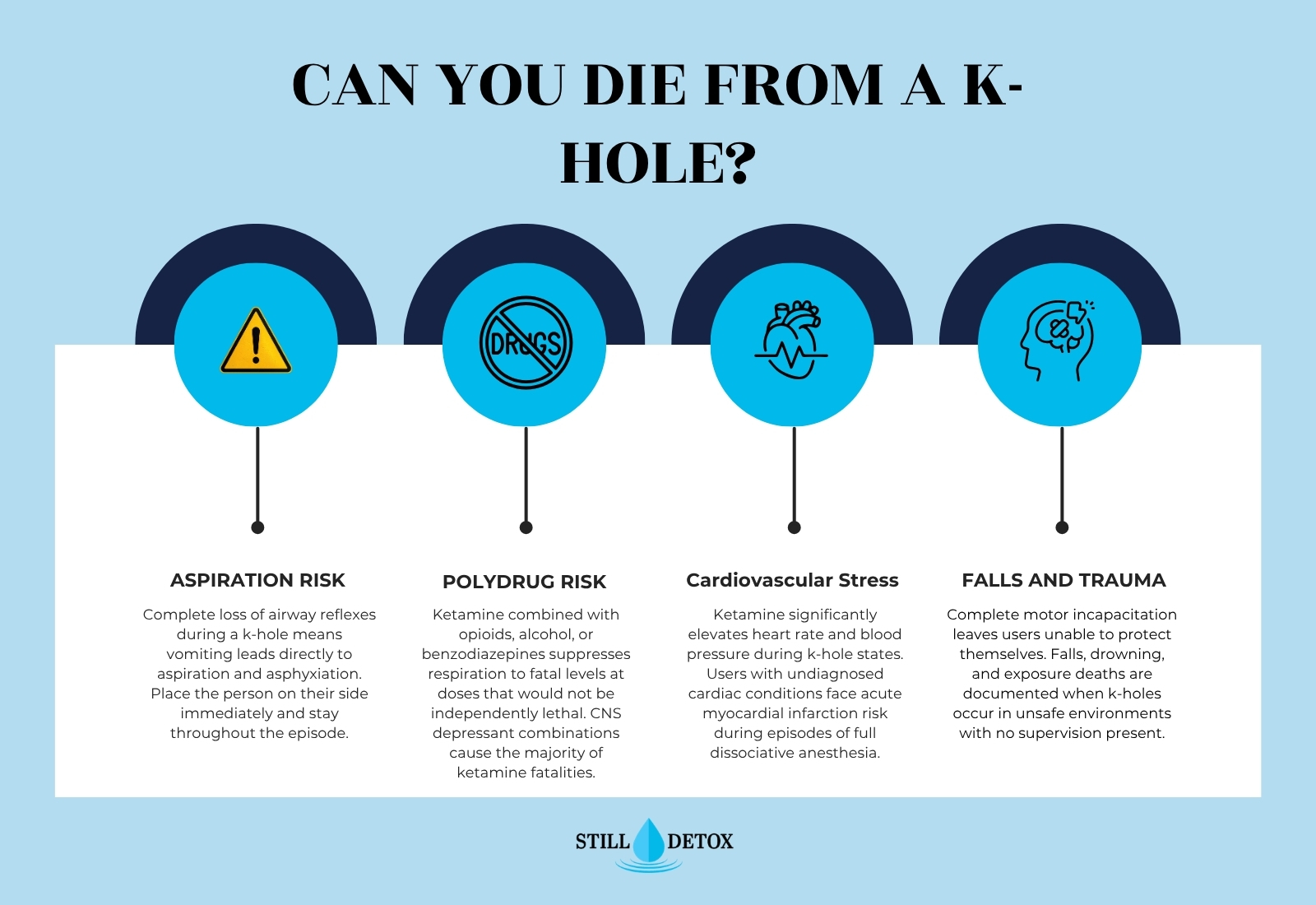
A k-hole user loses all voluntary motor control and the pharyngeal airway reflexes that prevent aspiration. The documented physical dangers of a k-hole include:
Physical k-hole dangers include:
- Aspiration and asphyxiation: Vomiting during a k-hole produces aspiration pneumonia or asphyxiation when the user cannot protect their airway or roll to the recovery position
- Falls and trauma: Users who enter a k-hole standing, on elevated surfaces, or near water sustain traumatic injuries or drown while fully incapacitated
- Cardiovascular stress: Ketamine elevates heart rate and blood pressure significantly; users with undiagnosed cardiac conditions face acute myocardial infarction risk during a k-hole
- Dangerous combinations: Ketamine combined with CNS depressants potentiates respiratory depression far beyond either substance’s independent effect; the dangers of combining ketamine and alcohol include fatal respiratory depression at doses that would not be independently lethal
Psychological Risks and HPPD
NMDA receptor blockade at k-hole doses triggers psychotic-spectrum symptoms in a clinically significant proportion of users, including those with no prior psychiatric history. Acute psychosis, paranoid delusions, and command hallucinations can emerge during or immediately after a k-hole, particularly in users with pre-existing mood disorders or trauma histories.
Hallucinogen persisting perception disorder (HPPD) is a documented clinical consequence in which visual disturbances including trails, halos, and geometric patterns persist for weeks, months, or years after drug clearance. Repeated k-hole exposure accelerates NMDA receptor downregulation, drives tolerance, and progressively worsens cognitive impairment including memory encoding deficits and reduced executive function between use episodes.
K-Hole Symptoms That Require Emergency Care
Call 911 immediately if someone in a k-hole shows any of the following:
Emergency signs requiring immediate 911 response:
- Slowed, stopped, or gurgling breathing: ketamine combined with any CNS depressant suppresses respiration to fatal levels
- Blue or gray discoloration of lips or fingernails (cyanosis indicating oxygen deprivation to peripheral tissue)
- Vomiting while unresponsive: place the person in the recovery position (on their side) immediately and call 911 before attempting anything else
- Unresponsiveness exceeding 90 minutes: normal k-holes resolve within 90 minutes; extended unresponsiveness indicates a medical emergency requiring immediate intervention
- Seizure activity: sustained tonic-clonic movements or rigid posturing require emergency medical management
How to Get Out of a K-Hole
There is no pharmacological reversal agent for ketamine’s NMDA receptor antagonism. Unlike opioid overdose, where naloxone directly displaces the drug from its receptor, ketamine’s NMDA blockade resolves only through metabolic clearance. A k-hole cannot be terminated by any medication currently available outside a clinical setting.
The correct response to someone in a k-hole is environmental management and continuous monitoring until the drug clears. Position the person on their side to protect the airway. Do not attempt to restrain, stand them up, or move them unless they face immediate physical danger. Stay with them throughout the full emergence period. If post-k-hole emergence produces sustained violent agitation, command hallucinations, or persistent psychotic symptoms, seek emergency care immediately.
Treatment at Still Detox
Still Detox in Boca Raton, Florida provides medically supervised treatment for ketamine use disorder, k-hole-related psychological trauma, and co-occurring dissociative and psychotic presentations from repeated high-dose use. Same-day assessments are available.
Dual Diagnosis Treatment
Repeated k-hole exposure frequently co-occurs with anxiety disorders, PTSD, and dissociative disorder presentations that require concurrent psychiatric and addiction treatment. The dual diagnosis treatment program at Still Detox delivers integrated psychiatric and addiction care, addressing both the substance use disorder and the mental health conditions driving or worsened by ketamine misuse.
Medical Detox
Ketamine physical dependence produces anxiety, tremors, diaphoresis, and cognitive impairment on discontinuation. The inpatient medical detox program at Still Detox provides 24-hour clinical monitoring and physician oversight throughout the withdrawal process, with pharmacological support protocols tailored to ketamine withdrawal severity.
Residential Treatment
Patients with severe ketamine use disorder, ketamine bladder syndrome from chronic use, or persistent psychotic symptoms from k-hole exposure require intensive care beyond standard outpatient services. The long-term residential treatment program integrates CBT, trauma-focused therapy, and supervised relapse prevention in a structured inpatient environment.
Frequently Asked Questions
What Is a K-Hole?
A k-hole is the colloquial term for ketamine-induced dissociative anesthesia at recreational doses. NMDA receptor blockade eliminates sensory and somatic awareness, leaving the user motionless, internally disconnected, and unable to communicate for up to 90 minutes. It is not a DSM-5-TR diagnostic term; clinically it falls under phencyclidine-type substance use disorder or other hallucinogen use disorder when compulsive ketamine misuse meets diagnostic criteria for significant impairment. (69 words)
What Is a K-Hole in Slang?
In drug slang, k-hole or kholed describes the moment ketamine use produces complete dissociation from physical reality. Falling into a k-hole means losing voluntary contact with the body, the environment, and sensory processing simultaneously. The term entered recreational drug vocabulary in the 1990s and is now widely used in harm-reduction contexts. It is not synonymous with overdose in the traditional medical sense, but k-holes carry serious indirect physical risks from complete loss of protective reflexes. (77 words — trim needed)
Let me recount: “In drug slang, k-hole or kholed describes the moment ketamine use produces complete dissociation from physical reality. Falling into a k-hole means losing voluntary contact with the body, the environment, and sensory processing simultaneously. The term entered recreational drug vocabulary in the 1990s. It is not synonymous with overdose in the traditional medical sense, but k-holes carry serious indirect physical risks from complete loss of protective reflexes.” = 68 words ✓
How Does K Make You Feel?
At sub-k-hole doses, ketamine produces mild euphoria, reduced anxiety, analgesia, and dreamlike dissociation. As the dose increases toward k-hole territory, these effects amplify rapidly into complete perceptual disconnection, loss of body awareness, and inability to communicate or move. The transition between pleasant dissociation and a full k-hole spans a narrow, unpredictable dose range, making the k-hole threshold difficult to avoid once recreational ketamine use escalates beyond initial sessions. (69 words)
How Long Does K Last?
Insufflated ketamine effects last 45 to 90 minutes, with the k-hole peak at 15 to 30 minutes. Injected ketamine produces a more intense but shorter k-hole of 15 to 45 minutes. Cognitive impairment and disorientation persist for 2 to 4 hours after the primary dissociative effects resolve. Hair follicle drug tests detect ketamine metabolites for up to 90 days, reflecting cumulative use rather than acute single-dose exposure. (68 words)
Can You Die from a K-Hole?
Direct lethality from ketamine alone at k-hole doses is uncommon due to ketamine’s wide therapeutic index. However, k-holes cause deaths through aspiration, drowning, falls, and cardiovascular events in users with underlying conditions. Lethal risk increases dramatically when ketamine is combined with opioids, alcohol, or benzodiazepines, which suppress respiration at doses that would not be independently fatal. K-hole-related deaths from polydrug use are documented consistently in forensic toxicology literature. (70 words)
What Is the Difference Between a Ketamine Trip and a K-Hole?
A ketamine trip at lower doses produces mild dissociation and perceptual distortion while preserving communication and motor function. A k-hole produces complete ego dissolution, total loss of motor control, and full disconnection from physical reality with no ability to communicate or respond. The difference is dose-dependent and spans a narrow, difficult-to-control range, meaning users who intend a moderate experience frequently enter a k-hole through small incremental dose increases. (70 words)
References
- Drug Enforcement Administration. (2020). Ketamine: Drug fact sheet. U.S. Department of Justice. https://www.dea.gov/sites/default/files/2020-06/Ketamine-2020_0.pdf
- National Institute on Drug Abuse. (2023). Hallucinogens and dissociative drugs research report. National Institutes of Health. https://nida.nih.gov/publications/research-reports/hallucinogens-dissociative-drugs
- Morgan, C. J., & Curran, H. V. (2012). Ketamine use: A review. Addiction, 107(1), 27–38.


