
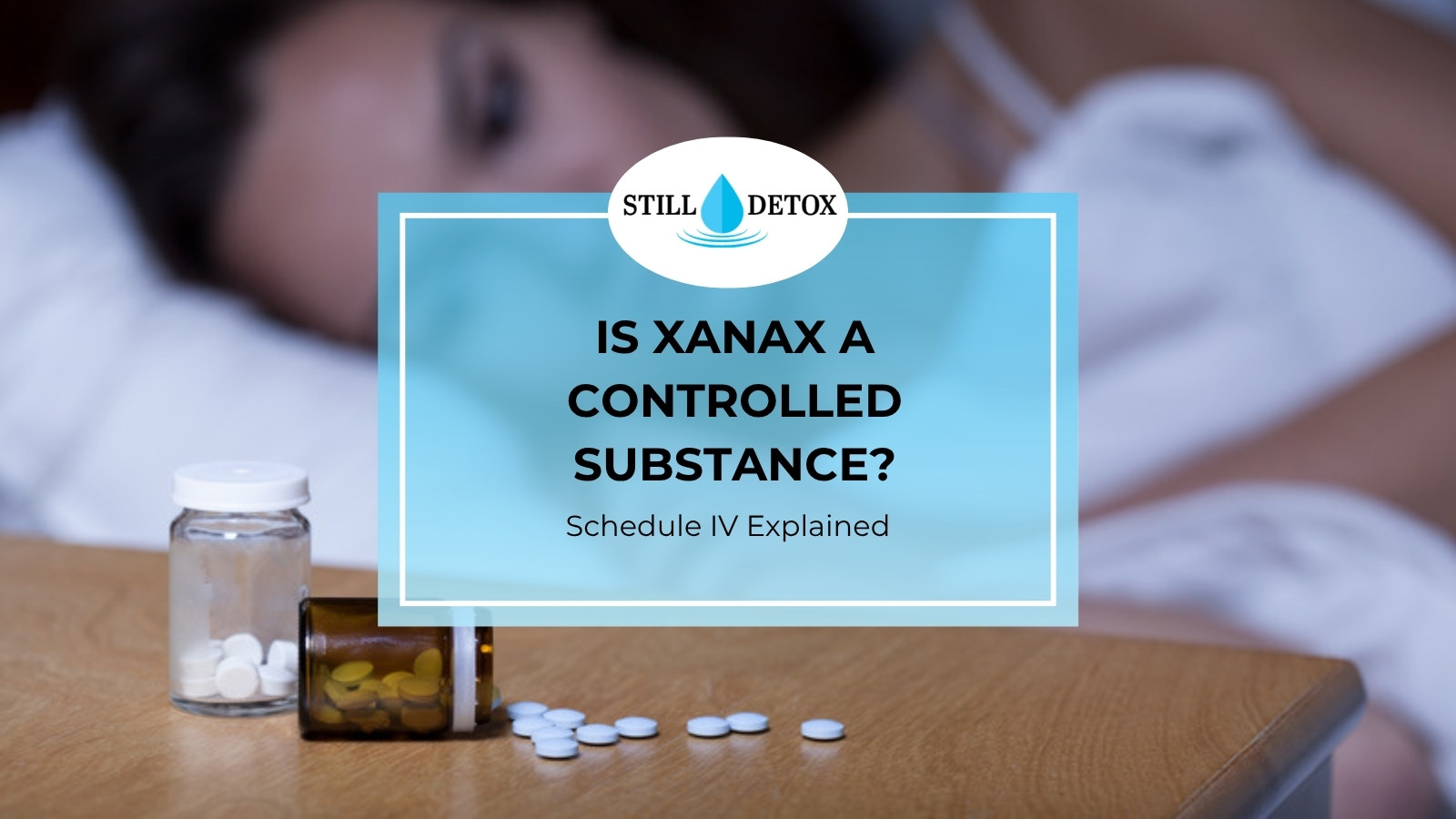
Yes, Xanax (alprazolam) is a controlled substance: federal law lists alprazolam in Schedule IV, the same group as Valium, Ativan and Klonopin, and it is legally available only with a prescription. Schedule IV is a legal category, not a promise that Xanax is safe.
Schedule IV status sets the prescription rules for Xanax, but daily Xanax use carries a risk of physical dependence, according to the FDA.
Is Xanax a controlled substance?
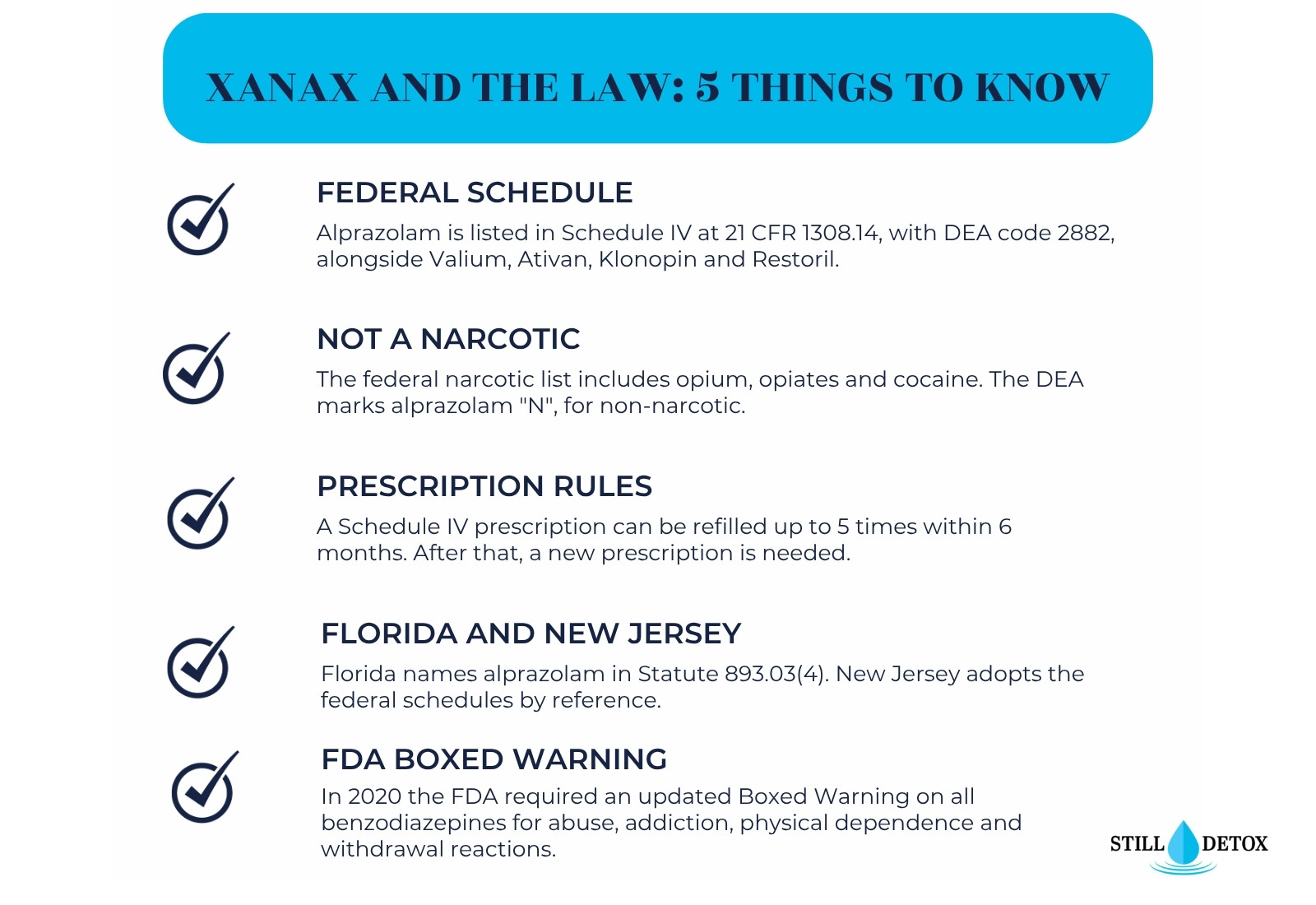
Xanax is a controlled substance. The federal Schedule IV list at 21 CFR 1308.14 names alprazolam, the active ingredient in Xanax, under DEA code 2882, and the FDA label for Xanax states that it contains a Schedule IV controlled substance.
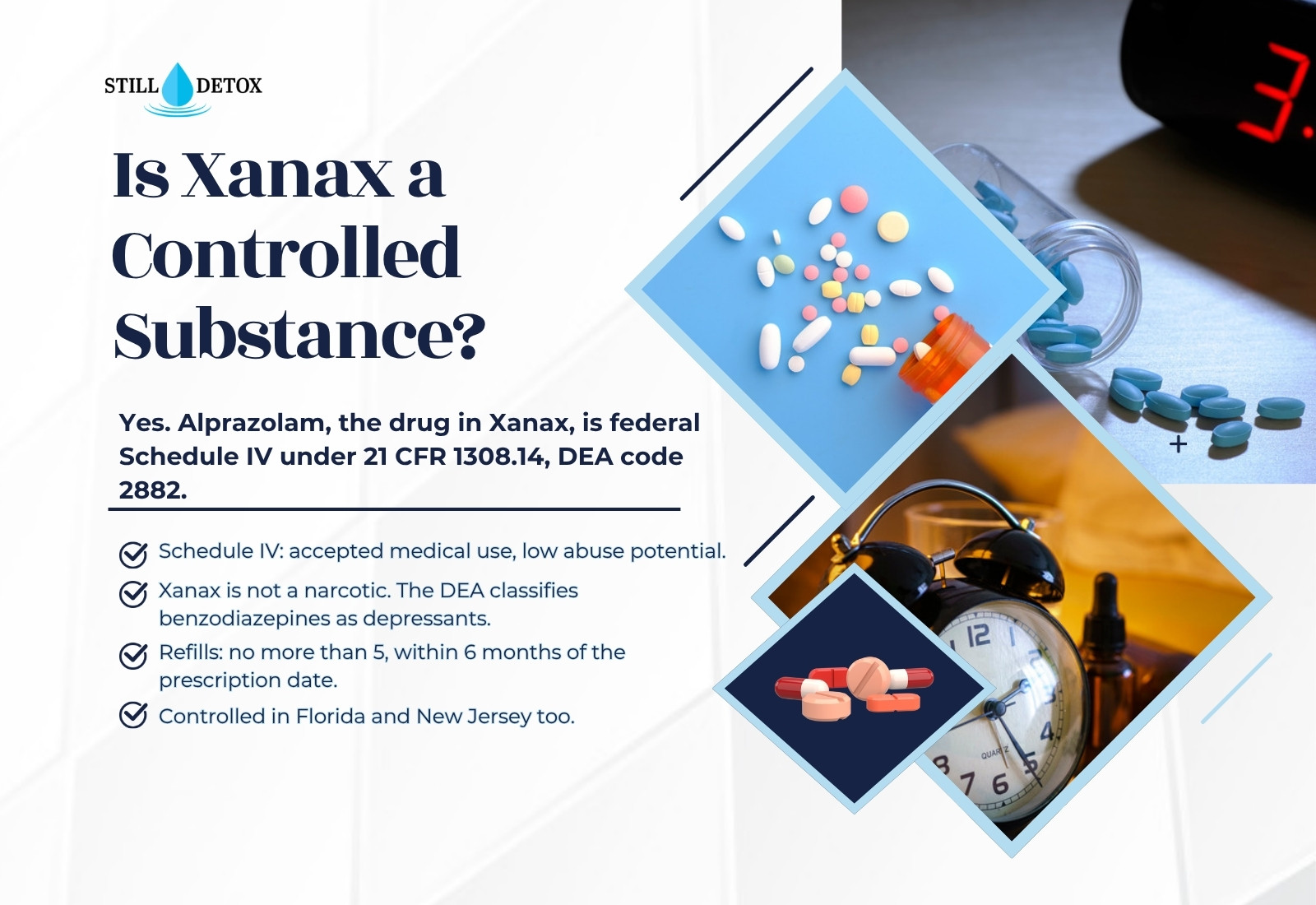
The Xanax label header carries the code "CIV", which stands for controlled substance Schedule IV. Benzodiazepines, sometimes called "benzos", are only legally available through a prescription, according to the DEA.
Which other benzodiazepines are Schedule IV?
Xanax shares Schedule IV with other benzodiazepines. These 5 brand-name benzodiazepines sit on the same federal list:
| Brand name | Generic name | Federal schedule | DEA code |
|---|---|---|---|
| Xanax | Alprazolam | Schedule IV | 2882 |
| Valium | Diazepam | Schedule IV | 2765 |
| Ativan | Lorazepam | Schedule IV | 2885 |
| Klonopin | Clonazepam | Schedule IV | 2737 |
| Restoril | Temazepam | Schedule IV | 2925 |
Because diazepam sits on the same federal list, the practical differences in Valium vs Xanax come from the two medicines themselves, not from their legal status.
What does Schedule IV mean?
Schedule IV means federal law judges a drug to have a currently accepted medical use and a low potential for abuse compared with Schedule III drugs. The Controlled Substances Act sorts drugs into 5 schedules by medical use and by abuse or dependence potential.
There are 3 tests a drug must meet for Schedule IV under 21 U.S.C. 812(b)(4):
- Low potential for abuse: A Schedule IV drug has a low potential for abuse relative to Schedule III drugs.
- Accepted medical use: A Schedule IV drug has a currently accepted medical use in treatment in the United States.
- Limited dependence: In the statute's words, abuse of a Schedule IV drug "may lead to limited physical dependence or psychological dependence" relative to Schedule III drugs.
There are 5 federal schedules, with DEA examples for each:
| Schedule | What it means | DEA examples |
|---|---|---|
| Schedule I | No currently accepted medical use and a high potential for abuse | Heroin, LSD, ecstasy, peyote |
| Schedule II | High potential for abuse, with use potentially leading to severe dependence | Oxycodone, fentanyl, methamphetamine, Adderall |
| Schedule III | Higher potential for abuse than Schedule IV | Tylenol with codeine, ketamine, anabolic steroids |
| Schedule IV | Low potential for abuse and low risk of dependence | Xanax, Valium, Ativan, Ambien, tramadol |
| Schedule V | Lower abuse potential than Schedule IV | Robitussin AC, Lomotil, Lyrica |
Readers asking whether cyclobenzaprine is a controlled substance can check the same federal lists at 21 CFR 1308.11 through 1308.15.
Why is Xanax only Schedule IV when it carries an addiction risk?
Xanax is Schedule IV because the schedules rank drugs against each other, not against zero risk. The FDA still warns that benzodiazepines, including Xanax, expose users to risks of abuse, misuse and addiction, even at recommended doses.
In September 2020, the FDA required an updated Boxed Warning for all benzodiazepine medicines because of serious risks of abuse, addiction, physical dependence and withdrawal reactions. The FDA states that physical dependence can occur when benzodiazepines are taken steadily for several days to weeks, even as prescribed.
There are 3 risks named in the Xanax Boxed Warning:
- Opioids: Using benzodiazepines with opioids may result in profound sedation, respiratory depression, coma and death.
- Abuse, misuse and addiction: The Boxed Warning states that the use of benzodiazepines, including Xanax, "exposes users to risks of abuse, misuse, and addiction, which can lead to overdose or death."
- Dependence and withdrawal: Continued use of Xanax carries a risk of clinically significant physical dependence, and the risk grows with longer treatment and higher daily doses.
Is Xanax a narcotic?
Xanax is not a narcotic. Federal law defines a "narcotic drug" by a list that includes opium and opiates, their derivatives, and cocaine, and the DEA lists alprazolam as non-narcotic. The DEA classifies Xanax and other benzodiazepines as depressants.
Under 21 U.S.C. 802(17), the narcotic group includes opium, opiates and their derivatives, and cocaine. The DEA notes that "narcotic" today refers to opium, opium derivatives and their semi-synthetic substitutes, and that a more current term for these drugs is "opioid."
The DEA's own Schedule IV table includes a column headed "Narcotic", and it marks alprazolam "N". Diazepam, lorazepam, clonazepam and temazepam carry the same "N". Benzodiazepines produce sedation, relieve anxiety and muscle spasms, and reduce seizures, according to the DEA.
Is Xanax a Schedule II drug?
Xanax is not a Schedule II drug. Schedule II holds drugs with a high potential for abuse, such as oxycodone, fentanyl and Adderall, and a Schedule II prescription may not be refilled at all.
What are the prescription rules for Xanax?
A Xanax prescription can be filled or refilled for no more than 6 months after the date it was issued, and refilled no more than 5 times. After that, the prescriber must write a new prescription.
There are 3 ways a pharmacy can receive a Schedule IV prescription under 21 CFR 1306.21:
- Paper: A paper prescription signed by the practitioner, or a fax of that signed prescription.
- Electronic: An electronic prescription that meets DEA requirements.
- Oral: A phone order from the prescriber that the pharmacist promptly puts in writing.
The refill limits come from 21 CFR 1306.22, which applies to every Schedule III and IV prescription.
Can Xanax be prescribed through telehealth?
As of October 2026, federal rules allow Xanax to be prescribed through telehealth when certain conditions are met. Under 21 CFR 1307.41, a DEA-registered practitioner may prescribe Schedule II to V controlled substances by telemedicine when the rule's conditions are met, and the DEA and HHS extended this rule through December 31, 2026.
Is Xanax a controlled substance in Florida and New Jersey?
Xanax is a controlled substance in both states. Florida law names alprazolam in its own Schedule IV list, and New Jersey regulations adopt the federal Schedules I to V by reference, so alprazolam's federal Schedule IV listing also applies in New Jersey.
What does Florida law say about Xanax?
Florida Statute 893.03(4) lists alprazolam among Schedule IV substances. Florida Statute 893.13(6)(a) bars a person from possessing a controlled substance unless it was lawfully obtained from a practitioner or under a valid prescription. A violation of Florida Statute 893.13(6)(a) is a felony of the third degree.
What does New Jersey law say about Xanax?
New Jersey regulation N.J.A.C. 13:45H-10.1 incorporates the federal controlled dangerous substance Schedules I to V at 21 CFR 1308.11 through 1308.15 by reference. The New Jersey Controlled Dangerous Substances Law also says that when a substance is scheduled under federal law and notice is given to the state director, the director shall similarly control it.
This summary of federal, Florida and New Jersey controlled substance law is not legal advice.
What happens if you stop taking Xanax suddenly?
Stopping Xanax suddenly, or cutting the dose too fast, can result in withdrawal reactions, including seizures, which can be life-threatening. The FDA advises people not to stop a benzodiazepine without first making a plan with their health care professional to lower the dose slowly.
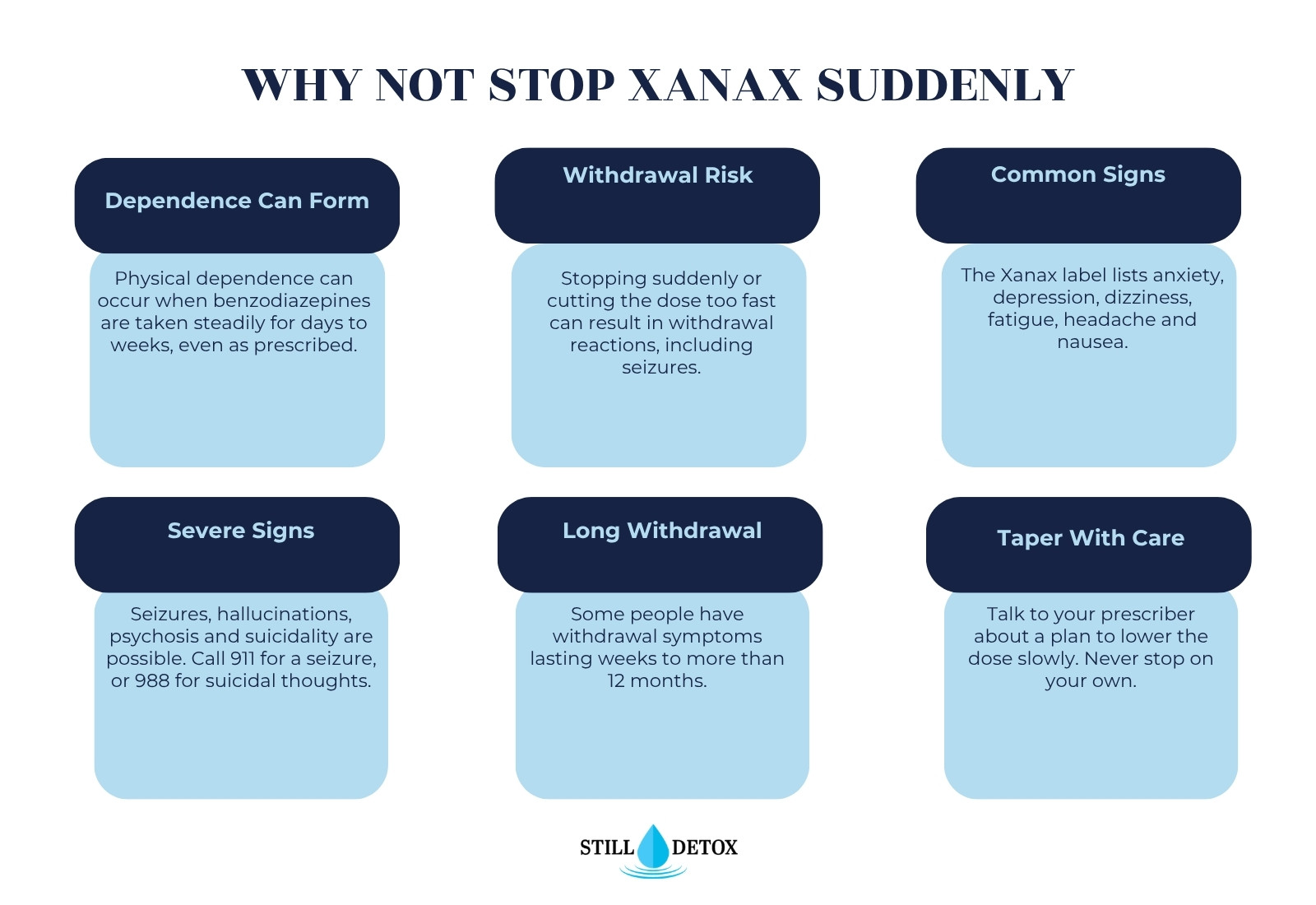
These 8 entries come from the longer list of acute withdrawal signs on the Xanax label:
- Anxiety
- Depression
- Feeling detached from yourself or your surroundings (depersonalization and derealization)
- Dizziness
- Fatigue
- Headache
- Blurred vision
- Nausea, vomiting, diarrhea and decreased appetite
The label lists more severe withdrawal reactions too, including seizures, hallucinations, delirium tremens, psychosis and suicidality. Some people develop a protracted withdrawal syndrome, with symptoms lasting weeks to more than 12 months.
If stopping Xanax brings a seizure or trouble breathing, call 911.
"A lower schedule is a legal category, not a safety rating. If you take Xanax every day, the safest way to stop is a slow, supervised taper, never cold turkey on your own."
Britney Marshall, RN, Director of Nursing, Still Detox
For people in South Florida, benzo addiction treatment in Florida at Still Detox starts with a Medical Director evaluation within 24 hours of admission and an individualized taper. The Still Detox care team in Boca Raton checks vital signs every 4 hours during the acute window.
Are fake Xanax pills dangerous?
Fake Xanax pills are dangerous because the DEA warns that many fake pills made to look like Xanax and other prescription medicines contain fentanyl or methamphetamine. DEA lab testing found that 2 out of every 5 fake pills with fentanyl contain a potentially lethal dose.
Clonazepam and alprazolam, the drugs in Klonopin and Xanax, are the two benzodiazepines most frequently encountered on the illicit market, according to the DEA.
The DEA lists Xanax among the medicines that counterfeit pills copy, and it warns that counterfeit pills are nearly identical to real prescription medicines. A 2021 DEA fact sheet shows authentic white Xanax tablets beside yellow counterfeit Xanax tablets that contained fentanyl.
The DEA advises never trusting your own eyes to judge whether a pill is real, which means the look of Xanax bars bought outside a pharmacy proves nothing about what is inside. The DEA says the only safe medicines are those prescribed by a trusted medical professional and dispensed by a licensed pharmacist.
Where can you get help for Xanax dependence in Florida or New Jersey?
Still Detox offers medically supervised benzodiazepine detox in Boca Raton, Florida, and Mays Landing, New Jersey, where a care team lowers the dose gradually and watches for dangerous withdrawal signs. The FDA tells prescribers to evaluate patients and refer them for early treatment when a substance use disorder is suspected.
The diagnosis behind problematic benzodiazepine use is sedative, hypnotic, or anxiolytic use disorder. Physical dependence can develop even when Xanax is taken as prescribed, according to the FDA.
If you live in New Jersey, Philadelphia or Delaware, Still Detox's Mays Landing facility offers benzodiazepine detox in Atlantic County, New Jersey. At the Mays Landing facility, short-acting benzodiazepines such as Xanax are cross-tapered to a longer-acting one on an individualized schedule.
What else do people ask about Xanax and controlled substances?
Are benzos Schedule 3 or 4?
Benzodiazepines are Schedule IV (schedule 4) depressants under the Controlled Substances Act, according to the DEA.
What class of drug is alprazolam?
Alprazolam is a benzodiazepine. The DEA describes benzodiazepines as depressants that produce sedation, relieve anxiety and muscle spasms, and reduce seizures.
What level of controlled substance is alprazolam?
Alprazolam is a Schedule IV controlled substance, shown on the Xanax label as "CIV".
Is there a difference between Xanax and alprazolam?
Xanax is a brand name and alprazolam is the generic name of the same drug. The FDA lists alprazolam under the brand names Xanax and Xanax XR.
What drugs are considered narcotics?
Under federal law, narcotic drugs include opium, opiates and their derivatives, and cocaine. The DEA notes that "opioid" is now the more precise term for opium-based drugs and their substitutes.
Can you drink alcohol while taking Xanax?
You should not drink alcohol while taking Xanax. The FDA advises not to drink alcohol with benzodiazepines, and it warns that abuse and misuse raise the risk of overdose or death, especially when benzodiazepines are combined with alcohol or opioids.
Sources
- Schedule IV, 21 C.F.R. § 1308.14 (2026). Electronic Code of Federal Regulations. ecfr.gov
- Requirement of prescription, 21 C.F.R. § 1306.21, and Refilling of prescriptions, 21 C.F.R. § 1306.22 (2026). Electronic Code of Federal Regulations. ecfr.gov
- Temporary extension of COVID-19 telemedicine flexibilities for prescription of controlled medications, 21 C.F.R. § 1307.41 (2026). Electronic Code of Federal Regulations. ecfr.gov
- Schedules of controlled substances, 21 U.S.C. § 812, and Definitions, 21 U.S.C. § 802. Legal Information Institute, Cornell Law School. law.cornell.edu
- U.S. Drug Enforcement Administration. (n.d.). Drug scheduling. dea.gov
- U.S. Drug Enforcement Administration. (2024). Drugs of abuse: A DEA resource guide (2024 ed.). dea.gov
- U.S. Drug Enforcement Administration. (2024). Benzodiazepines: 2024 drug fact sheet. dea.gov
- U.S. Drug Enforcement Administration. (n.d.). Fake prescription pills [Fact sheet]; and (2021, May). Counterfeit pills [Fact sheet]. dea.gov
- U.S. Food and Drug Administration. (2020, September 23). FDA requiring Boxed Warning updated to improve safe use of benzodiazepine drug class. fda.gov
- Viatris Specialty LLC. (2023). XANAX (alprazolam) tablets, CIV: Full prescribing information and Medication Guide. U.S. Food and Drug Administration. fda.gov
- Fla. Stat. § 893.03(4) (2025) and § 893.13(6)(a) (2026). The Florida Senate. flsenate.gov
- N.J. Admin. Code § 13:45H-10.1, and N.J.S.A. 24:21-3. New Jersey Division of Consumer Affairs. njconsumeraffairs.gov