

The fentanyl fold is a slang term for the bent-forward posture, sometimes while standing, seen in people who have used fentanyl or fentanyl mixed with xylazine (tranq). The fentanyl fold is a sign of a life-threatening overdose when the person cannot be woken, so check a folded person right away.
Specialists think people fold because fentanyl dulls the brain and loosens control of the muscles that hold the body upright, and xylazine adds more drowsiness. Movement disorder specialists writing in 2025 call the posture street slang, not a medical diagnosis, and none of the three proposed explanations has been proven.
A folded person who will not wake up needs the same response as any overdose: naloxone, a 911 call and close watching of their breathing. So why does fentanyl bend the body, how does tranq change the fold, and what should you do first to keep the person alive?
What is the fentanyl fold?
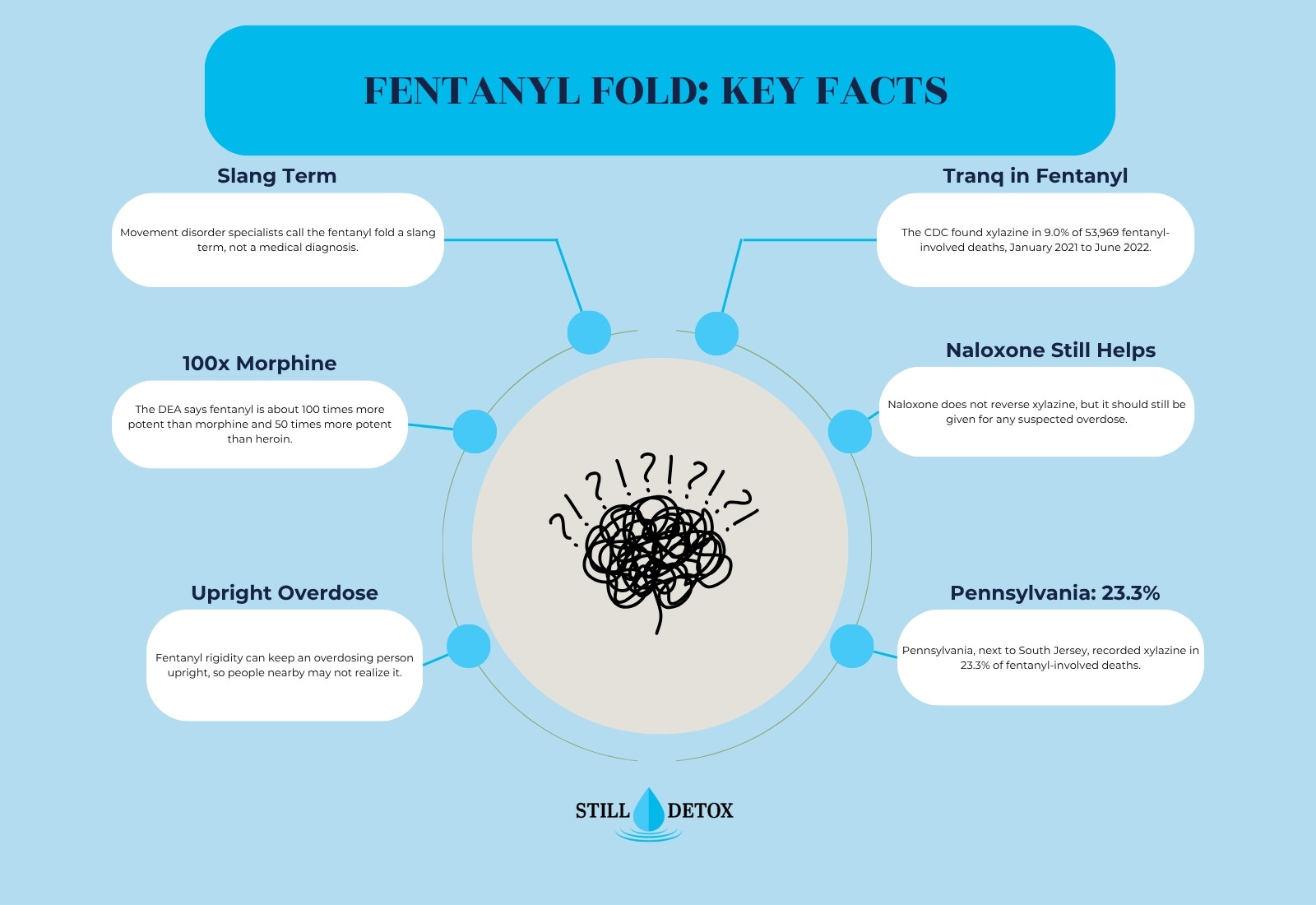
The fentanyl fold is a bent-at-the-waist posture that can appear after fentanyl use, sometimes while the person is still standing. Movement disorder specialists writing in Movement Disorders in 2025 call it street slang, not a medical diagnosis. In their view, the effects these slang terms describe are most often short-lived and reversible at first.
What other names does the fentanyl fold go by?
People also search for the fentanyl fold as the fent fold, fenty fold, fentanyl lean, fentanyl bend and fentanyl hunchback, or describe a person as "hunched over" on fentanyl. A related slang term is the heroin hunch.
Is "fentanyl fold" a medical term?
No. The fentanyl fold is not a clinical term. In a 2025 paper in Movement Disorders, specialists call "heroin hunch" and "fentanyl fold" slang terms and note that much of what is known about the posture comes from traditional and social media.
Why do people bend over on fentanyl?
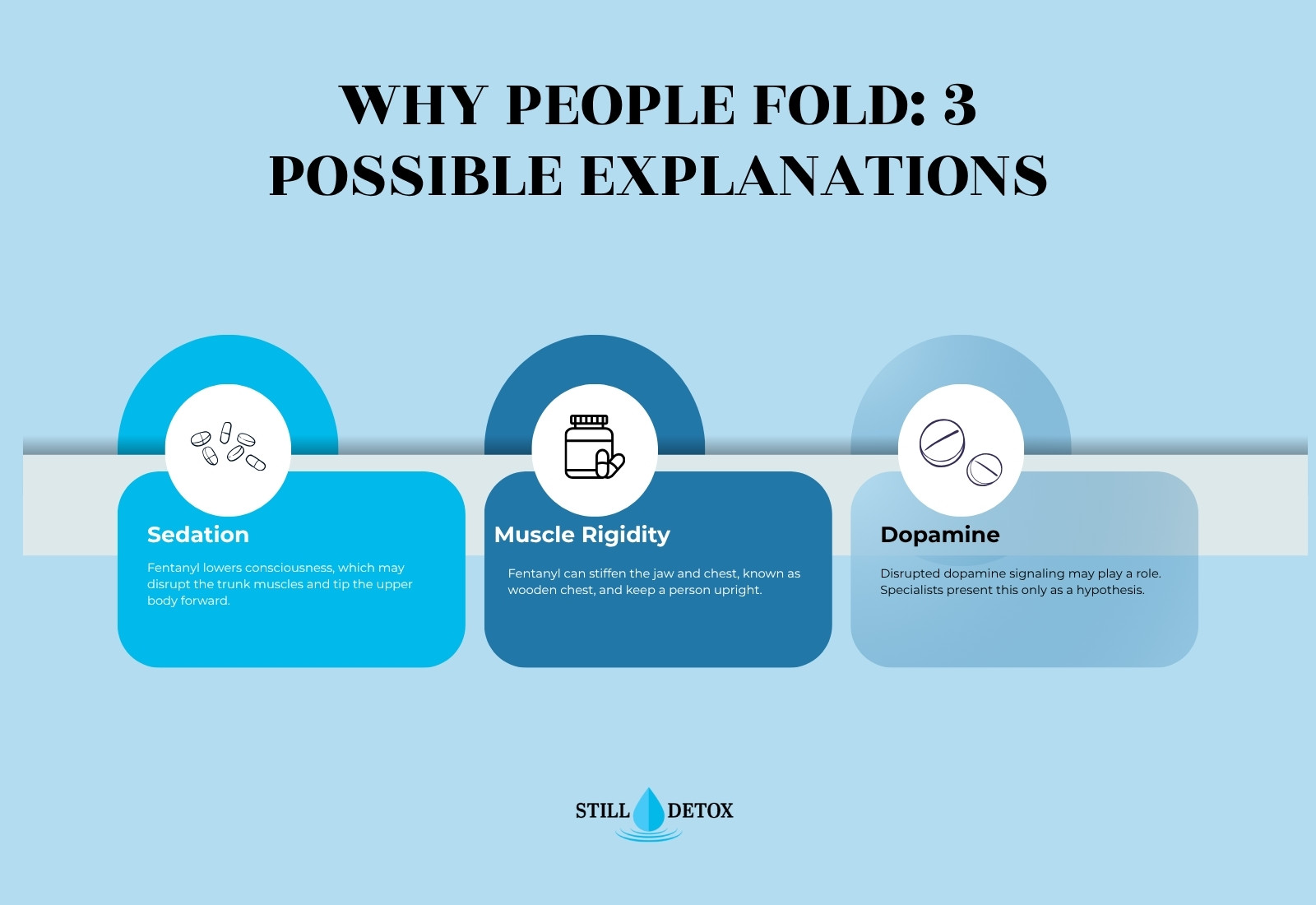
Specialists think people bend over on fentanyl because the drug dulls the brain and disrupts the muscles that hold the body upright, and xylazine adds more drowsiness and loose muscles. Three explanations have been proposed, and none has been proven yet.
How does opioid sedation bend the body forward?
Fentanyl causes sedation, drowsiness and confusion, like other opioid painkillers. The first explanation is that this lowered level of consciousness disrupts control of the trunk muscles, so the upper body tips forward.
How does fentanyl muscle rigidity fit in?
The second explanation is fentanyl muscle rigidity, which can stiffen the jaw and chest. The chest version is known as "wooden chest," and it makes breathing harder on top of fentanyl's slowed breathing drive.
What does xylazine add to the fold?
Xylazine makes people drowsy and relaxes muscles, and it can slow breathing, heart rate and blood pressure to dangerously low levels. That adds a second sedative on top of fentanyl's own drowsiness.
Could dopamine play a role?
Possibly. The third explanation points to disrupted dopamine signaling in the brain. The authors compare the fold to camptocormia, a forward-bent posture seen in parkinsonian conditions, and present the link only as a hypothesis.
Why do some folded people look limp and others look stiff?
One possible reason is that different effects are at work in different people. Xylazine relaxes muscles, while fentanyl rigidity can let a person overdosing on fentanyl remain upright instead of slouching.
Is the fentanyl fold an overdose?
Not always, but the fentanyl fold can be an overdose, and you may not be able to tell the difference by looking at posture. The CDC warns that it may be hard to tell whether a person is high or experiencing an overdose.
Fentanyl acts on the parts of the brain that control breathing, and in an overdose, breathing can slow to a life-threatening level. Being upright does not rule an overdose out, because fentanyl rigidity can keep a person upright while people nearby may be unaware that an overdose has happened.
Watch for 3 warning signs:
- The person cannot be woken up: An overdosing person stays unresponsive and cannot be woken.
- Breathing is slow, shallow or noisy: Choking sounds or a gurgling or snoring noise from someone who cannot be woken is an overdose sign.
- The pupils are pinpoint: The DEA says coma, pinpoint pupils and slowed breathing together strongly suggest opioid intoxication.
If someone you love keeps folding over, that pattern deserves attention. Fentanyl addiction is a form of opioid use disorder (OUD), and fentanyl addiction treatment in Boca Raton begins with medical detox, 24/7 nursing and an in-person evaluation by the Medical Director within 24 hours of arrival.
What should you do if someone is folded over and not responding?
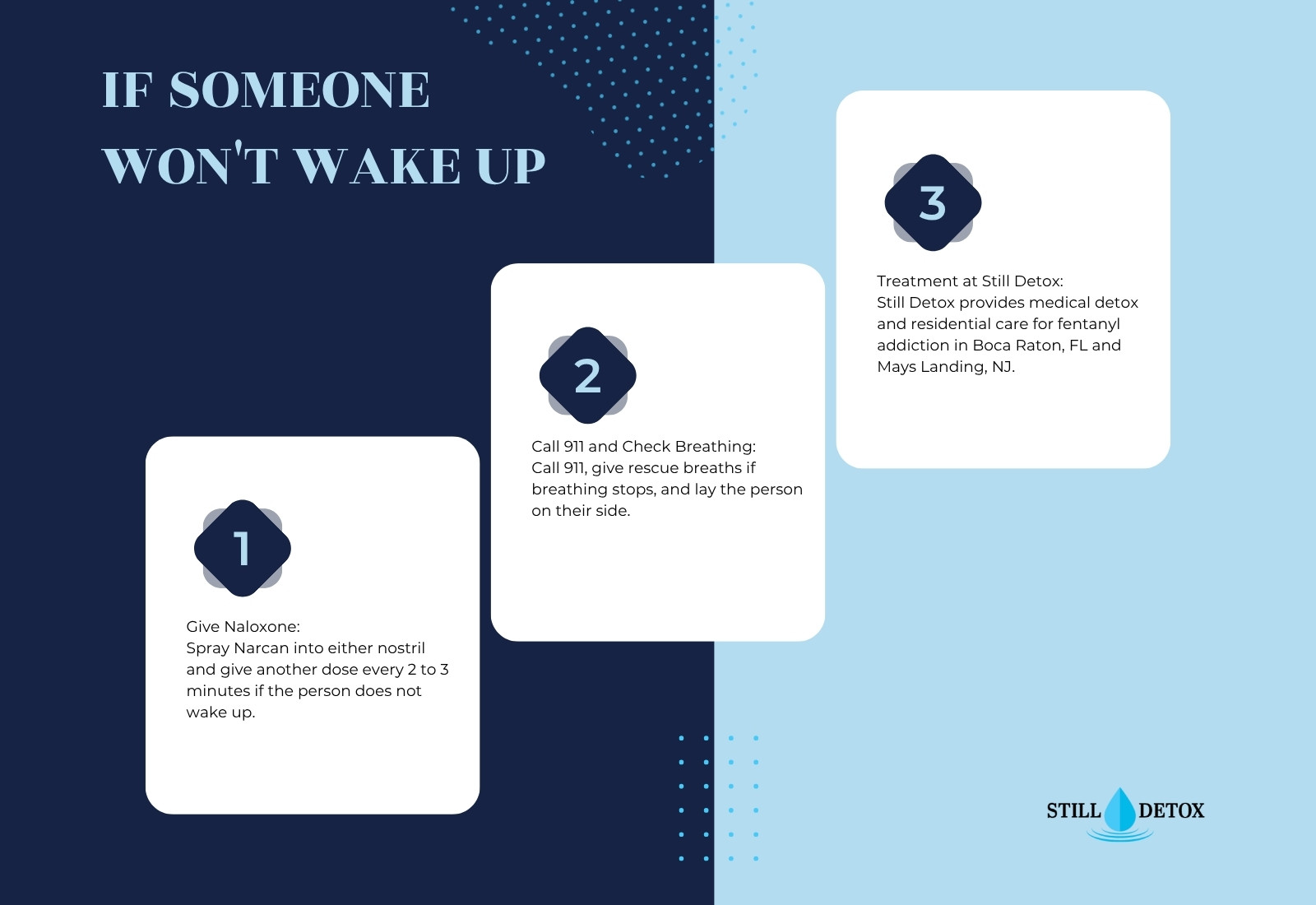
Treat a folded, unresponsive person as an overdose: give naloxone, call 911, and keep checking their breathing until help arrives. Keep giving naloxone every 2 to 3 minutes if they do not wake up, using a new device for each dose, because fentanyl may need more than one dose.
There are 6 steps to follow:
- Assume it is an overdose: It may be hard to tell a high from an overdose, so act as if it is one.
- Give naloxone: Spray one dose of Narcan nasal spray into either nostril. If the person does not wake up after 2 to 3 minutes, give another dose with a new device, ideally in the other nostril, and repeat every 2 to 3 minutes.
- Call 911: Emergency care matters even after naloxone, because the effects of xylazine may continue after naloxone is given.
- Check breathing: Make sure an unconscious person keeps breathing, and give rescue breaths if breathing stops.
- Roll the person onto their side: Lay the person on their side, with their head supported, to prevent choking.
- Stay until help arrives: Stay with the person until emergency help arrives.
Does Florida's Good Samaritan law protect you when you call 911?
Yes, for certain drug offenses. Under Florida Statute 893.21, a person who seeks medical help in good faith for someone having an alcohol or drug overdose cannot be arrested, charged, prosecuted or penalized for certain drug offenses, such as possession, when the evidence was found because they called for help. The law also protects the person who had the overdose. This is a summary, not legal advice.
How do you help a loved one who keeps folding?
Help a loved one who keeps folding by keeping naloxone ready and starting a calm, judgment-free conversation about treatment. Repeated folding is a warning sign of ongoing fentanyl use, and any episode can turn out to be an overdose.
There are 3 ways to help:
- Carry naloxone: The CDC advises anyone who knows a person at increased risk of opioid overdose to carry naloxone and keep it at home. Tell others where it is kept, because a person cannot use naloxone on themselves during an overdose.
- Talk without blame: Speak when your loved one is awake and sober, describe what you saw, and use person-first words such as "a person with opioid use disorder" instead of labels.
- Find treatment together: The SAMHSA National Helpline at 1-800-662-4357 gives free, confidential treatment referrals 24 hours a day, 365 days a year, and Still Detox in Boca Raton answers at (561) 556-2677.
How does tranq (xylazine) change the fentanyl fold?
Tranq (xylazine) adds a non-opioid sedative to fentanyl that naloxone cannot reverse, so a person may stay drowsy after the opioid is reversed. The White House Office of National Drug Control Policy named fentanyl mixed with xylazine an emerging threat on April 12, 2023.
What is tranq?
Tranq, also called tranq dope, is xylazine, a non-opioid sedative that is not approved for use in people. Xylazine is approved only in veterinary medicine, as a tranquilizer and pain reliever for animals.
Why does naloxone not fully wake someone on tranq?
Naloxone blocks opioids and has no effect on xylazine, so a person who used fentanyl with tranq may stay sedated after the fentanyl is reversed. Public health experts still recommend giving naloxone when xylazine is suspected.
How common is tranq in fentanyl?
Tranq became much more common in fentanyl deaths within a few years. The CDC found that the monthly share of illicitly manufactured fentanyl-involved deaths with xylazine rose 276% across 21 jurisdictions, from 2.9% in January 2019 to 10.9% in June 2022.
Pennsylvania, next door to South Jersey, recorded xylazine in 23.3% of illicitly manufactured fentanyl-involved deaths from January 2021 to June 2022, one of the highest shares in the CDC review.
How is the fentanyl fold different from the heroin hunch?
The fentanyl fold and the heroin hunch are both slang for opioid postures, but a fentanyl overdose can leave a person rigid and upright instead of slouched. Pharmacologists Gill, Kelly and Henderson (2019, Addiction) contrast the typical slouching of heroin overdose with fentanyl muscle rigidity, so an upright posture does not rule out an overdose.
The heroin hunch describes the slouched posture seen with heroin. The fentanyl fold belongs to the fentanyl and tranq era, when fentanyl rigidity can keep an overdosing person upright and harder to recognize.
How is fentanyl addiction treated at Still Detox?
Still Detox treats fentanyl addiction with two levels of care: medically supervised detox, then residential treatment for up to 30 days. Dual diagnosis care and medication-assisted treatment (MAT), which uses approved medicines for opioid use disorder, are provided within both levels of care. The Boca Raton, Florida facility is open now, and Still Detox New Jersey is opening soon.
There are 4 parts to fentanyl detox at Still Detox:
- Medical evaluation: The Medical Director evaluates every client in person within 24 hours of arrival.
- Monitored withdrawal: Staff check vital signs every 4 hours, with 24/7 nursing through detox.
- Detox length: Detox averages 7 to 10 days and runs up to 14 days for complex cases, following the opioid withdrawal timeline.
- Residential care: Most clients step down to residential treatment around day 8, for a program of up to 30 days.
If you live in South Jersey, Philadelphia or Delaware, Still Detox New Jersey in Mays Landing, about 26 minutes from Atlantic City, will offer fentanyl detox in Atlantic County, New Jersey when it opens.
What else do people ask about the fentanyl fold?
Why do some people stay standing while folded over?
Some people stay standing because fentanyl muscle rigidity can hold the body upright. That rigidity means people nearby may not realize an overdose is happening.
How long does the fentanyl fold last?
No set length has been established. The 2025 Movement Disorders paper describes posture changes that can last several hours at a time.
Is the fentanyl fold permanent?
Not at first, according to specialists, who describe the posture as most often reversible early on. The same 2025 paper warns that folding for several hours a day over months or years leads to muscle and bone changes that the authors say may become permanent.
Can Narcan reverse the fentanyl fold?
Partly. Narcan can reverse the fentanyl in a fentanyl overdose, but it cannot reverse xylazine. Give it anyway, repeat doses as needed, and call 911.
Is xylazine an opioid?
No. Xylazine is not an opioid. It is a non-opioid sedative, and naloxone does not reverse its effects.
Where does the term "fentanyl fold" come from?
The term "fentanyl fold" comes from street slang and social media. Specialists note that much of what is known about the posture comes from traditional and social media.
Sources
- Centers for Disease Control and Prevention. (2024, April 2). Preventing and responding to overdose. cdc.gov
- Centers for Disease Control and Prevention. (2025, June 11). Lifesaving naloxone. cdc.gov
- Centers for Disease Control and Prevention. (2024, May 16). What you should know about xylazine. cdc.gov
- Ganos, C., Erro, R., Abdullah, M., Hauck, T. S., Ciccarone, D., Sutherland, C., Saiyarsarai, P., Marras, C., Fox, S. H., Fasano, A., Lang, A. E., Squires, J., & Bhatia, K. P. (2025). Frozen in addiction: A new wave of drug-induced movement disorders? Movement Disorders, 40(12), 2596-2603. https://doi.org/10.1002/mds.70048
- Gill, H., Kelly, E., & Henderson, G. (2019). How the complex pharmacology of the fentanyls contributes to their lethality. Addiction, 114(9), 1524-1525. https://doi.org/10.1111/add.14614
- Kariisa, M., O'Donnell, J., Kumar, S., Mattson, C. L., & Goldberger, B. A. (2023). Illicitly manufactured fentanyl-involved overdose deaths with detected xylazine: United States, January 2019 to June 2022. Morbidity and Mortality Weekly Report, 72(26), 721-727. cdc.gov
- National Institute on Drug Abuse. (n.d.). Fentanyl DrugFacts. nida.nih.gov
- National Institute on Drug Abuse. (n.d.). Xylazine. nida.nih.gov
- Emergent Devices Inc. (2026). NARCAN (naloxone HCl) nasal spray 4 mg: Drug Facts carton labeling. U.S. Food and Drug Administration. fda.gov
- U.S. Food and Drug Administration. (2015). NARCAN (naloxone hydrochloride) nasal spray: Prescribing information. fda.gov
- Fla. Stat. § 893.21 (2025). Alcohol-related or drug-related overdoses; medical assistance; immunity from arrest, charge, prosecution, and penalization. flsenate.gov
- Substance Abuse and Mental Health Services Administration. (n.d.). SAMHSA's National Helpline. samhsa.gov
- Office of National Drug Control Policy. (2023, April 12). Biden-Harris Administration designates fentanyl combined with xylazine as an emerging threat to the United States. The White House.
- U.S. Drug Enforcement Administration. (n.d.). Fentanyl [Drug fact sheet]. dea.gov