

Kratom is a tropical tree (Mitragyna speciosa) from Southeast Asia whose leaves are sold in the United States as powders, capsules, teas and extracts that produce both stimulant-like and opioid-like effects.
People take kratom for energy, pain relief and help with opioid withdrawal. Kratom acts on the same brain receptors as opioid drugs, and the FDA has not approved kratom for any medical use. So what is kratom made of, and what does it do?
What is kratom?
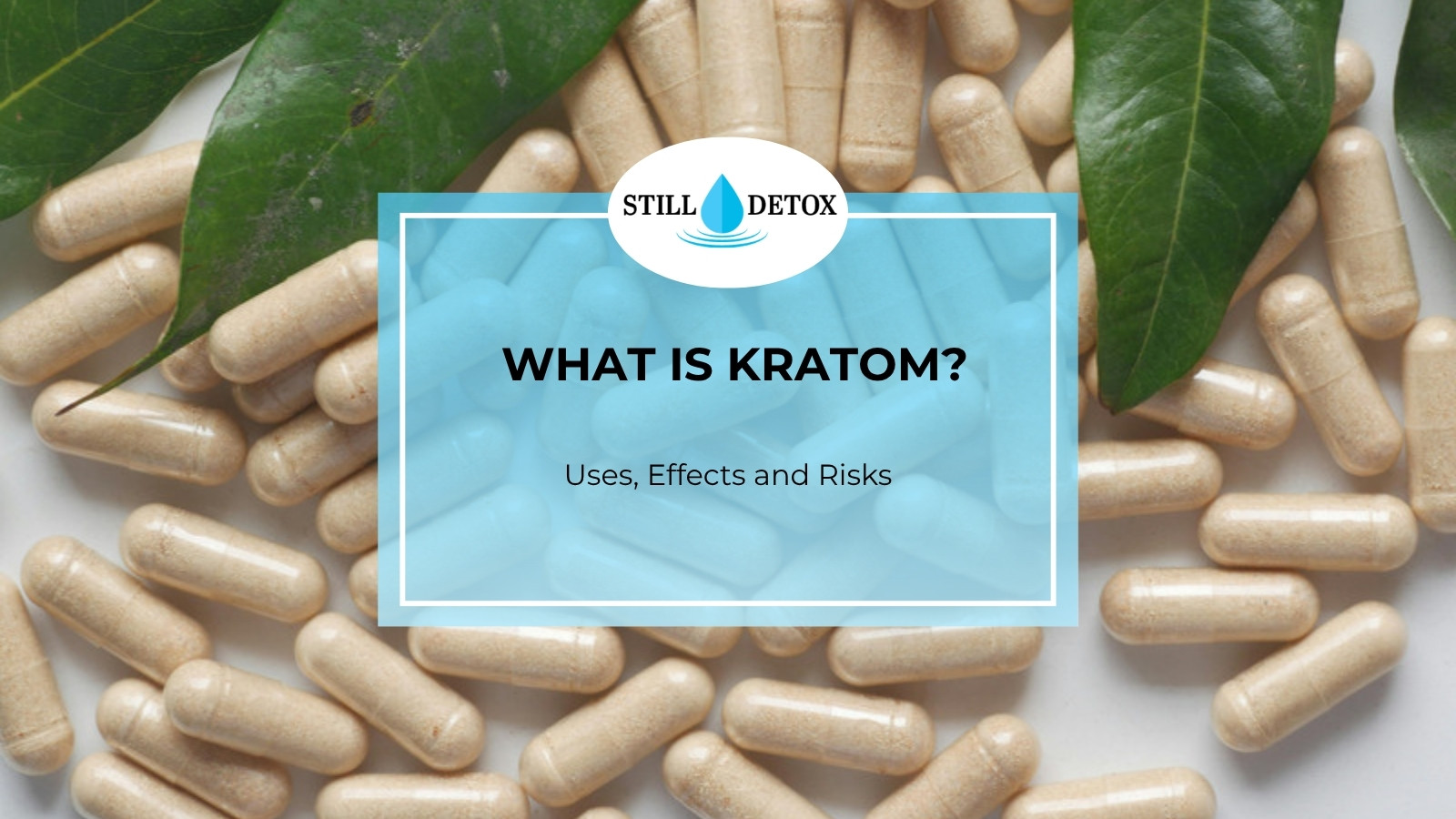
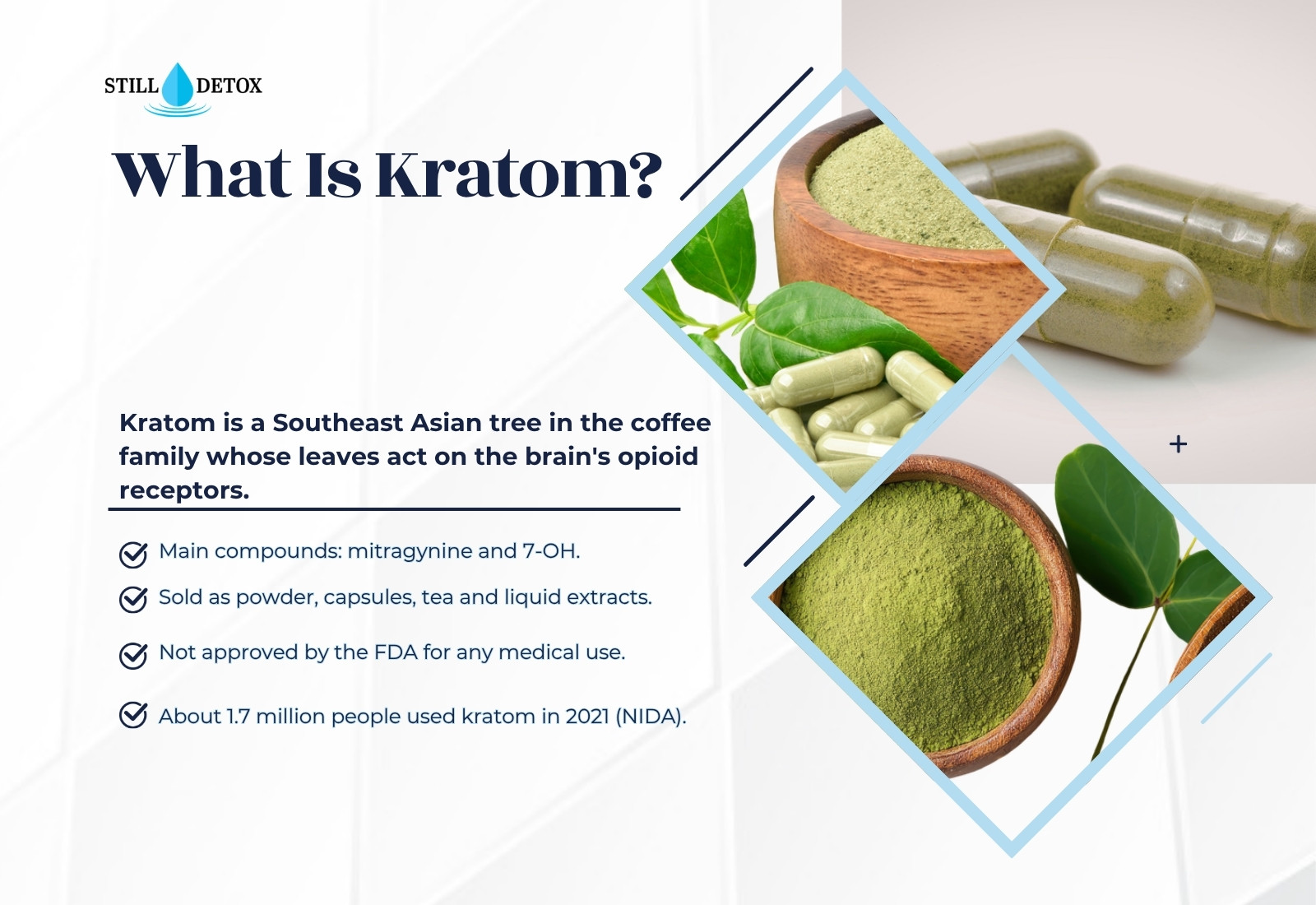
Kratom is the leaf of Mitragyna speciosa, a tree in the coffee family that grows in Thailand, Malaysia and Indonesia, and the name also covers the powders, capsules and extracts made from those leaves. NIDA describes kratom as an herbal substance with opioid-like and stimulant-like effects.
Kratom use in Southeast Asia goes back at least 150 years, according to a 2019 review by Veltri and Grundmann. Field workers chewed fresh leaves for energy and brewed kratom tea for pain.
What is kratom made of?
Kratom is made of dried, ground leaves that carry dozens of plant compounds called alkaloids. Mitragynine is the main kratom alkaloid, and NIDA reports that the body turns mitragynine into 7-hydroxymitragynine, a stronger opioid compound, during digestion.
The FDA reports that 7-OH makes up less than 2% of the alkaloids in natural kratom leaves. 7-OH binds the mu-opioid receptor far more strongly than mitragynine does.
What does kratom look like?
Kratom leaves are green leaves with white, green or red veins, according to Veltri and Grundmann (2019). Kratom sold in the United States is a fine powder made from those dried, ground leaves.
Sellers label kratom powder as red vein, green vein or white vein and claim different effects for each. Veltri and Grundmann note that people in Southeast Asia do not tell the vein colors apart.
How is kratom sold and consumed?
There are 5 common ways kratom is sold and consumed in the United States:
- Powder: Dried leaves ground fine and stirred into food or drinks, as NIDA describes.
- Capsules and tablets: Kratom powder packed into capsules or pressed into tablets.
- Tea: Leaves brewed in hot water, the traditional form in Southeast Asia.
- Liquid extracts: Kratom liquids that Yale Medicine describes as highly concentrated.
- Gummies: Candy-style kratom products, listed by Yale Medicine.
Yale Medicine reports that kratom products sit on shelves in gas stations, smoke shops and online stores, which is why kratom is called a “gas station drug.”
What type of drug is kratom?
Kratom is a plant-based drug that acts as a stimulant in small amounts and as an opioid-like sedative in higher doses, according to Yale Medicine. That mix means kratom fits no single drug class.
Kratom is sold like an herbal supplement, but the FDA states that kratom is not lawfully marketed as a drug, a dietary supplement or a food additive in conventional food. Yale Medicine notes that no federal standard governs a kratom product’s contents, strength or label.
What does kratom do in the body?
Kratom activates mu-opioid receptors in the brain, the receptors that opioid painkillers act on, through its two main compounds, mitragynine and 7-OH. NIDA notes that mitragynine also binds adrenergic, serotonin and dopamine receptors, and links that binding to the alert feeling some people describe.
NIDA reports that these effects “only partially compare to those of opioids like heroin or oxycodone.” Yale Medicine calls mitragynine and 7-OH atypical opioids, or partial opioid agonists, because they bind opioid receptors differently than morphine does.
Stimulant-like effects at low doses
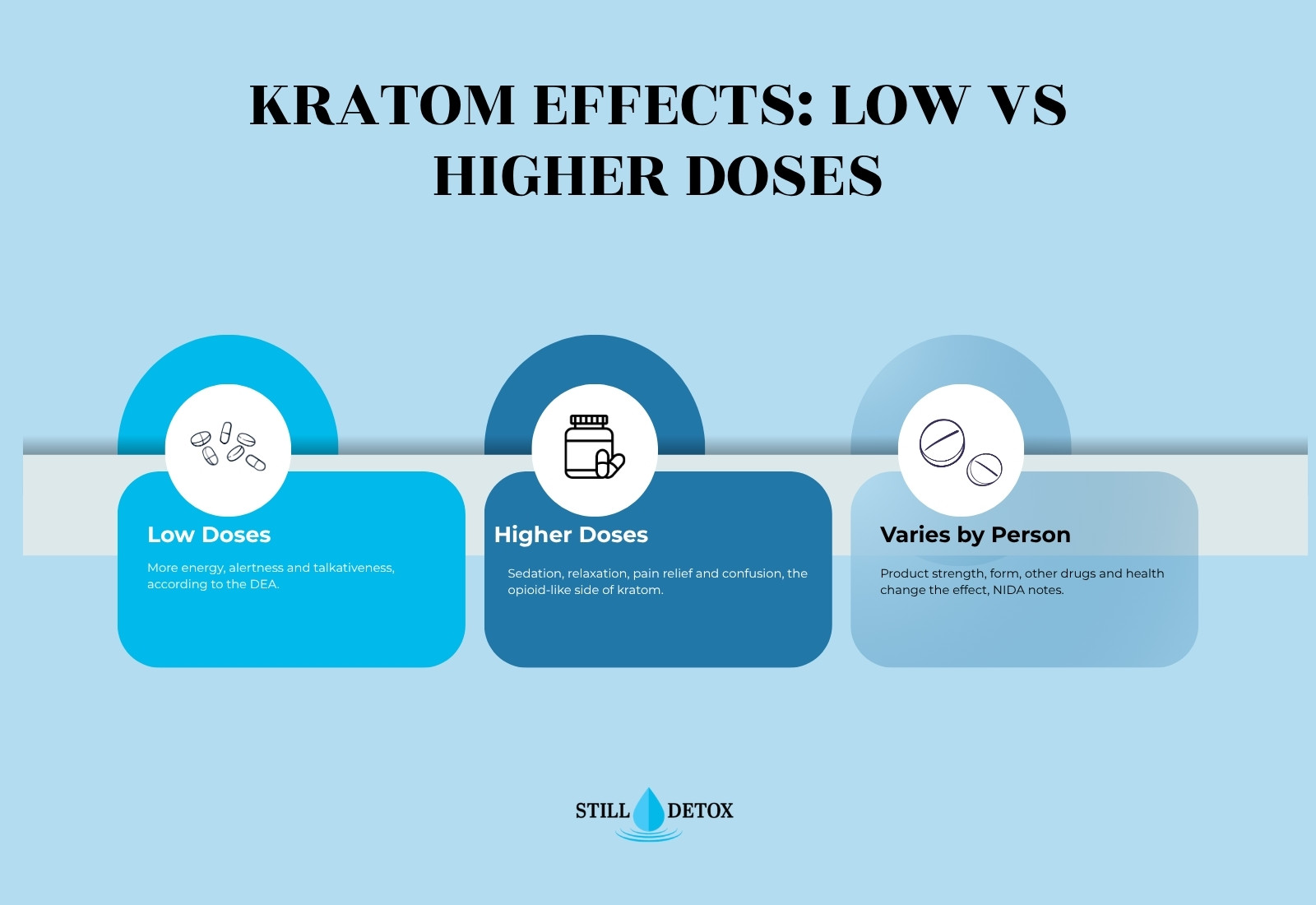
Low doses of kratom produce stimulant effects, with increased alertness, physical energy and talkativeness, according to the Drug Enforcement Administration (DEA). NIDA adds rapid heart rate to the stimulant-like effects people report.
Opioid-like effects at higher doses
Higher doses of kratom produce sedation, relaxation, pain relief and confusion, the opioid-like side of kratom. NIDA cautions that studies have not yet proven that kratom’s effects depend on the dose, even though many people describe this pattern.
What does kratom feel like?
Kratom feels like a burst of energy and alertness at small amounts and like calm relaxation with less pain at larger amounts, according to reports collected by NIDA and the DEA. NIDA notes that the same product feels different from one person to the next.
Kratom also brings unpleasant effects. The DEA lists nausea, itching, sweating, dry mouth and vomiting among kratom’s effects on the body.
Physical effects of kratom
The 7 physical effects of kratom listed in the DEA kratom fact sheet are:
- Nausea and vomiting: An upset stomach and throwing up.
- Constipation: Slower digestion and hard stools.
- Sweating and itching: Warm, flushed or itchy skin.
- Dry mouth: Less saliva and more thirst.
- Fast heartbeat: A racing pulse, which doctors call tachycardia.
- More urination: Needing the bathroom more than usual.
- Drowsiness and poor appetite: Sleepiness and eating less.
How long do kratom effects last?
Kratom starts to work within minutes, and the effects last a few hours, according to Mayo Clinic. NIDA lists the amount taken, the product’s strength, the form, other drugs in the body and a person’s health among the factors that change kratom’s effects.
What is kratom used for?
People use kratom to ease pain, manage opioid withdrawal and cravings, boost energy, and cope with anxiety or depression, according to NIDA. Most people report more than one reason, and none of these uses is approved by the FDA.
There are 4 main reasons people give for using kratom:
- Pain relief: Self-treating long-term muscle, joint or back pain.
- Opioid withdrawal: Easing withdrawal symptoms and cravings while cutting back on opioids or other drugs.
- Energy: Fighting fatigue during long workdays, the traditional use in Southeast Asia.
- Mood: Managing symptoms of anxiety and depression.
The FDA adds coughing and diarrhea to the conditions people self-treat with kratom. Dr. Melissa Weimer, an addiction medicine specialist at Yale Medicine, states that kratom is not a recommended or proven treatment for opioid withdrawal, and that proven medications for opioid use disorder exist.
Daily kratom use for any of these reasons builds dependence, and stopping brings kratom withdrawal symptoms within hours of the last dose.
How strong is kratom compared to opioids?
Kratom leaf is weaker than fentanyl and only partly matches heroin or oxycodone, because kratom’s compounds only partially activate opioid receptors, but kratom still produces physical opioid dependence. Concentrated 7-OH products are far stronger than kratom leaf.
Yale Medicine reports that kratom’s alkaloids do not fully activate the pathways that stop breathing in an opioid overdose, so kratom leaf carries less risk of unintentional overdose than traditional opioids. That lower risk does not make kratom safe.
“If you use it regularly enough, say consistently for two weeks, then you’re going to be at risk for opioid withdrawal and dependence because of its opioid properties,” Dr. Weimer told Yale Medicine.
Kratom leaf vs concentrated 7-OH
Some companies extract 7-OH from kratom and make products about 10 times more potent, Yale Medicine reports. NIDA reports that 7-OH slows breathing in laboratory studies, and naloxone reverses that effect. Dependence grows faster with concentrated 7-OH products, Dr. Weimer warns.
Kratom’s partial opioid action is why experts still debate whether kratom is an opioid.
What are the risks of kratom?
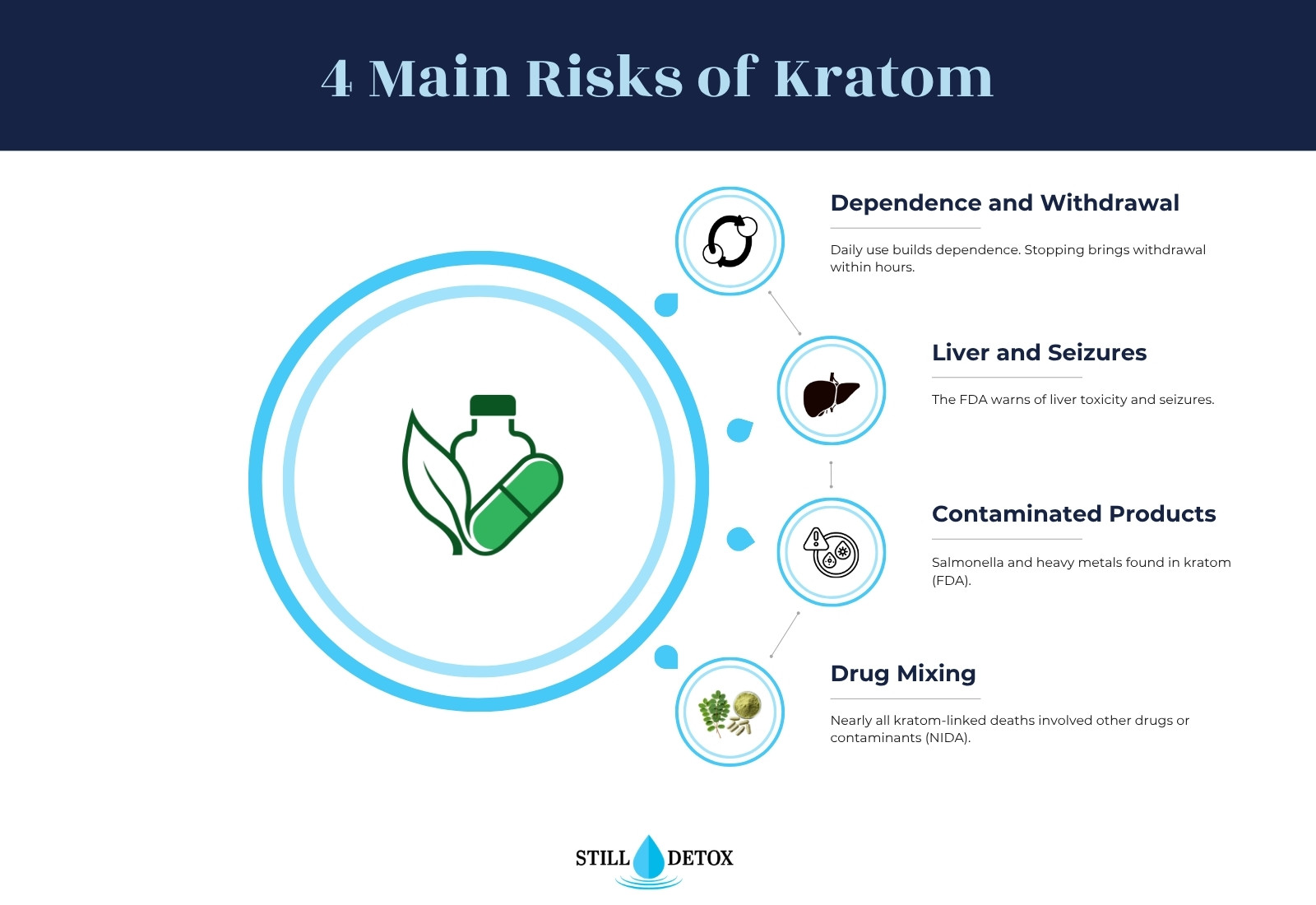
The main risks of kratom are dependence and withdrawal, liver damage, seizures, contaminated products and dangerous drug combinations, according to the FDA and NIDA. Concentrated 7-OH products add a faster path to dependence, Yale Medicine reports.
Dependence and withdrawal
Kratom dependence develops with daily use, and NIDA describes kratom withdrawal as mild to moderate for most people who stop. Smith and colleagues (2022) found moderate withdrawal among US adults, led by stomach upset, restlessness, anxiety and craving.
Liver damage and seizures
The FDA warns that kratom use brings a risk of liver toxicity, seizures and substance use disorder. NIDA notes case reports of serious liver problems in a small minority of people who used large amounts of kratom over a long time.
Contaminated kratom products
Kratom products have tested positive for Salmonella and for concerning levels of heavy metals, the FDA reports. Kratom buyers have no way to check a product for contamination at the store.
Mixing kratom with other drugs
NIDA reports that a very small number of deaths have been linked to kratom, and nearly all of those deaths involved other drugs or contaminants. Combining kratom with alcohol, opioids or sedatives raises the risk of kratom overdose.
When does kratom use become a problem?
Kratom use becomes a problem when a person keeps using kratom despite the harm it causes, loses control over the amount, and feels sick without it. Clinicians call this kratom use disorder.
The Diagnostic and Statistical Manual of Mental Disorders, Fifth Edition, Text Revision (DSM-5-TR) has no kratom-specific diagnosis. Smith, Epstein and Weiss (2024) explain in Current Psychiatry Reports that clinicians diagnose kratom use disorder under the “other” substance use disorder category.
There are 4 signs behind most kratom use disorder diagnoses, according to Smith, Epstein and Weiss (2024):
- Tolerance: Needing more kratom, or a stronger product, to feel the same effect.
- Withdrawal: Feeling restless, achy or sick between doses.
- Using more than intended: Taking kratom more frequently or in larger amounts than planned.
- Craving: A strong urge to take kratom that is hard to ignore.
Anyone who uses kratom every day and cannot cut back benefits from a medical evaluation before stopping, and a clinician-set taper is the safest way to quit kratom.
How does Still Detox help people stop using kratom?
Still Detox treats kratom dependence with medical detox followed by residential treatment, and Still Detox lists kratom, including 7-OH, among the substances that need medical detox. The same care runs in Boca Raton, Florida and Mays Landing, New Jersey.
“Kratom is sold in stores, but daily kratom use is a medical issue. When someone arrives using kratom every day, our Medical Director evaluates them in person within 24 hours, and our nurses are on the unit 24/7.”
Britney Marshall, RN, Director of Nursing, Still Detox
Kratom detox in Boca Raton
Still Detox Boca Raton sits on the University Hospital campus, next to Boca Regional Hospital. Specialized lab testing identifies 7-OH use at admission. Nurses check vital signs every 4 hours, and the Medical Director sets each taper by age and medical risk during kratom and 7-OH detox in Boca Raton.
Kratom detox in New Jersey
Still Detox New Jersey sits on 33 acres in Mays Landing, about 26 minutes from Atlantic City, and provides airport pickup. Families in South Jersey start with kratom detox in New Jersey.
What else do people ask about kratom?
What is the street name for kratom?
The DEA lists thang, kakuam, thom, ketum and biak as names for kratom in Southeast Asia. Veltri and Grundmann (2019) add biak-biak and Maeng Da as regional names.
What is kratom similar to?
Kratom is closest to an opioid with a stimulant side. NIDA reports that kratom’s compounds activate opioid receptors, but the effects only partially compare to heroin or oxycodone.
Does kratom make you feel buzzed?
Yes, for many people. The DEA reports that low doses of kratom bring alertness, energy and talkativeness, and higher doses bring sedation. Nausea and dizziness come with that buzz for some users.
What are the benefits of kratom?
No benefit of kratom is proven. NIDA states that researchers have not proven kratom safe or effective for any medical purpose, and the FDA has not approved kratom. NIDA funds research on kratom for pain.
How long does kratom high last?
A kratom high lasts a few hours and begins within minutes, according to Mayo Clinic. Larger amounts and stronger products produce stronger effects.
What is a kratom drink?
A kratom drink is kratom powder mixed into a beverage, kratom leaves brewed as tea, or a liquid kratom extract. Liquid kratom extracts are highly concentrated, Yale Medicine notes.
Sources
- Mayo Clinic. (2024, June 18). Kratom: Unsafe and ineffective.
- National Institute on Drug Abuse. (2026). Kratom. National Institutes of Health.
- Smith, K. E., Dunn, K. E., Rogers, J. M., et al. (2022). Assessment of kratom use disorder and withdrawal among an online convenience sample of US adults. Journal of Addiction Medicine, 16, 666–670.
- Smith, K. E., Epstein, D. H., & Weiss, S. T. (2024). Controversies in assessment, diagnosis, and treatment of kratom use disorder. Current Psychiatry Reports, 26(9), 487–496.
- U.S. Drug Enforcement Administration. (2020). Drug fact sheet: Kratom.
- U.S. Food and Drug Administration. (2025, December 2). FDA and kratom.
- Veltri, C., & Grundmann, O. (2019). Current perspectives on the impact of kratom use. Substance Abuse and Rehabilitation, 10, 23–31.
- Yale Medicine. (2026, June 17). Kratom: What is it and is it safe?