

The safest way to quit kratom is a slow, step-by-step taper planned with a clinician, because stopping daily kratom all at once brings on withdrawal and strong cravings within hours.
Kratom withdrawal is mild to moderate for most people, but concentrated extracts and 7-OH products make quitting harder. So how hard is it, and what actually helps?
How hard is it to get off kratom?
Getting off kratom is hard for daily users because the body expects kratom’s steady effect on opioid receptors, and stopping brings restlessness, aches and cravings. The National Institute on Drug Abuse (NIDA) describes kratom withdrawal as mild to moderate for most people who stop regular use.
Cravings remain the main relapse risk after stopping kratom. Singh and colleagues (2014) recorded strong kratom cravings among 293 regular users in Malaysia, and more than half of those users had severe kratom dependence.
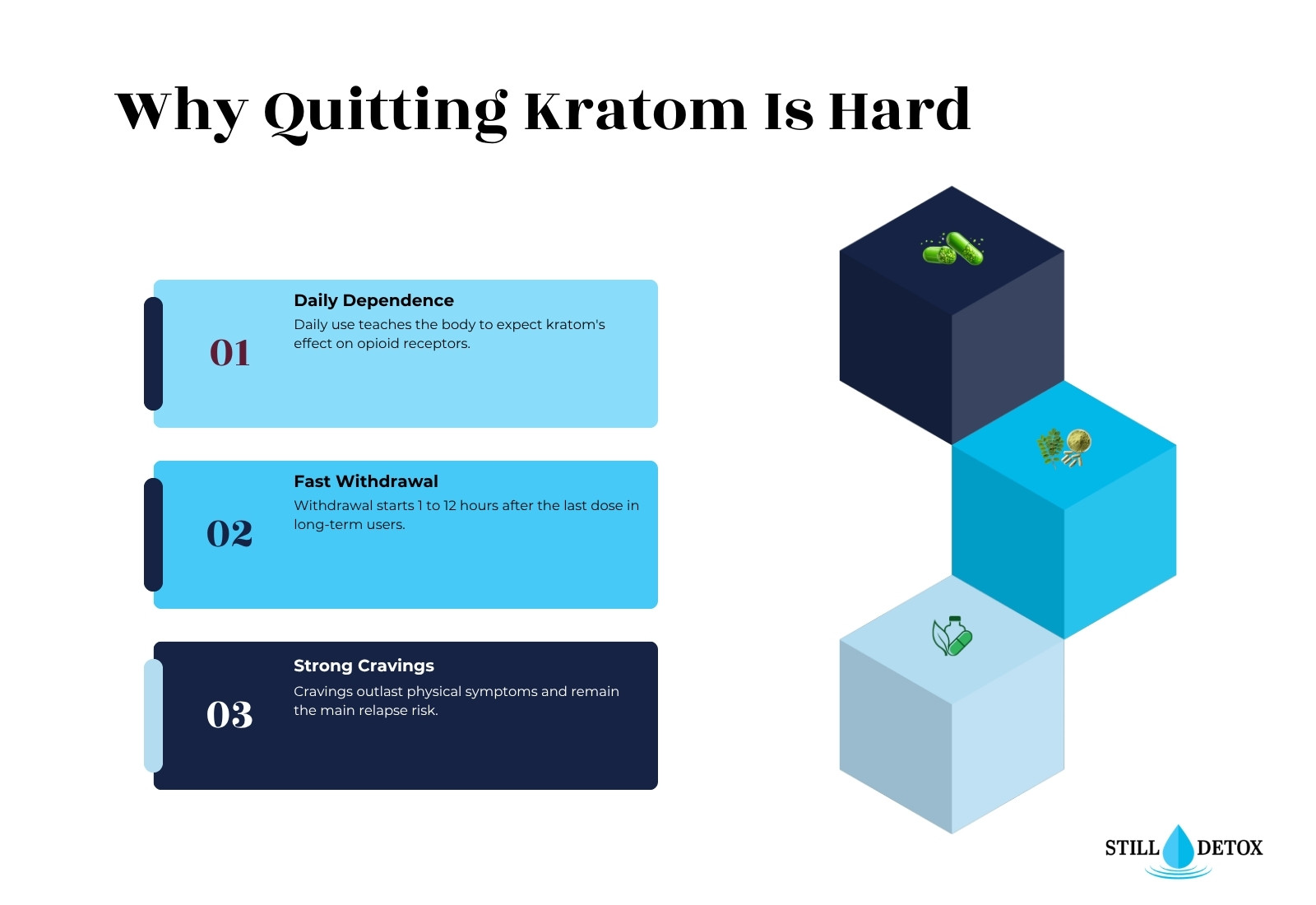
Concentrated products raise the difficulty further. Stanciu (2026) reported that traditional kratom produces mild, delayed withdrawal, while potent kratom derivatives produce rapid, severe withdrawal.
How do you taper off kratom safely?
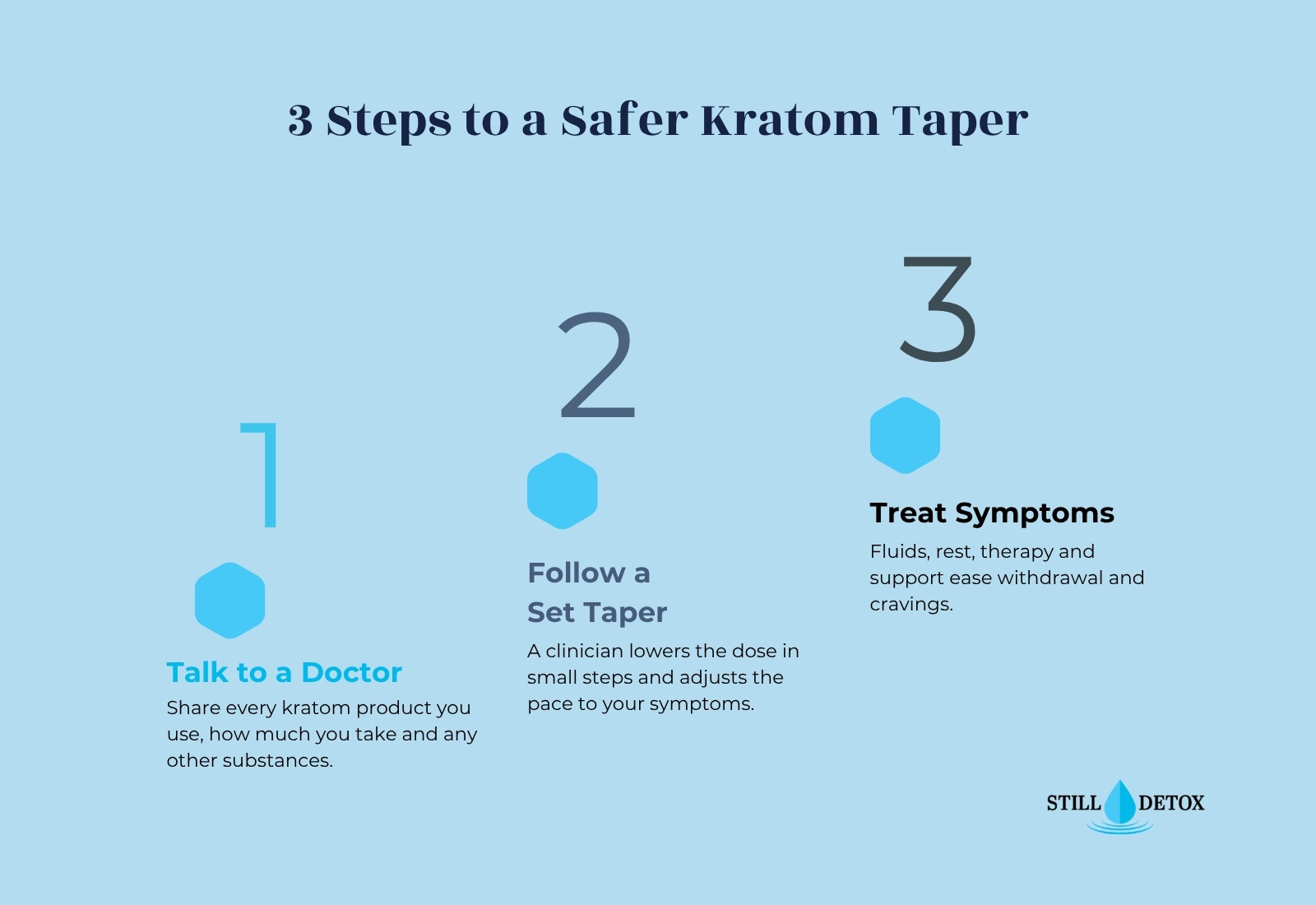
To taper off kratom safely, lower the daily amount in small, planned steps that a clinician sets and adjusts, rather than stopping all at once. The 2023 expert forum named gradual kratom dose tapering, alongside clonidine and lofexidine, as the first approach to kratom withdrawal.
How to prepare to quit kratom
Learning how to taper off kratom starts before the first lower dose.
There are 4 steps to take before starting a kratom taper:
- Talk to a doctor: Share how much kratom you take, how often, and which products you use.
- List every product: Write down each powder, capsule, extract or 7-OH product, because strength differs between them.
- Name other substances: Tell the doctor about alcohol, opioids, sedatives and prescription medicines.
- Plan support: Line up a person to check in with and a plan for cravings in the first weeks.
Does tapering kratom work?
Yes. The 2023 expert forum recommends gradual kratom dose tapering because a slow reduction gives the body time to adjust. No study has set one standard kratom taper schedule, so the pace depends on the person and the product.
Why home taper charts fall short
Home taper charts assume every gram of kratom is the same, yet kratom products range from leaf powder to concentrated extracts. NIDA notes that kratom’s effects depend on a product’s concentration and mix of compounds, and Yale Medicine reports that no federal standard governs kratom’s contents or strength.
Is it better to taper off kratom or quit cold turkey?
Tapering off kratom is better than quitting cold turkey for most daily users, because a gradual taper spreads withdrawal out instead of bringing it on all at once. The 2023 expert forum favors gradual kratom dose tapering over abrupt stopping.
Quitting kratom cold turkey starts withdrawal within hours. Saingam and colleagues (2023) recorded kratom withdrawal starting 1 to 12 hours after the last dose in long-term users in Southern Thailand.
How do you quit 7-OH or taper off kratom extract?
To quit 7-OH or taper off kratom extract, use medical supervision, because concentrated products bring faster and stronger withdrawal than kratom leaf. Stanciu (2026) described a patient who moved from kratom powder to 7-OH tablets and then to a stronger derivative before severe withdrawal.
Stanciu (2026) reported rapid, severe withdrawal in a patient who moved from 7-OH tablets to an even stronger kratom derivative. No published 7-OH taper schedule fits every product, so a clinician sets the pace. There is no way to get off 7-OH with no withdrawal at all, but a supervised taper keeps symptoms lower.
The FDA reports that 7-OH binds opioid receptors far more strongly than mitragynine, kratom’s main compound. Daily users of these products face a faster, harder 7-OH withdrawal than kratom leaf users.
When should you quit kratom with medical detox?
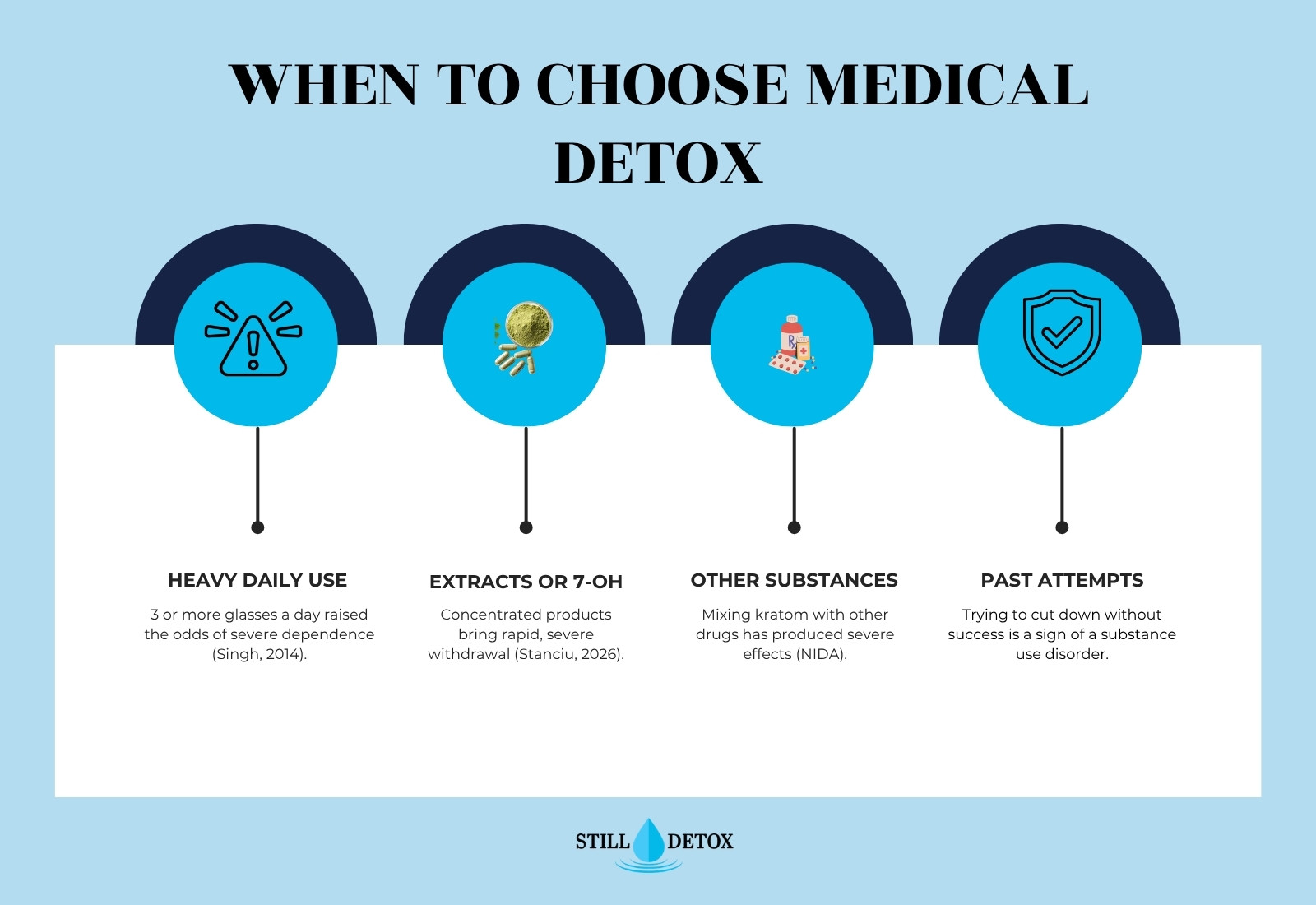
Choose medical detox to quit kratom if you use kratom heavily every day, use extracts or 7-OH, also use other substances, or have tried to quit before and gone back. A medical team adjusts the taper and treats symptoms as they appear.
There are 4 signs that call for medical detox:
- Heavy daily use: Singh and colleagues (2014) linked 3 or more glasses of kratom a day to higher odds of severe dependence.
- Extracts or 7-OH: Concentrated products bring rapid, severe withdrawal (Stanciu, 2026).
- Other substances: NIDA reports that kratom combined with other drugs has produced severe effects, including liver problems.
- Past attempts that failed: Unsuccessful efforts to cut down are one of the 11 DSM-5-TR criteria for a substance use disorder, which clinicians apply to kratom (Smith, Epstein and Weiss, 2024).
What helps after you stop kratom?
What helps most after you stop kratom is therapy for cravings and triggers, steady support, and a plan for the weeks after detox. Physical symptoms fade first, while cravings last longer in regular users (Singh and colleagues, 2014).
Cognitive behavioral therapy (CBT) and dialectical behavior therapy (DBT) teach skills for cravings and stress. Twelve-step and non-12-step groups add peer support, and aftercare planning keeps recovery going after treatment ends. Fluids, rest and comfort care ease kratom withdrawal during the first days.
How does Still Detox help people quit kratom?
Still Detox helps people quit kratom with a medically supervised taper during detox, followed by residential treatment, at locations in Boca Raton, Florida and Mays Landing, New Jersey. Medical detox averages 7 to 10 days and extends to 14 days for complex cases.
“Nobody should have to guess at a kratom taper. Our Medical Director sets each taper around the person’s age and medical risks, and our nurses check vital signs every 4 hours while the dose comes down.”
Britney Marshall, RN, Director of Nursing, Still Detox
There are 4 parts to quitting kratom at Still Detox:
- Medical evaluation: The Medical Director evaluates each person in person within 24 hours, and lab testing identifies 7-OH use.
- Individualized taper: The taper is set by age and medical risk, with 24/7 nursing care.
- Residential treatment: Clients step into residential care around day 8 for individual therapy, group therapy and case management.
- Aftercare: Discharge planning connects each person with support after treatment.
People in South Florida start with kratom and 7-OH detox in Boca Raton, on the University Hospital campus.
Families near Atlantic City turn to kratom detox in New Jersey at the Mays Landing facility.
What else do people ask about quitting kratom?
What is a healthy and effective way to taper off kratom?
A healthy and effective kratom taper lowers the daily amount slowly under a clinician’s care, with fluids, sleep and support for cravings. The 2023 expert forum recommends gradual tapering as the first approach.
How long does a kratom taper take?
No standard length exists for a kratom taper, and the pace depends on the daily amount and the product. Medical detox at Still Detox averages 7 to 10 days and extends to 14 days for complex cases.
What medication is used to treat kratom withdrawal?
No medication is FDA-approved for kratom withdrawal, NIDA reports. The 2023 expert forum names clonidine and lofexidine first, with buprenorphine used carefully, case by case.
What is the withdrawal timeline for kratom?
Kratom withdrawal starts 1 to 12 hours after the last dose in long-term users (Saingam and colleagues, 2023). Physical symptoms ease over the first days, and cravings last longer.
Can kratom help with opioid withdrawal?
Some people use kratom to ease opioid withdrawal, NIDA reports, but kratom is not approved for that use. Yale Medicine’s Dr. Melissa Weimer calls kratom not a recommended or proven treatment.
Is quitting kratom cold turkey safe?
Kratom withdrawal by itself is “generally milder” than opioid withdrawal, according to the 2023 expert forum, but cold turkey brings the full withdrawal at once. Heavy daily use, 7-OH products or other substances call for a supervised taper.
Sources
- Henningfield, J. E., Chawarski, M. C., Garcia-Romeu, A., et al. (2023). Kratom withdrawal: Discussions and conclusions of a scientific expert forum. Drug and Alcohol Dependence Reports, 7, 100142. pmc.ncbi.nlm.nih.gov
- National Institute on Drug Abuse. (2026). Kratom. nida.nih.gov
- Saingam, D., Singh, D., Geater, A. F., et al. (2023). The health impact of long-term kratom (Mitragyna speciosa) use in Southern Thailand. Substance Use & Misuse, 58, 1212–1225.
- Singh, D., Müller, C. P., & Vicknasingam, B. K. (2014). Kratom (Mitragyna speciosa) dependence, withdrawal symptoms and craving in regular users. Drug and Alcohol Dependence, 139, 132–137.
- Smith, K. E., Epstein, D. H., & Weiss, S. T. (2024). Controversies in assessment, diagnosis, and treatment of kratom use disorder. Current Psychiatry Reports, 26(9), 487–496.
- Stanciu, C. N. (2026). Severe early-onset withdrawal following intentional use of mitragynine pseudoindoxyl: A case report and emerging clinical considerations. Cureus, 18(3), e105224.
- U.S. Food and Drug Administration. (2025, December 2). FDA and kratom.
- Yale Medicine. (2026, June 17). Kratom: What is it and is it safe? yalemedicine.org